THOUGHTS ON:
Training, Rehabilitation,
&
Best Care Practices

New Year - New Goals: Setting & Achieving Your Goals This Year.
If you are like me, you love to set goals, spend hours on action plans to achieve those goals, and ponder on the impact and improvements you can make to yourself, your company, your family, your health, and everything else around you.
Fast forward from when we originally posted this blog, it is now 2020! Wow!
If you are like me, you love to set goals, spend hours on action plans to achieve those goals, and ponder on the impact and improvements you can make to yourself, your company, your family, your health, and everything else around you.
While you will not find a shortage of articles telling you how to set goals. Or how by February 1st, over 80% of people will have already abandoned their resolutions, let’s just keep this short and to the point in hopes that you are aiming to be part of the 20% who holds on, pushes through, and progresses not just your life, but your family’s, and everyone you interact with.
When gearing up for the new year, or getting back on track, set your aim high and work these 3 steps.
BE SMART
We have all heard of the ‘SMART’ acronym about goal setting.
Specific: Be as specific as possible with your goals, they are easier to break up and achieve if they are clearly defined.
Measurable: This is usually the easiest part. How will you know when you have achieved your goal? When you hit your mark. 1000 miles running - $100K in growth - 2 full weeks of vacation time with your family. Put a number to it!
Attainable: Don’t make your goals too easy. Set your goals just at the end of your reach. Goals that make you work and dig down deep create the best feelings of accomplishment when completed.
Relevant: Is this goal important to you? Does it help you become a better person? Can accomplishing this goal help and serve others?
Time-Based: Every goal must have a deadline, or it is just a thought; a dream; an everyday task.
Break down each goal you have set into smaller, workable, SMART pieces.
THE ONE THING - BUILD YOUR FOUNDATION
Studies have shown that we are incapable of multi-tasking! Don’t believe me, just try to do three things at once and see how well they are completed, if at all. The new year brings about much excitement about the possibilities and opportunities ahead, but if our focus shifts to too many things at once, it will all quickly fall apart. Start by reading ‘The One Thing’ by Gary Keller and focus all of your attention on one goal at a time. See it through to completion and then move on to the next.
When I sit down to plan out my year, quarter, or week, I review my One Thing, that big goal for the year. But, it has to be broken down further than that. Humans simply can’t focus on one thing for an entire year! You know the saying, ‘The way to eat an elephant is one bite at a time,’ it’s true. If you want to reach your BIG goal, break it down.
I have shifted my life, personal and professional, to ROCKS. This isn’t a fancy acronym, but I do like to think of these rock as the material needed to build the foundation of what I hope to achieve and provide to the world during my life. ROCKS are 2-3 small steps that can be taken each 90 days that move you a step closer to your ONE BIG THING. Science has shown us that the extent of our ability to focus on a task is 90 days, so this method works perfectly. Break your big goal down into 10-12 steps and put all your focus into 2 or 3 of them every quarter.
This works the same in business as it does running—every quarter, you have to change cycles. You may want to run a 3:30 marathon this year. You have four macrocycles of training to complete this year, each composed of 2-3 microcycles. Just going out and haphazardly running will not get you to your goal, you have to plan and focus.
10X EVERYTHING
Look at your goals. Look at the energy, time, commitment, and focus it will require, and 10 X it! In Grant Cardone’s ‘The 10X Rule’, he discusses that anything worth accomplishing will require ten times more time, energy, and resources than you initially thought. How do you attack this, with massive action.
In summary, take an hour this week, work through your goals and develop an action plan. Assure they are SMART, begin by focusing on just one, and TAKE MASSIVE ACTION!
- Happy New Year -
Dr. Reheisse is a Board Certified Chiropractic Sports Physician practicing in Cottonwood Heights Utah. Revive Sport & Spine provides evidence-supported chiropractic care and conservative sports injury management. If you have an injury that is preventing you from doing the things you enjoy, call or schedule now.

Spinal Manipulation - Who Benefits Best From This Effective Treatment Option
Spinal manipulation, or the chiropractic adjustment, is the hallmark of Chiropractic Medicine, but what population of patients benefit from this safe and effective treatment option?
Spinal manipulation, the hallmark of Chiropractic Medicine….

First -> Let’s address the elephant in the room! Spinal Manipulation has been touted to help or heal everything from low back pain to the common earache and yearly influenza epidemic. While many practitioners, and patients alike, claim that a chiropractic ‘adjustment’ cured all their ills, current research does not support those claims. We are not here to call those cases out as some people honestly did find an improvement to their conditions through spinal manipulation, we just can not provide consistent results to a large number of subject to clearly understand the mechanism.
However; Low Back Pain, Neck Pain, Muscle and Joint Injuries, Strain/Sprain Injuries…we have mounds of data to support the effectiveness of manipulation and manual therapy in these cases. So much, that we can now predict who will benefit best from this type of care.
What Does Spinal Manipulation Look Like?
Before we jump into what we call ‘Clinical Prediction Rules’ regarding joint manipulation, please realize that each person is an individual, and each condition is as unique as the person who presents with it. Utilizing these rules is not the end all be all; there will be outliers. Some people have tried joint manipulation, or exercise, or dry needling, or a myriad of other therapies with little to no results. Sometimes their condition is passed this type of intervention and needs to bypass conservative care for more invasive options. Moreover, many of these patients either receive ONLY ONE therapy or had the wrong ‘concoction’ of care for their condition, or the phase of healing they were in when the therapy was used was incorrect causing poor timing to be the culprit of poor outcomes. So…if you have tried a few of these, don’t give up and completely write them off. Get a second or third option, look at it with a set of fresh eyes and try a new direction, a new order of care and see how your condition improves.
Now, back to the predictions. Below are what we consider to be the characteristics of patients who research predicts will have the best and fastest outcomes from spinal manipulation.
The Number Of Days With Your Current Low Back Complaint is LESS THAN 16 Days.
Pain & Radiation Of Symptoms (Pain, Numbness, Tingling) Does Not Go Farther Than The Knee.
Fear Avoidance Behavior Assessment. You Do Not Fear That Your Back Pain Will Last Forever and Will Not Keep You From Enjoying Life In The Future.
Through Examination, Movement Assessment, and Provider Palpation, At Least 1 Spinal Segment of the Lumbar Spine is Restricted/Hypomobile.
At Lease 1 Hip Has More Than 35 Degrees of Internal Rotation.
So What Does This Mean?
If you present to an office like ours with ACUTE LOW BACK PAIN that is RADIATING PAIN TO THE GLUTES, RESTRICTED LUMBAR SPINE ROM, and ONE HIP HAS RESTRICTED INTERNAL ROTATION ROM…

YOU ARE A GOOD CANDIDATE FOR SPINAL MANIPULATION
&
WE SHOULD ANTICIPATE GREAT RESULTS.
Two studies on spinal manipulation, utilizing these Clinical Prediction Rules found:
Patients who presented with less than 4 of the 5 above rules, had a 45% likelihood for a positive response from spinal manipulation.
Positive Response means that after 2-3 treatments with spinal manipulation, patients saw a 50% reduction in symptoms and pain.
A patient who presented WITH at least 4 of the 5 rules, increased their likelihood of a positive outcome to 95%.
Another study, utilizing a side-lying lumbar manipulation technique along with ROM exercises, found a 50% reduction in symptoms in 11 of 12 participants. The one participant who did not respond still found a reduction in symptoms, but did not reach the 50% reduction mark the study considered as a ‘positive outcome.’
In summary, Spinal Manipulation is an effective and safe tool for low back pain. But it is just that, a tool! Care that relies on only one treatment modality will only be somewhat useful to a specific, and small, population. Care that focuses on the patients' individual presentation and goals, and adapts a variety of therapies for that particular condition will typically yield the best results. If you have tried manipulation, PT, massage, dry needling, or any other therapy as a stand-alone treatment option, I invite you to give us a call to see how we can develop a better treatment plan around your personal goals.

Resources:
Cleland, JA et al. The Use of a Lumbar Spine Manipulation Technique by Physical Therapists in Patients Who Satisfy a Clinical Prediction Rule: A Case Series. JOSPT 2006.
Flynn, T et al. A Clinical Prediction Rule For Classifying Patients With Low Back Pain Who Demonstrate Short-Term Improvement With Spinal Manipulation. Spine 2002.
Childs, JD et al. A Clinical Prediction Rule To Identify Patients With Low Back Pain Most Likely To Benefit From Spinal Manipulation: A Validation Study. Annals of Internal Medicine 2004.
Dr. Reheisse is a Board Certified Chiropractic Sports Physician practicing in Cottonwood Heights Utah. Revive Sport & Spine provides evidence-supported chiropractic care and conservative sports injury management.

Sciatica Pain Relief Part 4: Treatment & Rehabilitation
As we gather to close out this series on Sciatica, talking this time on what care looks like in our office when someone presents with Sciatic Nerve pain, you will recognize some similarities from the previous Sciatica-related articles. That is because rehabilitation for Sciatica is similar to the self-care and prevention exercises we shared previously. So…if you haven’t taken a look at our Sciatica Pain Relief series parts 1-3, click the links below and check them out. Our goal is to have you work through those modules before seeking care. You will often find that spending a week on the exercises we shared, might relieve your pain, and if maintained with some frequency, may prevent future occurrences. Nevertheless, if you are here, are located in Salt Lake City and the surrounding area, we are here to help.
As we gather to close out this series on Sciatica, talking this time on what care looks like in our office when someone presents with Sciatic Nerve pain, you will recognize some similarities from the previous Sciatica-related articles. That is because rehabilitation for Sciatica is similar to the self-care and prevention exercises we shared previously. So…if you haven’t taken a look at our Sciatica Pain Relief series parts 1-3, click the links below and check them out. Our goal is to have you work through those modules before seeking care. You will often find that spending a week on the exercises we shared, might relieve your pain, and if maintained with some frequency, may prevent future occurrences. Nevertheless, if you are here, are located in Salt Lake City and the surrounding area, we are here to help.
Treatment surrounding Sciatica takes on two parts: (1) Addressing the low back, regardless if low back pain is present and (2) Addressing the posterior hip, associated musculature, and its interaction with the sciatic nerve. One of these (#2) we can affect directly and often provide immediate relief. The other (#1) can be addressed by focused and modified daily action, joint mobility, decreased muscle tension, and…TIME.
Let's start with the low hanging fruit here. We have already discussed the association of the Sciatic Nerve and the muscles of the posterior hip. When it comes to treatment, our goal is to enact a change as fast as possible. We hope that patients come in having already tried stretching rolling, and increased movement to decrease the tightness and tension of the muscles in the back of the hip. From there, our job is to change the tissue in ways most can not do themselves.
Our typical treatment here is a combination or assisted progressive stretching, active and passive myofascial release movement, and dry needling…almost always dry needling.
To help understand what these treatments look like, check out these video demonstrations. These treatments have proven extremely effective in assisting patients to recover quickly from sciatica and sciatic nerve issues.
When it comes to rehabilitation, it is essential to understand that for the majority of people, even though the sciatic nerve radiating pain down the leg may have come on suddenly, it most likely took months to get to that point, leaving us with a bit of chronic muscle tension to address. THIS TAKES TIME.
When helping patients with their home care exercise plans, we look to address two areas, (#1) The Lumbar Spine, (#2) The Posterior Hip Muscles. If your problem is primarily in the hip/thigh region, exercise and daily life modification (usually sitting less) will bring quick and lasting relief. If your problem is primarily in the lumbar spine, our goal is to keep you as mobile and active as possible while the injury heals. Again…TIME.
POSTERIOR HIP MOBILITY
NERVE FLOSSING: Sciatic Nerve
LUMBAR SPINE MOBILITY & STABILITY
Sciatica is a common complaint, with a wide variety of causes. If you worked through our Sciatica Relief Series here and are still dealing with radiating leg and low back pain, please reach out to us with questions or come in for a consultation to further discuss your condition. If we can help you, we will let you know; if we can’t, we will get you to the best provider for your case.
Dr. Reheisse is a Board Certified Chiropractic Sports Physician practicing in Cottonwood Heights Utah. Revive Sport & Spine provides evidence-supported chiropractic care and conservative sports injury management.

Iliotibial Band Syndrome: Self-Care & Training Modification
As we work our way through this series, let not forget what we have learned so far.
Iliotibial band syndrome is a common overuse injury plaguing runners of all abilities. The most common offense is trying to increase your volume too soon while also increasing the intensity without cross-training or varying surfaces.
The Iliotibial band DOES NOT STRETCH! The tension we feel is caused by the muscles that support the IT band, Tensor Fascia Latae and Gluteus Maximus.
The stabbing pain we experiences as runners suffering from IT band syndrome is thought to be caused by the band itself shifting forward and backward as the knee flexes and extends. The research is out on that one…if we ever reach a consensus, I will let you all know!
Where are we now? Well…if you have made it this far, you are probably dealing with IT band syndrome and wondering if it will ever go away and let you get back to running the way you would like.
For this, we are going to discuss self-care. What you can do about the knee pain and tight hips at home while also mentioning a few stretches you can do at work or out on a run. Our goal is simple - Allow you to continue to train, modified while improving your IT band syndrome pain week-to-week.
What we are talking about today, where the real work takes place, the day in and day out self-care. And the big question….can you continue training?
As we work our way through this series, let not forget what we have learned so far.
Iliotibial band syndrome is a common overuse injury plaguing runners of all abilities. The most common offense is trying to increase your volume too soon while also increasing the intensity without cross-training or varying surfaces.
The Iliotibial band DOES NOT STRETCH! The tension we feel is caused by the muscles that support the IT band, Tensor Fascia Latae and Gluteus Maximus.
The stabbing pain we experiences as runners suffering from IT band syndrome is thought to be caused by the band itself shifting forward and backward as the knee flexes and extends. The research is out on that one…if we ever reach a consensus, I will let you all know!
Where are we now? Well…if you have made it this far, you are probably dealing with IT band syndrome and wondering if it will ever go away and let you get back to running the way you would like.
For this, we are going to discuss self-care. What you can do about the knee pain and tight hips at home while also mentioning a few stretches you can do at work or out on a run. Our goal is simple - Allow you to continue to train, modified while improving your IT band syndrome pain week-to-week.
What we are talking about today, where the real work takes place, the day in and day out self-care. And the big question….can you continue training?
SELF CARE PART 1 - START WITH A BETTER WARM-UP
I can not stress this enough! As you are working through an injury, maintaining some kind of load (training volume) is important, but you are better served spending time on a proper warm up, running just a few miles, then spending a good amount of time on the cool down. With just about every running injury we deal with, runners have a dismal warm-up if one at all. Most are so pressed for time, they lace up the shoes, run out the door, only to return and head straight to work. Most of us are not teenagers anymore, our bodies just can’t do this…not for long periods anyway. Start with a thorough warm-up - we will emphasize this again in our next article where we talk rehab and return to running so prepare yourself!
SELF CARE PART 2 - SELF MYOFASCIAL RELIEF
Understanding that foam rolling and stretching of the IT band itself is ineffective, where do we focus our attention? The hips…it is always the hips! But some attention at the knee can be beneficial while appropriate rest and recovery are always suggested after an acute flair-up or long run.
Rest & Recovery:
Traditional pain relievers for running related pain include ice, heat, topical creams like biofreeze, and some good old-fashioned rest. Today we have an array of tools that can aid in recovery, one we like to use frequently are compression boots from Rapid Reboot. We don’t expect everyone just to have these lying around, but they sure feel great after some dry needling, IASTM, and manipulation in the clinic.
Rolling & Stretching:
Now that we understand what anatomy we need to address, it is time to get your roll on! If we are able to continue to train, we suggest rolling and stretching 4-5 times each day. Before you lose it, these sessions are only 3-4 minutes each. If you are a frequent runner, or just starting out, here are the basics.
Rollers should be in your home, office, and car. You should have at least 3 lacrosse balls around, purse, cup holder in your car, in your desk, and your gym bag.
Roll in the morning, pre and post run, after your lunch break, when you get home, and then a good session before bed.
Cupping & Flossing:
These may not be tools accessible to all, but they help you achieve stretching in ways that are difficult to do on your own. One of my personal approaches to provide relief to the knee pain we experience with IT Band syndrome is to place a few cups (I have a few sets of these) around the lateral knee and lateral quadricep muscle, walk about for a few minutes, perform a few squats, rinse and repeat 2-3 times per week.


SELF CARE PART 3 - TRAINING MODIFICATION
Training modification is the hardest part to address. For most, the ability to continue training toward your race is almost as important as fixing the injury. While maintaining some load is ideal, there are instances where a total shut-down is necessary for a few weeks. If you are a typical runner, meaning that you are going to run through the injury, we must modify. Here are the basics. Remember that Iliotibial band syndrome is the result of too much mileage or intensity, too soon in your training plan. Not having a proper base as you head into a 20-week marathon training plan is a recipe for disaster.
Our first suggestion is to cut your volume by 50% and decrease your intensity for the next 2-4 weeks. Our goal is to maintain some running, but the speed work and downhill bombs need to take a backseat for a while.
Please, cross-train! As runners, we think that running is it, period. When we are injured, and more so when we are not so that we can prevent injury, we must cross train. If you have been battling IT band syndrome for more than a few weeks, it is time to work in some biking, swimming and weightlifting. This allows you to maintain most of your cardiovascular capacity while taking out the pounding associated with running.
Lastly, look at your running form. Can it be cleaned up a bit? For most of us, that is a very strong, Yes! I’m not saying to go out and get an extensive running evaluation to change the subtle nuances of your stride, most of us just are not at that level, but shortening your stride, increasing your cadence, and working on your running drills can provide a needed boost in your running efficiency.
Cadence should be upwards of 170-180 steps per minute.
Perform drills on a soft surface (track or field) 2-3 times per week.
More on this in the rehab portion next week.
Dr. Reheisse is a Board Certified Chiropractic Sports Physician practicing in the Greater Salt Lake City Area of Utah. Revive Sport & Spine provides evidence-supported chiropractic care and conservative sports injury management.

Resolve Low Back Issues Part 7: What Happens When You Need To Seek Care?
Our intention with this series on Low Back Pain has been to inform and empower you, or your loved ones, to take action and realize that movement can help, as well as, prevent low back pain. That your low back pain is not a life sentence.
Care & Rehab For Low Back Pain
Supporting The Greater Salt Lake Valley. Helping You Get Back To The Activities You Enjoy.
Our intention with this series on Low Back Pain has been to inform and empower you, or your loved ones, to take action and realize that movement can help, as well as, prevent low back pain. That your low back pain is not a life sentence.
While all of this information is useful and should be utilized before, during, and after a Back Pain episode, the reality is that some people will need to seek care.
You have had a front-row seat to one pillar of our care, the education and exercise component. When seeking care for low back pain, putting your faith solely in one person, and relying on them for everything is not advised and will severely hinder your progress.
YOU (YES, YOU) HAVE TO PUT IN THE WORK, TIME, & EFFORT!
As a Sports Chiropractor that treats low back pain every single day…we see it time and again in our patients… If home care is not adhered to and a person does not take their situation seriously and put in the effort, back pain will take forever (or it seems that way) to resolve.
Today we are going to give you another up-close look at our care process, this time what we actually do here in the office. Our goals are to (1) Determine the cause of your pain/injury (2) Provide care in the office that helps you toward your goal of running, golfing, sleeping, moving again…pain-free, and (3) Give you the tools and education to help yourself.
We structure our care around 3 pillars: Soft Tissue, Joint Motion, Exercise. We have exhausted our opinion and writing on exercise, please refer to parts 1-6 for direction. Now, lets briefly take a look at what care looks like inside the office.
SOFT TISSUE CARE
JOINT MANIPULATION
Dr. Reheisse is a Board Certified Chiropractic Sports Physician practicing in Cottonwood Heights Utah. Revive Sport & Spine provides evidence-supported chiropractic care and conservative sports injury management.

Resolve Low Back Issues Part 6: Self-Care - What You Can Do For Low Back Pain
Over the last 5 weeks, we have discussed everything from what low back pain is, most common causes, some of the most common myths associated with low back pain, and when to consider imaging studies (x-ray, MRI, CT) due to red flags that lead us to something more severe being the cause. We even covered a few tips to help when you find yourself traveling for work or vacation.
We have been building up toward the actual care of low back pain but wanted to fully educate on how common low back pain is, what we know about low back pain at this time, and help you focus on life outside of back pain.
Low Back Pain Self-Care
Over the last 5 weeks, we have discussed everything from what low back pain is, most common causes, some of the most common myths associated with low back pain, and when to consider imaging studies (x-ray, MRI, CT) due to red flags that lead us to something more severe being the cause. We even covered a few tips to help when you find yourself traveling for work or vacation.
We have been building up toward the actual care of low back pain but wanted to fully educate on how common low back pain is, what we know about low back pain at this time, and help you focus on life outside of back pain.
Today, we are going to do just that.
When we look to decrease disability from low back pain and encourage and support patients back to an active lifestyle, this is done in two ways. EDUCATION & EXERCISE. We have already discussed the education component. Now it is time for exercise. Below are 5 ways to help manage and prevent your low back pain with exercise and stretching routines that can be done at home, the gym, or even at the office.
Side Bar -> If anyone gives you a hard time, or tosses a laugh in your way for stretching at the office, I will leave it up to you to either invite them to join (because they need to do this too), or, wait until they start having an issue with low back pain and then pass them our card! Seriously though, invite your co-works to join in, make it an office party, it will be fun.
Fix Your Low Back With These 5 Easy Exercises & Stretches You Can Do At Home or Work.
STEP 1: Get Out Of Bed With Our Morning Routine.
After a good night’s sleep, it is common for our muscles to want to remain in bed. Because of this, early morning activities can challenge our bodies more than they are ready to handle, resulting in a nice low back strain injury. If you are already dealing with low back pain, you know that morning stiffness can prevent you from even rolling over, not to mention actually get up out of said bed.
STEP 2: Desk Sitters - Get Up & Move
While things are improving, the seats we subject ourselves too in our cars, on the train, and at the office are just comfortable enough to keep you seated for an extensive period of time, but provide little support to keep you from tightening up in the process. Start this NOW -> Set an alarm on your phone that goes off every 1-2 hours. Walk around the office, hand-deliver a message, and then take 30 seconds and perform these stretches.
STEP 3: Pre-Workout Hip Mobility
We are going to assume you have a daily routine of some exercise? If you do not, reset, and start adding some exercise to your life, no other method is as impactful on helping your low back issues. Once you get to the gym, or home if you prefer, go through a GOOD HIP MOBILITY routine. We know that the more we improve the mobility of our hips, the less our low back has to work…overwork.
STEP 4: Post-Workout Core Strength
The same goes for core strength as hip mobility. The stronger our core, the less our low backs have to work. Now…I don’t mean getting down on the floor and performing a half-hearted set or some sorry excuse for crunch/sit-up type exercise. We are talking functional here. Planks, Side Planks, Plank Rolls, Heavy Farmer and Suitcase Walks, as well as The Big 3.
STEP 5: Strength For Life
Most people who have dealt with low back pain have since, and forever will, shy away from true strength movements. But let me just plug that as humans, you should be able to squat as well as pick something heavy off the ground without fear of hurting yourself. As you work on hip mobility and core strength, you have to start working in squats and dead-lifts. Start with these modifications and work on control and endurance.
Exercise is considered the best medicine for low back pain. While this is true and I strongly support this. Our actual goal with care is to get our patients back to these activities. But often, patients present in enough pain that they are unable to run, ski, bike, weight lift, etc. With that said, most can start with basic stretching and mobility until the pain is relieved. From there, exercise can prevent flair-ups, or at least decrease their intensity and length of the episode. Either way, low back pain has to have a component that includes YOU doing some, if not most, of the work.

Next week we will look at some of the traditional, as well as, new developments in conservative care low back pain. Until then, and if you are craving more reading, check out our ‘12 Ways..’ Tips guide to further help your low back pain.
Dr. Reheisse is a Board Certified Chiropractic Sports Physician practicing in Cottonwood Heights Utah. Revive Sport & Spine provides evidence-supported chiropractic care and conservative sports injury management.

Resolve Low Back Issues Part 5: You Are Not Your Image. (Red Flags & Imaging Considerations)
In part 4 of our Fix Your Low Back series, we discussed some of the most common myths and misunderstandings around low back pain, care of low back pain, as well as updating some of the old-fashioned thoughts. Today, we are going to discuss imaging and red flags as it pertains to low back pain and a couple of VERY IMPORTANT things you need to know.
Low Back Pain Imaging
Best Practices & The Truth
In part 4 of our Fix Your Low Back series, we discussed some of the most common myths and misunderstandings around low back pain, care of low back pain, as well as updating some of the old-fashioned thoughts. Today, we are going to discuss imaging and red flags as it pertains to low back pain and a couple of VERY IMPORTANT things you need to know.

Imaging is an excellent diagnostic tool, when appropriate, to help ASSURE PROPER care.
Not-so-long ago, a patient would walk into a chiropractic office and get a standard set of x-rays; or they would schedule an appointment with an orthopedic physician and would be required to obtain an MRI before they can be seen.
This standard practice has fortunately been labeled as inappropriate, and national organizations such as the American Chiropractic Association and American College of Physicians have recently taken a strong stance against these practices.
CURRENT BEST PRACTICES
Do not obtain spinal imaging for patients with acute low-back pain during the initial 6 weeks after onset in the absence of red flags.
Imaging should not be utilized to monitor a patient’s progress.
WHAT WE KNOW ABOUT IMAGING NOW
There are two extremely important things to know concerning imaging…
Imaging can be harmful. Radiation aside. Unnecessary x-rays and MRIs can bring to light ‘normal variances’ that are NOT the generator of pain but are easy to blame. This causes what is being referred to as the ‘medicalization’ of low back pain.
Example: Someone presents with low back pain, an image is immediately ordered, it shows a bulging disc or some other skeletal irregularity, and the blame for the complaint is placed on this without further discussion. This patient goes on to think that they are doomed to low back pain forever, that their ‘bad back’ will keep them from enjoying their normal activities, and unfortunately, they end up with a regular dose of over-the-counter and prescription drugs.
Now, this is not always the case, but once or twice each month, a patient with low back pain presents to our office stating that they had a bulging disc in their low back over 10 years ago and have been in constant pain ever since. These cases have more to them than just pain, the overutilization and misuse of imaging lead to fear avoidance and catastrophizing. Both are always present in chronic low back pain!
Through recent studies, we know that to a certain degree, lower spine degeneration and pathology are normal, AND NON-PAIN GENERATING, at almost all ages.

What is so important about this chart? Well….
These numbers represent the percent of specific age groups that had degeneration and disc pathology of the lower back in patients who had NO SYMPTOMS OR COMPLAINTS whatsoever.
Also, this was no small review….this study included over 3100 people!
In review, If we took a pain-free 40 y/o person with NO history of low back pain…
Almost 70% would demonstrate degeneration on x-ray.
50% would show a bulging disc on MRI.
Our take-a-way here… YOU ARE NOT YOUR IMAGE! They can play tricks on your thinking and make your back pain much worse just by you believing that what your image is showing is the end all be all of your pain.
With that aside, we do need imaging. WHEN INDICATED THROUGH A PROPER EXAM! Imaging is great for ruling out serious pathology.

RED FLAGS
Red flags are indicators that let physicians know there might be something more serious going on. This can come from a simple history and exam and they demand attention and should be considered before care of any kind is provided. With that said, here is a small list of ‘Red Flags’ common with low back pain complaints.
History of Cancer.
Night Pain.
Progressive Neurological Symptoms & Weakness.
Pain Following Trauma (Fall, Auto Accident, etc.)
Sudden Loss of Bowel or Bladder Function.
Recent Weight Loss.
New Back Pain With Fever.
Failure of 4-6 Weeks of Conservative Care.
History of Recent Fracture of Suspected Fracture.
Family History & Signs of Osteopenia & Osteoporosis.
In summary, and I hate to keep harping on this, but your imaging results may not be as important as they are made out to be in regards to uncomplicated, and even chronic, low back pain.
Spinal degeneration, disc bulge, and other pathologies are often normal findings as we age and have not been proven to be pain generators.
Imaging early in the care process in the absence of red flags is NOT in line with current ‘best practice’ suggestions and guidelines.
Studies have shown that a thorough history and exam with your provider can provide information to determine the actual cause of your low back pain.
Dr. Reheisse is a Board Certified Chiropractic Sports Physician practicing in Cottonwood Heights Utah. Revive Sport & Spine provides evidence-supported chiropractic care and conservative sports injury management.

Resolve Low Back Issues Part 4: Most Common Myths Of Low Back Pain
Few musculoskeletal conditions have a cult-like following of myths as Low Back Pain, many of which have been said by various healthcare providers across all specialties. To help clear the air, let's take a look at the 5 most common misunderstandings and myths that we encounter in our chiropractic clinic that could actually make your low back pain worse.
Low Back Pain Myths
Few musculoskeletal conditions have a cult-like following of myths as Low Back Pain, many of which have been said by various healthcare providers across all specialties. To help clear the air, let's take a look at the 5 most common misunderstandings and myths that we encounter in our chiropractic clinic that could actually make your low back pain worse.
Before we get started…
These myths and misunderstandings are not aimed at making low back pain seem 'made-up,’ it is a very real and challenging condition. These myths are just folklore passed down from old, unsubstantiated in the research, ways of thinking. Our truth is that, if you believe one thing and that makes you feel that your low back is wrecked for life, a long road of pain is what you are in store for. We call this fear-avoidance and catastrophizing, the medicalization of a condition. We will touch more on this when we cover imaging next week. But a big part of recovering from low back pain is believing that you can get better. It may sound silly, but no more ridiculous than believing these myths below!
NUMBER 1: Your back pain is from a misalignment, bone out of place, or a ‘subluxation.’

We don’t practice this way any longer, stop using explanations from this era.
These are common descriptions patients and doctors alike will give when describing their back pain. The most common being...you threw your back out, and it is now misaligned...commonly spoken by chiropractors of a generation ago or current doctors, chiropractors, and physical therapists that have not caught up with current research. The truth to this is that your spine is a dynamic structure designed to move, what we ACTUALLY find is that the pain you are feeling is often associated with immobility, or areas of the spine that should be moving, but due to tight muscles and previous injury, may not be moving well or correctly anymore. Spinal manipulation or an ‘adjustment’ is designed to restore normal motion to these restricted areas.
A bone did not shift out of place and therefore needs to be put back in! That’s not how it works.
NUMBER 2: Arthritis is the root of all evil!

Arthritis is like wrinkles on your face…lets just keep it nice and say they are signs of wisdom. Truthfully, if you live and play hard and long enough, we will all experience some degree of degeneration. However, and please understand this, it is a natural process and does not necessarily equate to pain! When conditions present that are more challenging, using arthritis as the ‘fall guy’ is the easy way out for a provider and an often acceptable answer for the patient.
NUMBER 3: “But…I have scoliosis and a short leg” that is the cause of my back pain.

Just like arthritis, scoliosis and an actual short leg (1cm or shorter than the other) are comfortable areas to place blame when someone presents with back pain. Both can absolutely lead to dysfunction, and if unaddressed, pain and discomfort. To a certain degree, uneven leg lengths and spinal rotation/curvature are normal variants, meaning most people have these at a mild level and are unlikely to be a pain generator. For most (not all) look to place the blame elsewhere.
NUMBER 4: Rest is what I need to recover, right?

The days of ‘take 2 of these, rest, and call me in the morning’ are long gone. You likely have a relative who spent a good amount of their life with back pain that limited some or all of their activity. When you see a case like this or someone who is much too young to be experiencing recurrent back pain, it may seem like the right thing to do is rest up for a while. Fortunately, we now have stacks of research that supports the fact that bed rest is the worst (top 3 at least) idea when it comes to low back pain. The new adage is ‘Movement is Medicine.’ When someone presents to our office, we are not only just trying to relieve pain, but to relieve pain SO THEY CAN GET OUT AND MOVE. Even walking, WALKING, has been shown to reduce low back discomfort and be a great tool to prevent future occurrences.
NUMBER 5: Slap a brace on it & it will be fine.

Brace low back pain long term & you should join the circus with that thinking.
This is excellent advice if you are looking to weaken your core muscles completely. Did you know that powerlifters use the belt to their advantage to complete amazing feats of strength not to brace their low back, but to give their stomach something to press in to, creating intraabdominal pressure (think bracing your stomach if someone was to punch you) that stabilizes the spine from the inside? Our bodies are amazing, it has its own ‘weight belt’ built-in. Using straps, belts, or any other contraption like this for extended periods of time tells your body that you do not need it to do its job anymore. This core weakness and inability to naturally brace yourself through muscle control —> LEADS TO CHRONIC LOW BACK PAIN.
In summary, things change. Our treatment methods and your outlook on your condition must change. Every single one of these five myths is still spouted today in an office somewhere near you. Knowing the validity of that is often more important than the care you receive. While in certain circumstances, these can be valid reasons for low back pain. For most, especially those who come through our Cottonwood Heights, Utah Chiropractic and Rehabilitation clinic, we want a better answer. One that helps address and correct the dysfunction. One that promotes confidence and encourages the patient to try harder, that they can feel better and live a life they enjoy.
Next week, in part 5 of our Fix Your Low Back Series, we are going to discuss red flags, when you need imagining, and why you shouldn’t always rest your diagnosis and pain on those images.
Dr. Reheisse is a Board Certified Chiropractic Sports Physician practicing in Cottonwood Heights Utah. Revive Sport & Spine provides evidence-supported chiropractic care and conservative sports injury management.

Resolve Low Back Issues Part 1: What Is Low Back Pain?
Low back issues are one of the most common causes of disability worldwide, responsible for BILLIONS of dollars spent on health care and lost time at work annually. If you have ever experienced low back pain, you know that it can not only impact your hobbies and ability to remain active, but it can make even the most common of daily activities challenging. Our goal with this series is to help you better understand the cause of your low back pain, provide real solutions to help you manage it, and show you that there are many care options out there, some you can do at home, that allow you to remain free of prescription drugs and surgery.
Back pain is not a one-size-fits-all problem, there are most commons, but your approach to care needs to be as individual as you. Without a proper and thorough assessment, it is hard to say which approach will work best for you, but through the experience of helping hundreds of people alleviate their low back pain every day, we can focus on a few of the most common causes and their proven strategies for relief.
What Is Low Back Pain?
Low back issues are one of the most common causes of disability worldwide, responsible for BILLIONS of dollars spent on health care and lost time at work annually. If you have ever experienced low back pain, you know that it can not only impact your hobbies and ability to remain active, but it can make even the most common of daily activities challenging. Our goal with this series is to help you better understand the cause of your low back pain, provide real solutions to help you manage it, and show you that there are many care options out there, some you can do at home, that allow you to remain free of prescription drugs and surgery.
Back pain is not a one-size-fits-all problem, there are most commons, but your approach to care needs to be as individual as you. Without a proper and thorough assessment, it is hard to say which approach will work best for you, but through the experience of helping hundreds of people alleviate their low back pain every day, we can focus on a few of the most common causes and their proven strategies for relief.
HOW COMMON IS LOW BACK PAIN?
When we talk about low back pain and its prevalence, you are more like to experience low back pain multiple times in your life than to never experience it at all. That being said, the presentation can vary from stabbing, shooting, and radiating type pain to a more dull, achy, and feeling of tightness. However you choose to describe this feeling, the trust is that it can and will disrupt your sleep, daily routines, and your desired recreational activities. There is good news at the end of this rope, and this is that the majority of low back pain sufferers have pain related to posture, overtraining, muscle tightness and is usually our body’s protective response to something it does not like, meaning it is treatable and preventable!
To lay some foundation for our low back pain discussion, here are a few current statistics:
Low Back Pain is the leading cause of disability worldwide, costing nearly $100 Billion in heatlhcare cost and lost wages.
It is estimated that 80% of people will expereience back pain during their life with over 50% having an episode this year.
Over 90% of low back pain complaints are mechanical in nature and do NOT require drugs or surgery.
Of those who have back surgery, around 27% will require another surgery within 5 years.
It is estimated that 60-75% of back pain is preventable through exercise, education, and proper work ergonomics.
WHAT CAUSES LOW BACK PAIN?
Back pain, although extremely common, is a somewhat complicated complaint where one very important thing must be understood before we move forward...
…back pain is a SYMPTOM, not a diagnosis.
Back pain can be debilitating, but the real goal here is to understand the cause of your back pain so that we can determine what factors need to be modified in your life to prevent future episodes.
To look at this through a simple analogy, let’s say you go out to your car tomorrow and it doesn’t start. Now, if you called your spouse, friend, or mechanic, you would tell them your car won’t start (I have back pain), but the real question is WHY doesn’t your car start? It could be from a dead battery, empty gas tank, or something more severe and deep within the engine. Regardless, your car still will not start. Using this analogy, would you treat each of the above-mentioned problems the same? No! Now, does it make sense to take the same approach when treating low back pain?
Looking at back pain, we typically break it down into 3 categories: Functional, Structural, and Pathological.
Functional: Simply put, how you move, or don’t move at all, is causing repeated stress and now you are pain sensitive, stiff, and infrequent or constant pain. This is the most common group. Letting a condition in this category go unaddressed too long can cause it to spill over into our structural category.
Structural: Structural conditions include the things you can see on x-rays and MRI’s. This is the category that includes arthritis (we all get it, you’re not special), disc bulges and disc herniations. These can absolutely cause pain but are usually the result of some long term dysfunction. NOTE: As we will discuss later, just because something shows up on an x-ray or MRI, does not mean it is the cause of your pain!
Pathological: This is the least common of the group, making up about 1-1.4% of back pain complaints. This is often the result of bowel diseases, kidney stones, long term unhealthy habits, and cancer. These are very rare and should not get your attention at first. Dr. Google will lead you this way but he is very deceptive!
These groups interact with each other frequently. For example, let’s say you sit at a desk 8 hours each and every day of the week. From here, you like to lift weights. It has been shown that repeatedly lifting heavy objects with a rounded spine (functional), can lead to disc bulges (structural).
IMPORTANT ANATOMICAL FEATURES OF THE LOW BACK
When we look at the structures of the low back, it is easy to get lost in what all is there. Once we take into account how the core and hip muscles interact and support the low back, it can get pretty complicated.

Most are familiar with the vertebrae, and even more with the disc between each vertebrae. Each of these form a pseudo-joint, and along with the pillars of facet joints down each side, we have the vertebral collumn. We know that muscles move and stabilize joints and restriction, tightness, or a strain/sprain type injury to these tissue can cause a cycle of pain, one caused by the other, and so on.

Looking at the muscles, there are too many to mention for our purposes here, but as mentioned above, when looking at low back pain, you must include the core and hip musculature in the conversation and not just the commonly blamed errector spinae and multifidi muscles of the low back. Honestly, there is so much more to low back pain than this, but to stay on track and address the most commons, understanding where the facet joints are, how the hip muscles and core muscles support the low back complex will suffice for our lesson.
LET’S REVIEW WHAT WE LEARNED HERE IN PART 1:
Low Back Pain is one of the most common reasons a person presents to a doctors office and results in over $100 Billion in healthcare costs and lost work time.
Of all the structurs associated with the low back, we can break most complaints down into 3 categories: Structural, Functional, Pathological.
Low Back Pain is NOT a diagnosis, it is a SYMPTOM!
Not that we have the basics down, look out for part 2 of our Low Back Pain series where we will cover the most common causes and basic self-treatment options. -> Part 2 <-
Dr. Reheisse is a Board Certified Chiropractic Sports Physician practicing in Cottonwood Heights Utah. Revive Sport & Spine provides evidence-supported chiropractic care and conservative sports injury management.

Runner's Knee Part 4: Treatment, Rehabilitation, & Return To Running
After three exhilarating weeks of discussing Runner’s Knee, we have covered the anatomy, mechanism of injury, hip and ankle mobility, training modifications when injured, and self-care options. This week, we culminate with what happens when self-care is not enough, when you need to seek help, and what that looks like.
After three exhilarating weeks of discussing Runner’s Knee, we have covered the anatomy, the mechanism of injury, hip and ankle mobility, training modifications during injury, and self-care options. This week, we culminate with what happens when self-care is not enough, when you need to seek help, and what that looks like.
SEEKING HELP
When to seek care while dealing with patellofemoral pain is a common question we encounter. In all honesty, as runners, our natural tendency is to ‘wait & see’ and try to run the problem away. Furthermore, some will try to rest a week or two, putting training on hold, only to start running again and find the knee pain is still present.
Not to be all high and mighty, but in my professional opinion, the earlier you seek care, the less likely you are to lose precious training time, and the quicker we can get you over Runner’s Knee. To help simplify this, here are three rules to adhere to when debating care for your knee pain.
Knee pain is worsening with each run, earlier in the run, and lasting longer after each run causing your training to suffering.
Knee pain is not responding with consistent self-care and proper warm-up and cool-down routines.
Knee pain starts to be present during regular daily activities such as walking, taking the stairs, and rising from a chair.
WHAT DOES TREATMENT LOOK LIKE
So, you have decided to seek help with Runner’s Knee.
Step one: find a doctor who runs!
Now that step one is out of the way, let's talk about the basics of what actually happens and what you can expect from care in a sports medicine/chiropractic office.
To get us started, let's look at the hardest question first...How long will it take? That is a hard question to answer because every case is different. Each person presents with a different level of pain, unique exacerbations, varying training volume, intensity, and running age, as well as racing expectations and outlook on their condition. From all of that, nailing down an exact timeframe for peak performance is elusive. However, typical treatment plans range from 2 weeks to 2 months, again depending on goals and the time the condition has been present.
Once this is understood, the next step is to understand that this is a team effort. For most clinics, you will only be actively receiving care for 1-2 hours per week. What happens during the other 166 hours of the week is up to you, and we discussed that in our last article regarding self-care.
When an athlete presents to a clinic like ours, treatment should be a 3-tiered approach.
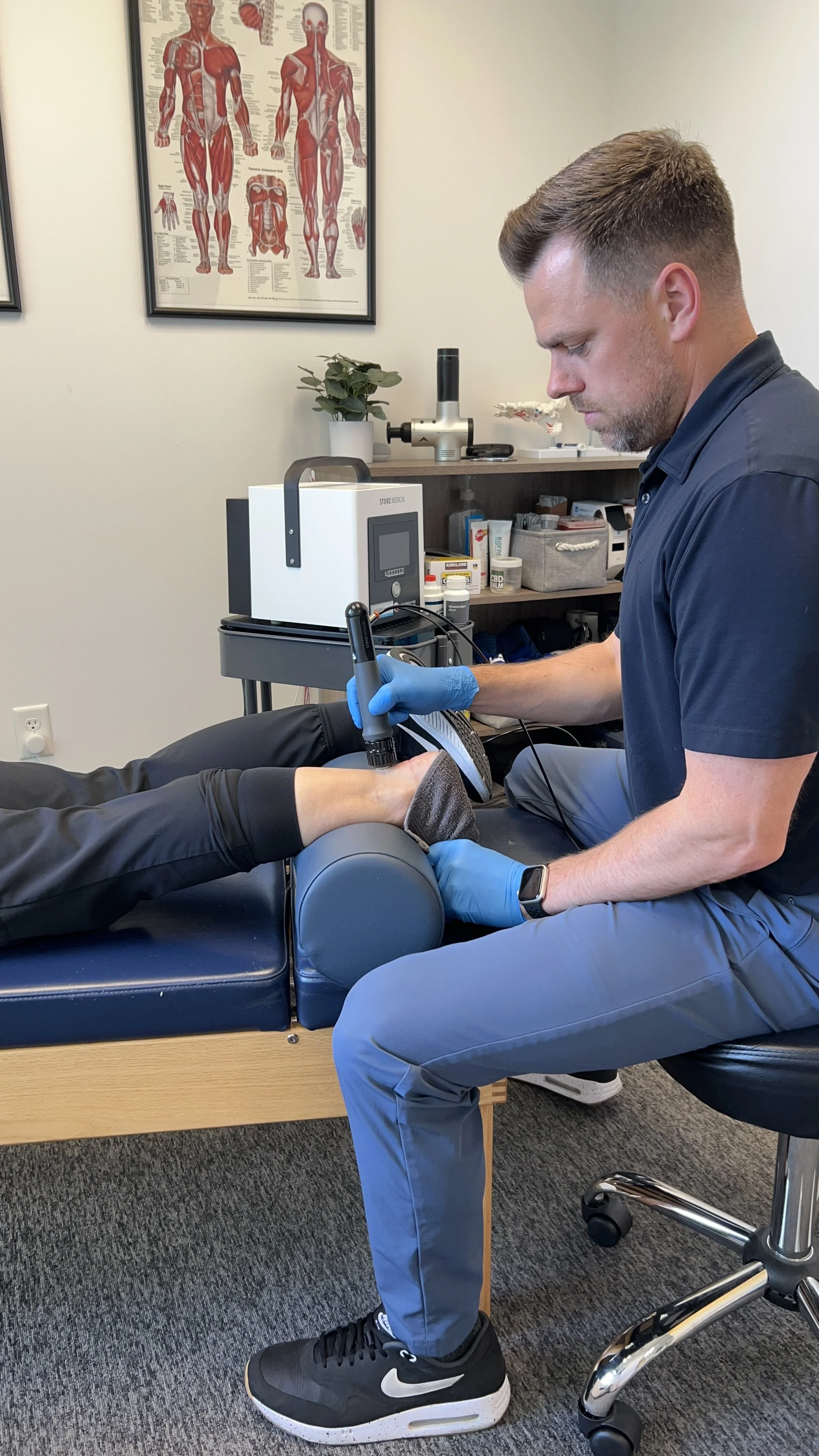
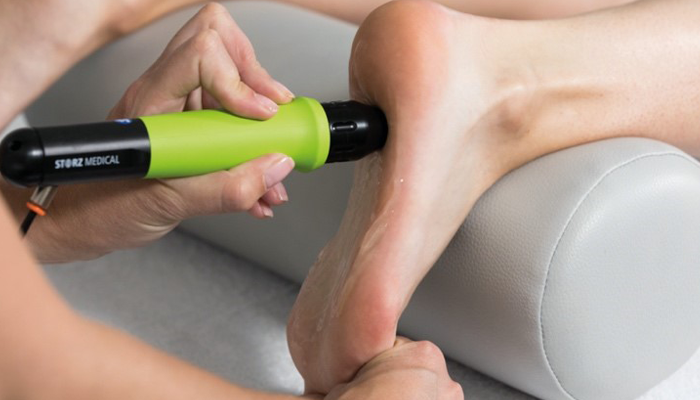
Soft Tissue: As we have reviewed the anatomy, we know that there is significant muscle ‘issues’ involved in runner’s knee. For this reason, this is where we start. How to decrease the tension and abnormal pull from muscles so that the patella tracks correctly and decreases joint wear is one part of the puzzle. There are numerous ways to achieve this and in our clinic, we find Dry Needling, Shockwave Therapy, IASTM - instrument-assisted soft tissue mobilization, and cupping therapies to provide the best, and quickest, results.
Joint Mobility & Stability: After the soft tissue is addressed, we look at the structure. As discussed in our second article, the mobility of the hip and ankle are vital to correcting and relieving runner’s knee pain. Manipulation is designed to restore normal motion to a joint that is currently not moving properly. Over time, restored joint motion can improve running mechanics and decrease strain and stress placed on the surrounding muscles.
Rehabilitation Exercise: Lastly, once we have the muscles and joints under control, a building back up must occur in two ways. One, we must create stability and control of the joint through muscle strength. Two, training volume must begin to ramp up, slowly and controlled, which we discussed in the third article of this series. To further address part one, rehabilitation exercises need to be explained and directed.
Below is a basic 3-phase rehabilitation program aimed at relieving patellofemoral pain while helping to rebuild strength and prevent future occurrences.
Phase 1: During the first phase of care, our exercise prescription is aimed at pain relief and improved mobility. These exercises should be performed 3-5 times per week, preferably as part of your running warm-up if we are able to continue training through care. We start with 1 set of 10 reps for each exercise and 30 seconds for the wall sit, working up to 2 sets over the course of this phase of care, which is typically 2-4 weeks.
Phase 2: The second phase of care focuses on returning to your full running volume while building strength and stability. We expect to perform these exercises 3-5 times per week again, preferably before running, but we will start with 1 set of 15 for each exercise and a 45-second hold for the wall sit. Over the 2-4 weeks of this phase, we will work up to 2 sets of each exercise.
Phase 3: The third phase focuses on strength and injury prevention. At this time, we move to self-care as the patient is released from active care. Our goal is to perform 2-3 sets of 10-15 reps for each exercise as a warm-up before each and every run.
RETURN TO RUNNING
Once we work through care and training is gradually ramping back up, or you have been consistent with home care, how do you know you are ready to return to full, unrestricted running? To help determine whether you can get back out there and get after it, we use our return-to-running assessment. Our goal here is to complete all five exercises without pain. In this assessment, each exercise must be completed for 60 seconds, with as many repetitions as possible.
Finally, we have covered more information than you could ever want to know about runner’s knee - patellofemoral pain syndrome. Hopefully this has been enough information to keep you out of our office, but... runners have many other issues and injuries to face, and Runner's Knee is but one of them. Until next time...
Train Smart, Recover Well, Race Great!
-Dr. Reheisse
Dr. Reheisse is a Board-Certified Chiropractic Sports Physician practicing in Murray, Utah. Revive Sport & Spine provides evidence-supported chiropractic care and conservative sports injury management.