THOUGHTS ON:
Training, Rehabilitation,
&
Best Care Practices

Youth Running: Benefits, Risks, & Considerations
Running is one of the best (coming from a runner) and easiest sports to take up in the world. Running is a major part of nearly every sport on the planet, making it an excellent option for our school-aged athletes. In 2017, almost 500,000 runners ran XC, and over 1 million athletes ran track. With the ease of access and a million different training techniques and training theories comes the risk of adverse effects. Over the last 10 years, we have seen a 34% increase in injuries incidence among runners.
Running is one of the best (coming from a runner) and easiest sports to take up in the world. Running is a major part of nearly every sport on the planet, making it an excellent option for our school-aged athletes. In 2017, almost 500,000 runners ran XC, and over 1 million athletes ran track. With the ease of access and a million different training techniques and training theories comes the risk of adverse effects. Over the last 10 years, we have seen a 34% increase in injuries incidence among runners.

Shin splints can be an precursor to stress fractures in young runners. Check out our MTSS Blog Series to prevent and rehab this common injury.
It is estimated that 20-80% of runners will experience an injury in a given year. Random range, right? You try to find two studies that can agree on this! However, we do know that more than 50% of all pediatric sports injuries are due to overuse. We also know that overuse has is signs and symptoms and can be prevented.
What do we know about youth running? A lot actually. Let’s look at the facts and discuss how we can prevent future injuries so our young runners can enjoy a life-long relationship with this wonderful sport.
BENEFITS OF RUNNING FOR YOUTH ATHLETES
Great Cardiovascular Health.
Improved Cognitive Development.
Exercise increases metacognition, behavior regulation, and accelerates behavioral and emotional engagement.
Bone Health - Increased Bone Density
Positive Self Image & Emotional Wellbeing
Aids in Development of Total Athleticism.

Running injuries are common in youth-aged runners, but the benefits from frequent exercise, competition, and camaraderie far outweigh the risks. Learn more about beginning running for health and fitness here.
CURRENT TRENDS IN YOUTH RUNNING: INJURY RISKS
Accelerated Growth.
Peak height velocity (when children grow fastest, resulting in bones lengthen faster than muscles and tendons can keep up with) occurs around 12 for females and 14 for males.
Just before this rapid growth, bone mineral content is at its lowest, making bones and growth plates vulnerable to the load and stress of running.
Low Bone Mass For Age.
Affects 39% of female youth runners.
Might be the more likely cause of stress fractures than training load.
Low Energy Availability, Relative Energy Deficiency in Sports
Adolescence is a time of rapid growth with unmet energy demands…inadequate calorie intake with increased running demand can lead to abnormal menstrual function in females, bone mass depletion, and high risk of musculoskeletal injuries and stress fractures.
Males Commonly Suffer From Low Bone Mineral Density As Well.
Risk factors include being less than 85% weight for height, running over 30 miles per week, a history of stress fractures, and having a diet lacking in calcium-rich foods.
Answering ‘YES’ To The Following:
‘do you believe that being thinner leads to faster running performances?’
BIG RED FLAG
Increased Anxiety or Avoidant Coping Strategies Such As Denial.
Perfectionism-related thoughts are associated with higher rates of depression, anxiety disorders, obsessive-compulsive disorders, and eating disorders.
History Of Previous Running Injuries.
Strong indicators for in-season injuries are injuries during summer training (female) and history of previous running injury (males).

HOW CAN WE PREVENT INJURY IN YOUTH RUNNERS:
To prevent injury, cross training is necessary. Recent data suggest that shorter intense bouts of activity like sprinting, other sports, and neuromuscular training are better for developing motor skills compared with endurance running. Remember, though they grow, they are still kids and need time to play. Play outside, play other sports, rest from play. Don’t forget that.
Strength Training #1 - Improved Core And Pelvic Strength Led To Faster Race Times.
A 6 week strength program aimed at pelvic and core strength led to improved race times. Strength training also leads to better weight control, improved motor performance skills, improved cardiovascular health, and enhanced psychosocial well-being…oh, and less sports-related injuries.
Strength Training #2 - Spine & Hip Strengthening.
Exercises aimed at the spine and hip muscles helped injured youth runners rehab from injury faster and prevented future occurrences of common running injuries such as Achilles tendinosis, iliotibial band syndrome, runner’s knee, plantar fasciitis, and shin splints.
Strength Training #3 - Strength Training For Runners Program.
We have developed an instructional series around some of the best strength exercises for runners. You can check those out here.
Set Realistic Expectations - Know Age & Developmental Stage Capabilities.
Unrealistic expectations lead to athlete frustration, low self-esteem, burnout, and injury! This can lead to reclusiveness, depression, and loss of enjoyment.
Monitor Youth Runners For Signs Of Burnout.
Students athletes who withdraw from activities they previously enjoyed may be experiencing chronic stress and burnout from their sport. This leads to more complicated issues if unaddressed, like depression, obsessive-compulsiveness, and eating disorders.
If an athlete becomes more irritable, anxious, or struggles with perfectionism, they are demonstrating signs of burnout. They need time off or decreased self, coach, and or parental pressures related to their sports.
Coordination Of Care For An Athlete.
Extrinsic risk factors for injury include improper training volume, intensity, or progression, early sports specialization, poor footwear, and inefficient running form. These factors are better addressed when the athlete, parent, coach, and healthcare provider have open communication with the athletes BEST INTEREST at the forefront.
Modify Training Program To Allow Rest Periods
Injury can be reduced by developing a training plan that limits weekly and yearly participation time to reduce repetitive movements and increase scheduled rest periods within each week, season, and annual training cycle.
Suggested rest is at least 1 day per week, 1-2 weeks every 3 months, and participation limited to 9-10 months per year.
Avoid Early Sports Specialization (Bolded Based on IMPORTANCE)
Highly specialized youth athletes (those participating in one sport more than 8 months of the year) report more injuries than their peers, independent of age, sex, or training volume.
Early Sport Specialization is associated with unidimensional identity with the sport leading to the athlete feeling as like they lack control with their participation in that sport. This leads to burnout.

All Credit To The Authors & AJSM. No Copyright Violation Intended. Click Here To Access Full Article.
When To Seek Treatment
Now that we are aware of injury risks, YOU have to take preventive measures. For some, this means a little time off before training ramps up again. For others, it’s time to hit the gym, toss a ball around, shoot some hoops, and spend some time at the pool.

Early Care Is Crucial To Retruning To Running In a Resonable Time-Frame. Schedule Today.
Shin Splint Pain Relief -> CLICK HERE
IT Band Pain Relief -> CLICK HERE
Runner’s Knee Pain Relief -> CLICK HERE
When it comes to injuries, we know two things.
(1) Rest is rarely beneficial for sports injury recovery. Rehab needs to be active!
(2) The sooner you seek care with an injury, the sooner you will be back out and running.
If you or your child has been training for the upcoming cross country season but are continually being sidelined by injury and illness, it’s time to find help and get back on track. If you are a runner in the Salt Lake City area, Revive Sport & Spine is your go-to clinic to get you back up and running quickly, giving you the tools to help you run faster, farther, and more efficient than before.
Krabak et al. Youth Distance Running: Strategies for Training and Injury Reduction. American College of Sports Medicine. 2019. Current Sports Medicine Reports. www.acsm-csmr.org.
Dr. Reheisse is a Board Certified Chiropractic Sports Physician practicing in Cottonwood Heights Utah. Revive Sport & Spine provides evidence-supported chiropractic care and conservative sports injury management for the great people and adventurers of the Salt Lake City Valley.

Medial Tibial Stress Syndrome Part 3 - Treatment and Rehabilitation
So we have made it to this point. You have been rolling, stretching, warming up before your runs, but your nagging shin splint pain will not go away. Maybe it has improved 50%, but as you continue to train for your upcoming event, the pain has plateaued. Sound familiar?
So we have made it to this point. You have been rolling, stretching, warming up before your runs, but your nagging shin splint pain will not go away. Maybe it has improved 50%, but as you continue to train for your upcoming event, the pain has plateaued. Sound familiar?
I know it has for me. As we discuss treatment options here in part three of our Medial Tibial Stress Syndrome series, a few of the techniques we show that are commonly used here in the office were used to help me overcome my battle with shin splints when I was working toward my first marathon.
Just with any other injury, if you are truly doing everything you can (allowing ample time to warm-up before exercise, training within your limits and not hanging too long in the upper limits as you progress, you are stretching, rolling, and giving constant attention to recovery and rest) and you can not shake the pain after 10-14 days, YOU NEED HELP! Our goal with this series is to give you options, ideas, and a direct path of the things you should be doing, but if they don’t get you to where you need to be, or out of pain…that is why we are here!
Below are a few of the treatment options we typically utilize when caring for medial tibial stress syndrome, as well as a basic return to running rehab protocol that not only provides strength in needed areas but is aimed at preventing future injuries.
NOTE: The care we provide is adapted to each individual person and their presenting condition. What works for one athlete may not work for another. This is where the exam and functional analysis come in. If any of these exercises cause pain, STOP, and seek care from licensed professionals. (Like Us!)
SHIN SPLINTS: IN OFFICE TREATMENT
MYOFASCIAL RELEASE
IASTM - Instrument Assisted Soft Tissue Mobilization
DYNAMIC CUPPING THERAPY
DRY NEEDLING THERAPY
KINESIO TAPING
SHIN SPLINT REHABILITATION PROTOCOLS
Medial Tibial Stress Syndrome - Rehabilitation Exercises - Phase 1
Medial Tibial Stress Syndrome - Rehabilitation Exercises - Phase 2
Dr. Reheisse is a Board Certified Chiropractic Sports Physician practicing in Cottonwood Heights Utah. Revive Sport & Spine provides evidence-supported chiropractic care and conservative sports injury management.

Medial Tibial Stress Syndrome Part 2 - Self-Care For Shin Splints
In PART 1 of our Shin Splints series, we took a look at the anatomy associated with medial tibial stress syndrome as well as the factors that make runners especially susceptible to them, namely the repetitive nature of running compounded by most cases typically doing too much too soon. Here in PART 2, we are going to look at self-care options as well as some considerations for preventing repeate episodes of shin splints so that you can keep running and training for your goal races.
In PART 1 of our Shin Splints series, we took a look at the anatomy associated with medial tibial stress syndrome as well as the factors that make runners especially susceptible to them, namely the repetitive nature of running compounded by most cases typically doing too much too soon.
Here in PART 2, we are going to look at self-care options as well as some considerations for preventing repeate episodes of shin splints so that you can keep running and training for your goal races.
SELF CARE OPTIONS FOR MTSS-SHIN SPLINTS
Self Myofacial Release - 4 Ways To Care For Your Shin Splint Pain
Pre-Running Warm-Up For Shin Splints
Training Modifications, Gear Suggestions, & Other Prevention Considerations
Form, Cadence, & Ground Contact Time:
This is a tricky subject, honestly I’m not sure why I even mentioned it. One can go miles down the form training rabbit hole and come out the other side worse they they were before. However, I do want to mention three things that must be considered and worked into your training plan to help prevent shin splints and make you a more efficient and faster runner.
The ground fights back! The more time we spend in contact with the ground, the harder this battle will be. I’m not here to talk about heel-striking, forefoot running, etc., but I will mention cadence. The higher your cadence, the less time your foot spends on the ground. Meaning, the less ground reactive forces you absorb and the less stress on your body.
Again, I’m not here to correct form. But I do believe we can all be more efficient. Strength training helps us become more efficient for those later stages of the race. Please add strength training to your program, it is extremely useful.
Alter your surfaces. Don’t always pound the pavement. The track and trails are your friend…and your feet will thank you for it.
Shoes:
Shoes are something I get asked about frequently. My honest answer is this, ‘We have more shoe technology and selection than ever…we also have more injuries than ever.’ Take that for what it is worth but I do believe shoes should be rotated and changed frequently. I suggest a 2-3 pair rotation, avoid running in the same pair two days in a row, and switching out for a new pair every 200-300 miles depending on the shoe.
Warm-Up & Cool-Down:
This is SO BIG. In every injury we encounter and talk about, how you warm-up (if at all) and cool-down has a direct impact on your injury risk, and recovery speed from injury. Warming up prepares your body for the task ahead, giving it the best chance to avoid injury. Colling down helps work out those tight spots after training while encouraging faster recovery.
Dr. Reheisse is a Board Certified Chiropractic Sports Physician practicing in Cottonwood Heights Utah. Revive Sport & Spine provides evidence-supported chiropractic care and conservative sports injury management.

Medial Tibial Stress Syndrome Part 1 - What Are Shin Splints and Why Runners?
Springtime is here! The weather is warming up, the sun is starting to shine on those early morning runs, and we can finally shed many of those heavy layers of clothes for our preferred running shorts and singlet top!
But…spring time also means something else for runners.
Springtime is here! The weather is warming up, the sun is starting to shine on those early morning runs, and we can finally shed many of those heavy layers of clothes for our preferred running shorts and singlet top!
But…spring time also means something else for runners.
For most runners, it means it is time to come out of the pain cave, get off the globogym cardio theater dreadmill, and start hitting the roads again. For some, it means it is time to come out of hibernation and begin training again. While this all seems well and good, the road can cause some aches and pains that the somewhat forgiving treadmill or cushy couch hid from you all winter long.
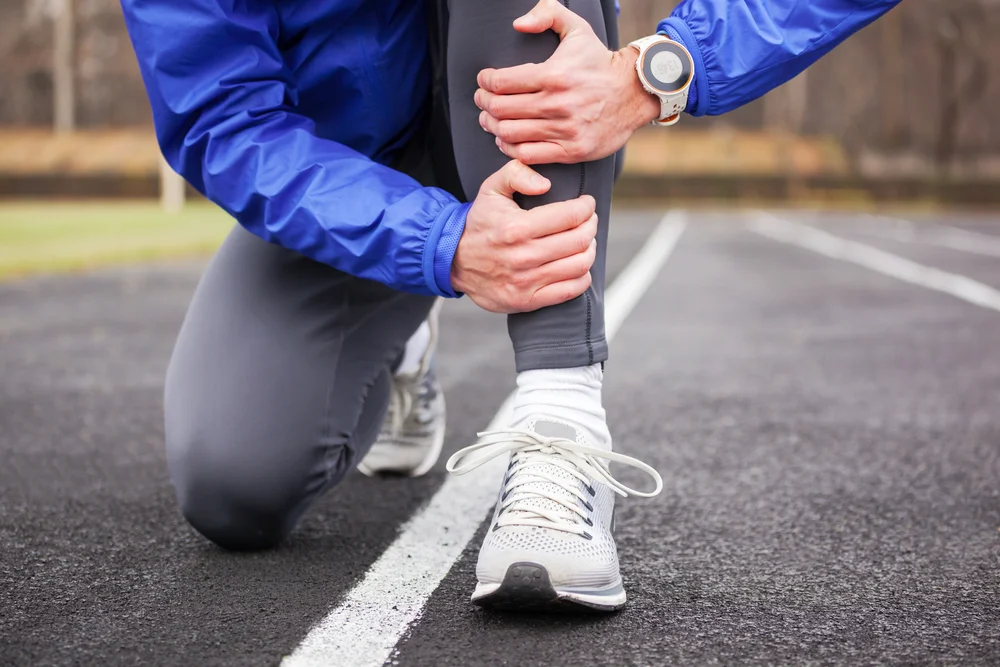
You know what I am talking about. That all too familiar pain down the inside of shin bone that can also sometimes radiate into the foot and seems to intensify with every run. Road running in the spring can be wonderful, but it can also be painful. The road is an unforgiving surface (part of the reason our treatment plans include running on a track or trail) that can bring even a veteran runner to their knees in frustrating agony with each run.
Yes, I’m talking about Shin Splints!
Today we are beginning our Shin Splint Relief & Prevention series by discussing what ‘shin splints’ are, how they occur, who is more likely to experience shin splints, as well as a few other complicating factors. We will follow this up with self-care in Part 2, and Treatment & Rehabilitation options in Part 3.
WHAT ARE SHIN SPLINTS: MEDIAL TIBIAL STRESS SYNDROME
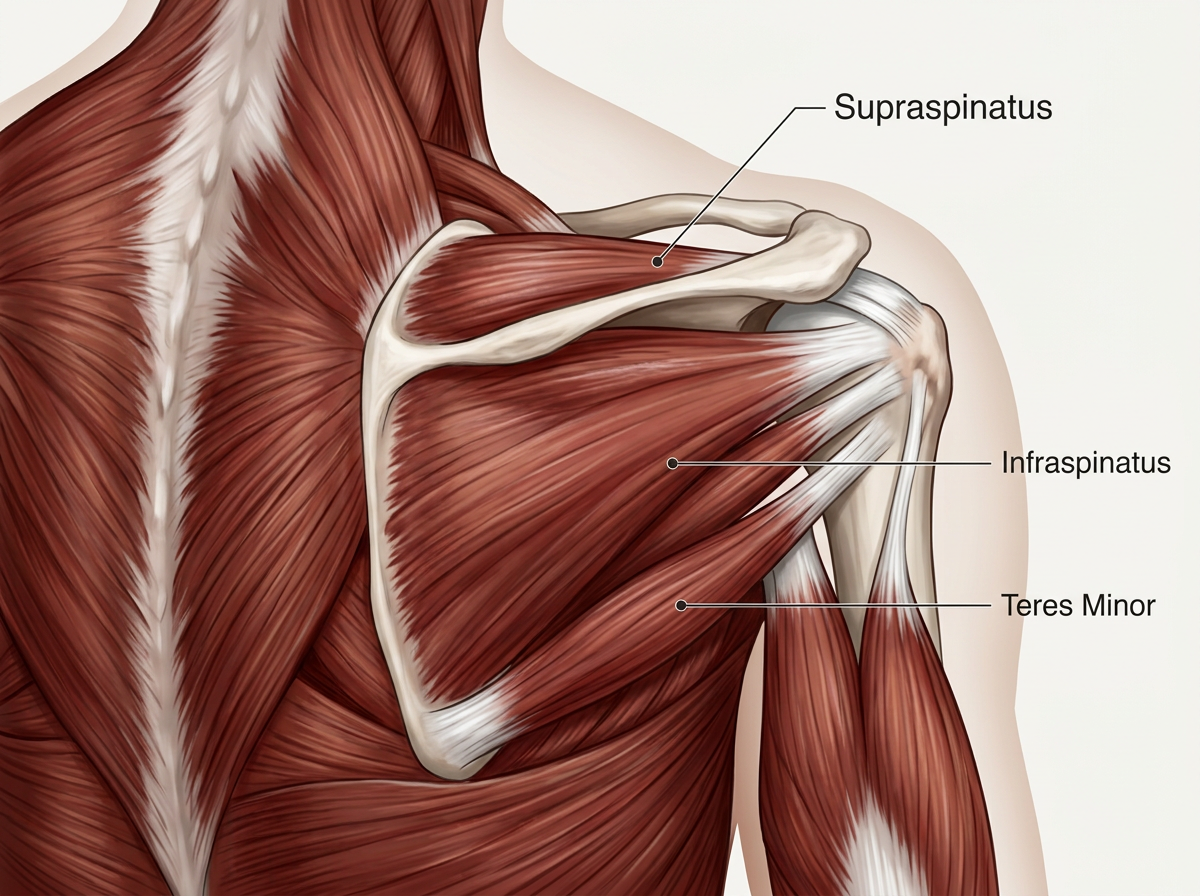
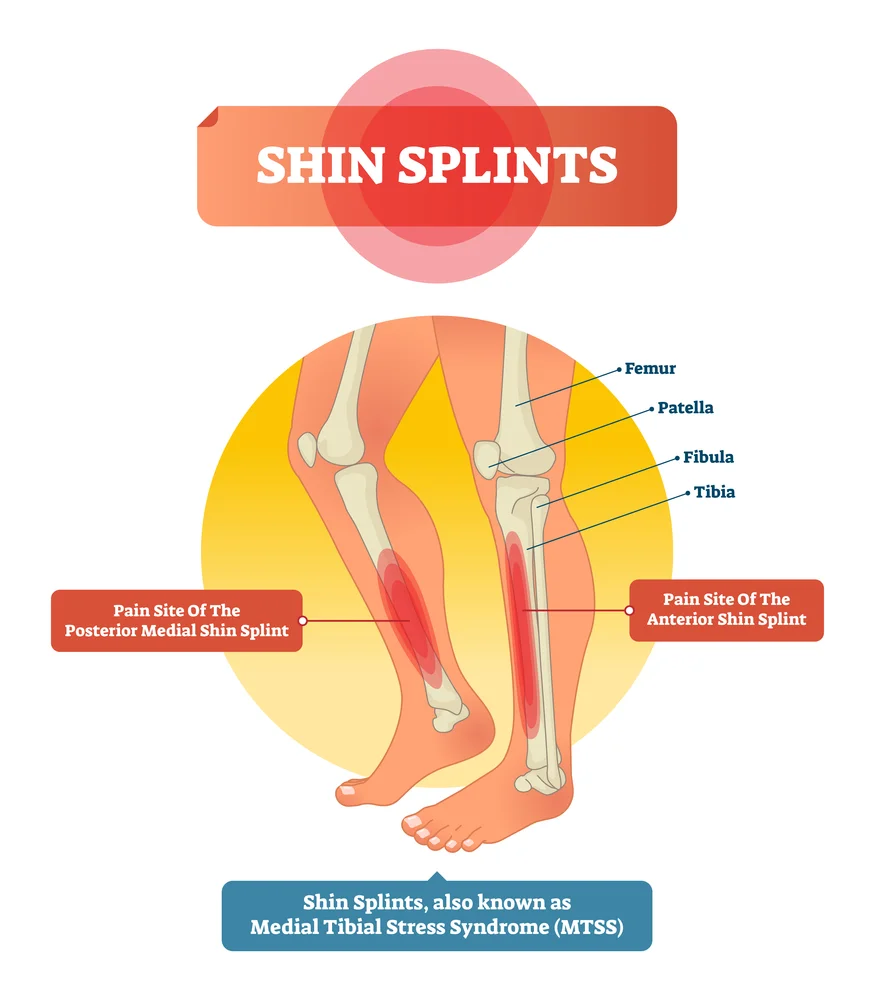
From an anatomical perspective, shin splints are a condition where there is pain, tenderness, and sometimes swelling along the middle, inside of the tibia (shin) bone. While the cause is debated as to whether this pain comes from a muscle and tendon response to doing too much too soon, the tibia bones inability to handle the stress and pounding from running, or damage to the connective tissue that wraps and supports all of these structures in the lower leg and foot.
The hallmark sign of Shin Splints is the extreme tenderness along the inside of the shin that seems to improve as a runner warms up, but begins to worsen, last longer, and eventually prevent running as time passes without care. From this, this condition is more aptly named Medial Tibial Stress Syndrome.
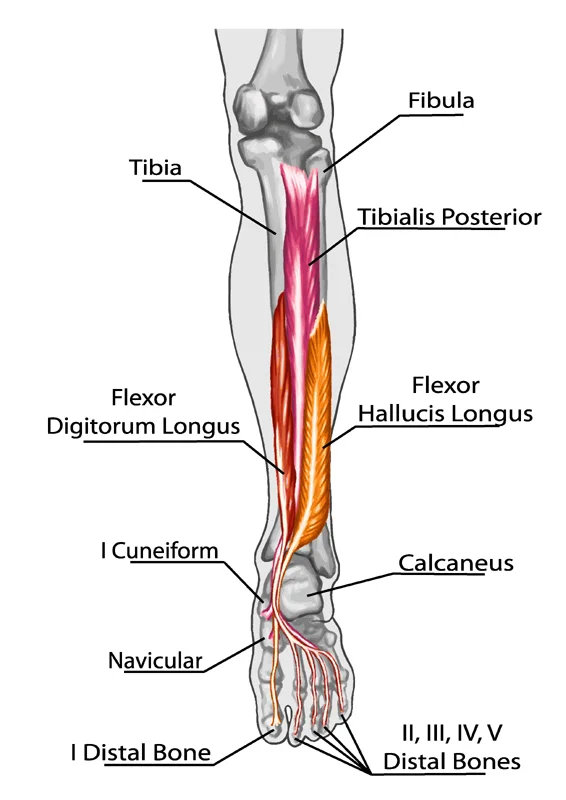
Before we discuss why this condition plagues runners, and what we in the medical community think is actually happening, let’s look at the important anatomy involved.
WHY RUNNERS & WHAT FACTORS LEAD TO SHIN SPLINTS
Running injury statistics are horrifying, with studies estimating that anywhere from 40-80% of runners experience an injury EVERY YEAR. I am not going to bother trying to track down the actual number because it changes montlhy as new research comes out, but the fact is that as runners, we run a high risk of injury. From that, it is estimated that 1 in 5 are dealing with shin splints. Since this is such great news, let’s look at some reasons why this injury is so common and who could be at higher risk.
New Runners - If you are truly new to running, Shin Splints are almost a right of passage. In the process of your body adapting to this new stress, figuring out your form, and slowly increasing your mileage, your body will get to the point where it starts to scream…’why are you doing this to me’. As we progress through this series, you will find ways to build up your body, more specifically your legs, so that it can handle this new stress of running.
Running Biomechanics - The Tibia bone is believed to absorb 2-3x’s your body weight with each step. Take into account that the average runner has a cadence (steps per minute) of 140-180, it is no wonder we begin breaking down at the tibia.
Higher BMI/Body Weight - Looking at the last statement, if you have higher body weight, and you are new to running, forcing your tibia to withstand the pounding from running should be a slow process with ample recovery.
Training Volume - Just like new runners, if you are a veteran with a solid training base of 30-35 miles per week and you sharply bump up to 55-60 miles per week, you are essentially treating your body like a newbie with a very unfamiliar stress.
SIMILAR PROBLEM: Too Much Too Soon & Classic Overtraining
Form - Forefoot, Midfoot, or Heel Striker, you efficiency within that form and allowance for adaptation to stress is what either prevents or causes injury. I have seen all forms present with shin splints, and it is usually a combination of the above causes.
WHAT ACTUALLY CAUSES SHIN SPLINTS
While the cause of Medial Tibial Stress Syndrome is still debated, with research naming a different cause. It is likely a combination of the factors we are going to cover. This is why, if you have been suffering from shin splints for a month or so and are just trying to run through them, it is important to get an evaluation, a structured plan around your goals, and some treatment to get you over the hump.
Weak Ankle Dorsiflexion - Loss of eccentric control.
One issue that many believe to be a cause, or at least a contributor to shin splints is poor control of the anterior leg muscles, or weakness of the Tibialis Anterior muscle. This one stands out in newer runners because it is responsible for the slapping sound one makes when their foot hits the ground. This comes from weak eccentric control of the muscle, or the ability to slowly let it down to the ground. Our bodies are amazing, so when one area fails, another area takes the load…
Poor Pronation Control & Tight Posterior Tibialis Muscle
Lets first start by reminding everyone that pronation is a normal part of the gait cycle, but poor control of the speed of pronation can cause problems. If we have excessive tightness through the posterior tibialis muscles, either due to overuse or poor adaptation to load, it is unable to respond well enough when the foot hits the ground, causing the foot to crash in during pronation. If this is the case, we see each step pulling on this already tightened muscle, as well as the facia that wraps it and attached to the inside of the tibia bone (that spot where you are tender), inflaming the area, damaging the muscle, and leading to poor mechanics while running.
Bowing of the Tibia Bone
To further the case of this mid-shin bone pain where the posterior tibial muscle lies, we have data that shows the Tibia bone actually bowing during running. While our bodies are adaptive and resilient, we believe this bowing to be minimal, undetectable without fancy equipment, but a natural part of our body handling the forces the road gives back with each step. Where this comes in to play is with a young or new-to-running runner who decides to run through their pain. If this goes on long enough, and the runner overtrains, this can lead to a stress fracture injury.
Over Training - Too Much Too Soon
This is probably the most common reason runners experience shin splints, and most other injuries for that matter. Over-training is the common factor of the 3 potential causes we mentioned above. As a new runner or an experienced one looking to increase mileage, a plan that not only includes a structured running plan, but strength training, cross training, and rest must be considered.
SUMMARY
Shins Splints are most known to cause pain along the inner edge of the tibia bone that is tender to the touch. Swelling may or may not be present.
While many causes are debated, one thing holds true. Whether you are a new runner or a veteran. Doing too much too soon will likely lead injury.
Runners are most at risk due to the repetitive nature of running. Add in volume changes, the pounding of the road, lack of self-care and warming up before each run..it all adds up.
Dr. Reheisse is a Board Certified Chiropractic Sports Physician practicing in Cottonwood Heights Utah. Revive Sport & Spine provides evidence-supported chiropractic care and conservative sports injury management.

Iliotibial Band Syndrome: Self-Care & Training Modification
As we work our way through this series, let not forget what we have learned so far.
Iliotibial band syndrome is a common overuse injury plaguing runners of all abilities. The most common offense is trying to increase your volume too soon while also increasing the intensity without cross-training or varying surfaces.
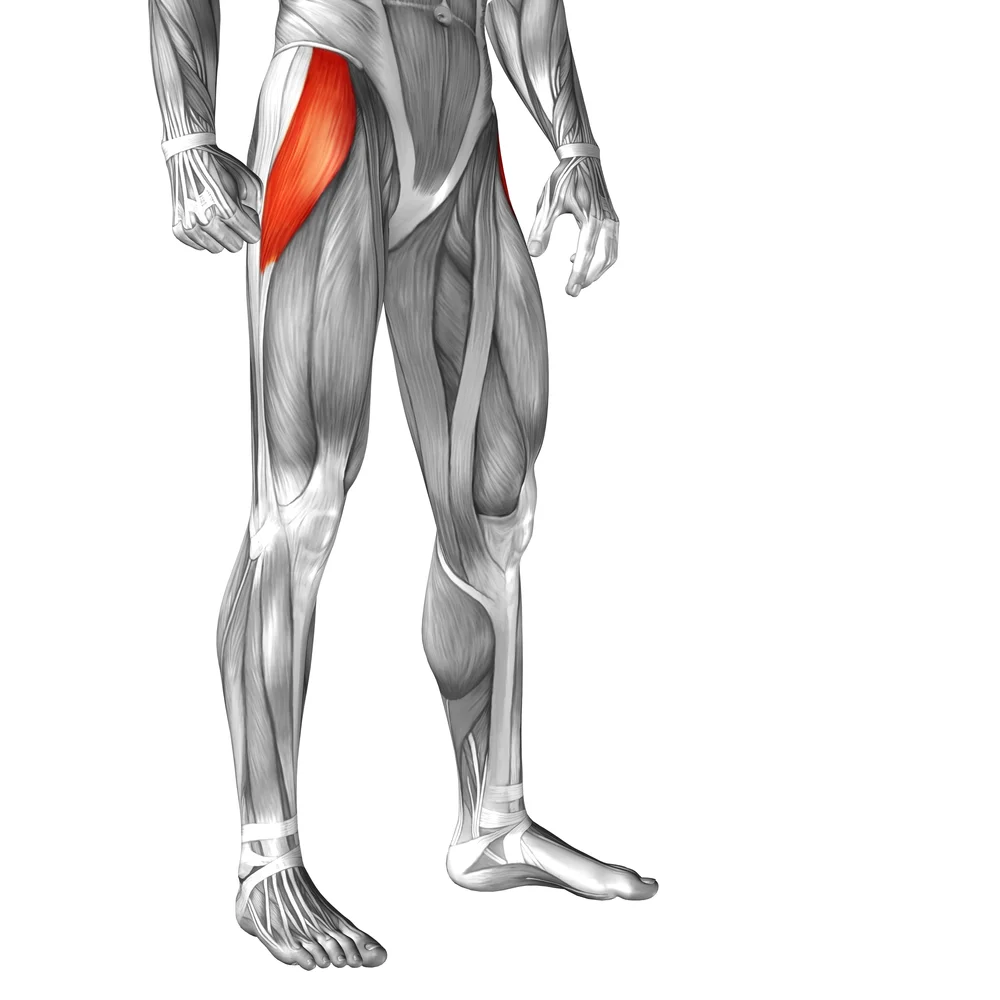
The Iliotibial band DOES NOT STRETCH! The tension we feel is caused by the muscles that support the IT band, Tensor Fascia Latae and Gluteus Maximus.
The stabbing pain we experiences as runners suffering from IT band syndrome is thought to be caused by the band itself shifting forward and backward as the knee flexes and extends. The research is out on that one…if we ever reach a consensus, I will let you all know!
Where are we now? Well…if you have made it this far, you are probably dealing with IT band syndrome and wondering if it will ever go away and let you get back to running the way you would like.
For this, we are going to discuss self-care. What you can do about the knee pain and tight hips at home while also mentioning a few stretches you can do at work or out on a run. Our goal is simple - Allow you to continue to train, modified while improving your IT band syndrome pain week-to-week.
What we are talking about today, where the real work takes place, the day in and day out self-care. And the big question….can you continue training?
SELF CARE PART 1 - START WITH A BETTER WARM-UP
I can not stress this enough! As you are working through an injury, maintaining some kind of load (training volume) is important, but you are better served spending time on a proper warm up, running just a few miles, then spending a good amount of time on the cool down. With just about every running injury we deal with, runners have a dismal warm-up if one at all. Most are so pressed for time, they lace up the shoes, run out the door, only to return and head straight to work. Most of us are not teenagers anymore, our bodies just can’t do this…not for long periods anyway. Start with a thorough warm-up - we will emphasize this again in our next article where we talk rehab and return to running so prepare yourself!
SELF CARE PART 2 - SELF MYOFASCIAL RELIEF
Understanding that foam rolling and stretching of the IT band itself is ineffective, where do we focus our attention? The hips…it is always the hips! But some attention at the knee can be beneficial while appropriate rest and recovery are always suggested after an acute flair-up or long run.
Rest & Recovery:
Traditional pain relievers for running related pain include ice, heat, topical creams like biofreeze, and some good old-fashioned rest. Today we have an array of tools that can aid in recovery, one we like to use frequently are compression boots from Rapid Reboot. We don’t expect everyone just to have these lying around, but they sure feel great after some dry needling, IASTM, and manipulation in the clinic.
Rolling & Stretching:
Now that we understand what anatomy we need to address, it is time to get your roll on! If we are able to continue to train, we suggest rolling and stretching 4-5 times each day. Before you lose it, these sessions are only 3-4 minutes each. If you are a frequent runner, or just starting out, here are the basics.
Rollers should be in your home, office, and car. You should have at least 3 lacrosse balls around, purse, cup holder in your car, in your desk, and your gym bag.
Roll in the morning, pre and post run, after your lunch break, when you get home, and then a good session before bed.
Cupping & Flossing:
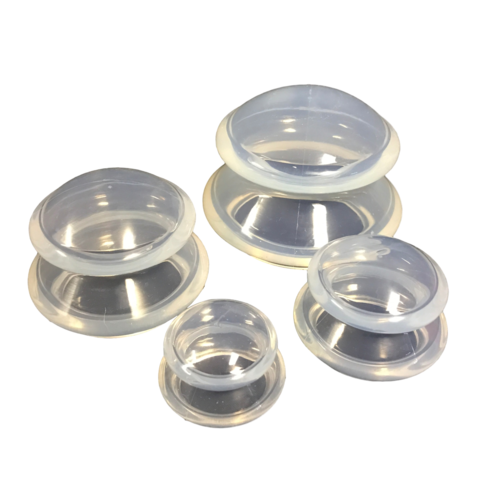
These may not be tools accessible to all, but they help you achieve stretching in ways that are difficult to do on your own. One of my personal approaches to provide relief to the knee pain we experience with IT Band syndrome is to place a few cups (I have a few sets of these) around the lateral knee and lateral quadricep muscle, walk about for a few minutes, perform a few squats, rinse and repeat 2-3 times per week.


SELF CARE PART 3 - TRAINING MODIFICATION
Training modification is the hardest part to address. For most, the ability to continue training toward your race is almost as important as fixing the injury. While maintaining some load is ideal, there are instances where a total shut-down is necessary for a few weeks. If you are a typical runner, meaning that you are going to run through the injury, we must modify. Here are the basics. Remember that Iliotibial band syndrome is the result of too much mileage or intensity, too soon in your training plan. Not having a proper base as you head into a 20-week marathon training plan is a recipe for disaster.
Our first suggestion is to cut your volume by 50% and decrease your intensity for the next 2-4 weeks. Our goal is to maintain some running, but the speed work and downhill bombs need to take a backseat for a while.
Please, cross-train! As runners, we think that running is it, period. When we are injured, and more so when we are not so that we can prevent injury, we must cross train. If you have been battling IT band syndrome for more than a few weeks, it is time to work in some biking, swimming and weightlifting. This allows you to maintain most of your cardiovascular capacity while taking out the pounding associated with running.
Lastly, look at your running form. Can it be cleaned up a bit? For most of us, that is a very strong, Yes! I’m not saying to go out and get an extensive running evaluation to change the subtle nuances of your stride, most of us just are not at that level, but shortening your stride, increasing your cadence, and working on your running drills can provide a needed boost in your running efficiency.
Cadence should be upwards of 170-180 steps per minute.
Perform drills on a soft surface (track or field) 2-3 times per week.
More on this in the rehab portion next week.
Dr. Reheisse is a Board Certified Chiropractic Sports Physician practicing in the Greater Salt Lake City Area of Utah. Revive Sport & Spine provides evidence-supported chiropractic care and conservative sports injury management.

Iliotibial Band Syndrome: Why Runners? Understanding Biomechanics & Common Risk Factors.
Knowing more about the anatomy associated with the Iliotibial band (IT Band Article #1) is a great start, but that alone will not decrease the stabbing feeling you had on the outside of your knee as you attempted a long run this past weekend.
We are moving forward with our IT Band Syndrome Relief series. This time we aim at the biomechanics (boring for some, but very important) of the Iliotibial band and why it is causing you pain. From there, we are going to look at some common risk factors and other things you are doing every time you go out to run that is making it worse.
Knowing more about the anatomy associated with the Iliotibial band (IT Band Article #1) is a great start, but that alone will not decrease the stabbing feeling you had on the outside of your knee as you attempted a long run this past weekend.
We are moving forward with our IT Band Syndrome Relief series. This time we aim at the biomechanics (boring for some, but very important) of the Iliotibial band and why it is causing you pain. From there, we are going to look at some common risk factors and other things you are doing every time you go out to run that is making it worse.
BASIC BIOMECHANICS
When we look at the function of the Iliotibial Band, it primarily assumes the role of lateral knee stability. Understanding that it originates from the Iliac crest and inserts on the tibia (Gerdy’s tubercle, remember?) we realize that it is a two joint muscle. When a muscle crosses and acts on two joints, in this case, the hip and knee, the likelihood of injury dramatically increases, especially when it is subjected to overuse overload.
With this setup, the IT Band also acts to extend, abduct (raise the leg out to the side), and externally rotate out the hip. As we will discuss in our next article about self-care for the IT Band, we know the muscle of the hip are the primary culprit and where we will focus our attention during clinical and home care.
BUT WHY THE PAIN AT THE KNEE?
While the Iliotibial band crosses the knee to attach to the tibia (fibular and patella according to some studies) providing stability to the outside of the knee, it moves as the knee bends and extends during walking and running.
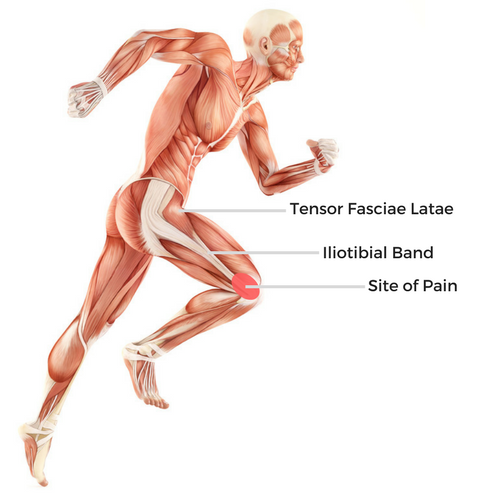
When we bend our leg, the IT Band moves anterior to, or forward, across the lateral condyle of the femur bone (SNAP!), then, when the knee nears 30 degrees of bend, it moves posteriorly, or back over the lateral condyle of the femur (SNAP!).
Now, think about how many steps you take on your average 5-mile run. If you have tightness in the hip musculature, namely the TFL and Glute Max muscles, they are pulling tension through the IT Band causing an up close and personal relationship between the band and the femoral condyle we just mentioned. When we work through the running gate cycle, we cross the 30 degrees of flexion and extend back out of it over and over….SNAP, SNAP, SNAP!
Take this friction, and add force. The force from each and every foot slap on the ground while running has to be dispersed through the muscles, ligaments, tendons, and joints. While not proven, my own personal ‘journey’ with IT Band Syndrome led me to find that when I trained on softer surfaces, my knee pain was less severe.
Either way, this force, friction, and the magic number of 30 degrees do not play well together. As you can see in this video, if you run with somewhat decent form, your foot strikes the ground somewhere between 20 and 30 degrees of knee flexion (SNAP!) and when you follow-through the gait cycle to push off and bring your leg forward, you near full extension (SNAP!) and back into bending of the knee (SNAP!).
COMMON RISK FACTORS & RUNNING MISTAKES
Common Risk Factor #1: Too Much, Too Hard, Too Soon
We have all done it…try to pick up where we left off either from an injury, vacation, or some much needed time off after a goal race. However, this typically affects the newer runner. You find a plan online, it looks fun, doable, but you soon find out it was too much. Increasing your intensity and volume at the same time spells disaster for the most veteran runner, for the newbies, this is the quickest way to stop running. Take it slow, slower than you want to. Build up your volume, EARN YOUR BASE, then maintain that volume and slowly increase your intensity. THERE IS NO OTHER WAY!
Common Risk Factor #2: Not Taking The ‘Road’ Less Traveled
Do you always run on the road? I mean ALWAYS? How about sticking to one side of the road on every run? We all know that roads are banked, but if you are always running on the right side, your body will adapt to that slight lean, causing problems down the road (pun intended there). With that, try the track, trails, aqua jogging, a treadmill. Just like shoes, you need variety. Note: Watch the video above, and look for pt 3, we talk on this more.
Common Risk Factor #3: “What Is Strength Training?” -Runners Everywhere
One of the most common causes of IT Band Syndrome is weakened hip muscles. It will come as no surprise when we discuss clinical and home care that strengthening the hips is a GIANT part of the rehab and future prevention process. It’s okay runners, I was scared of the weights at one point in time too!
Common Risk Factor #4: Who Has Time To Warm-Up?
The next significant change we make during care is the Warm-Up. If you just said, “The What?” Then we just found the cause of your IT Band Syndrome Pain. Warming up not only helps prevent injury, but it makes you a better runner. There, I said it, now start doing it.
Common Cause #5: Developmental & Gait Abnormalities
Overpronation, leg length discrepancies, bow-leggedness, poor hip mobility due to underlying causes. These are all challenging, and for most, they just add to the problem. A perfect example is that I personally found that I have a 1.5 cm short leg. I found this out when I was over 30, my body was adapted to it. Putting a lift in or selecting a supportive shoe would have only worsened my condition. I did, however, have to be strategic in my strength training, mobility work, and where and how I trained. If you fall into this category, call our office, or someone near you that understands running injuries as you do need help from a professional to find the right rehab exercise and mobility drills to help you run pain-free.
SUMMARY
Tight and weak hips lead to poor function and support of the IT Band. This allows the band to SNAP at the knee, producing overuse friction, and long-standing pain.
Risks come in all varieties, some you are doing every day. Take your training slow, work in strength training, vary your training surfaces, and warm up before running!
Dr. Reheisse is a Board Certified Chiropractic Sports Physician practicing in the Greater Salt Lake City Area of Utah. Revive Sport & Spine provides evidence-supported chiropractic care and conservative sports injury management.

Resolve Low Back Issues Part 7: What Happens When You Need To Seek Care?
Our intention with this series on Low Back Pain has been to inform and empower you, or your loved ones, to take action and realize that movement can help, as well as, prevent low back pain. That your low back pain is not a life sentence.
Care & Rehab For Low Back Pain
Supporting The Greater Salt Lake Valley. Helping You Get Back To The Activities You Enjoy.
Our intention with this series on Low Back Pain has been to inform and empower you, or your loved ones, to take action and realize that movement can help, as well as, prevent low back pain. That your low back pain is not a life sentence.
While all of this information is useful and should be utilized before, during, and after a Back Pain episode, the reality is that some people will need to seek care.
You have had a front-row seat to one pillar of our care, the education and exercise component. When seeking care for low back pain, putting your faith solely in one person, and relying on them for everything is not advised and will severely hinder your progress.
YOU (YES, YOU) HAVE TO PUT IN THE WORK, TIME, & EFFORT!
As a Sports Chiropractor that treats low back pain every single day…we see it time and again in our patients… If home care is not adhered to and a person does not take their situation seriously and put in the effort, back pain will take forever (or it seems that way) to resolve.
Today we are going to give you another up-close look at our care process, this time what we actually do here in the office. Our goals are to (1) Determine the cause of your pain/injury (2) Provide care in the office that helps you toward your goal of running, golfing, sleeping, moving again…pain-free, and (3) Give you the tools and education to help yourself.
We structure our care around 3 pillars: Soft Tissue, Joint Motion, Exercise. We have exhausted our opinion and writing on exercise, please refer to parts 1-6 for direction. Now, lets briefly take a look at what care looks like inside the office.
SOFT TISSUE CARE
JOINT MANIPULATION
Dr. Reheisse is a Board Certified Chiropractic Sports Physician practicing in Cottonwood Heights Utah. Revive Sport & Spine provides evidence-supported chiropractic care and conservative sports injury management.

Resolve Low Back Issues Part 5: You Are Not Your Image. (Red Flags & Imaging Considerations)
In part 4 of our Fix Your Low Back series, we discussed some of the most common myths and misunderstandings around low back pain, care of low back pain, as well as updating some of the old-fashioned thoughts. Today, we are going to discuss imaging and red flags as it pertains to low back pain and a couple of VERY IMPORTANT things you need to know.
Low Back Pain Imaging
Best Practices & The Truth
In part 4 of our Fix Your Low Back series, we discussed some of the most common myths and misunderstandings around low back pain, care of low back pain, as well as updating some of the old-fashioned thoughts. Today, we are going to discuss imaging and red flags as it pertains to low back pain and a couple of VERY IMPORTANT things you need to know.

Imaging is an excellent diagnostic tool, when appropriate, to help ASSURE PROPER care.
Not-so-long ago, a patient would walk into a chiropractic office and get a standard set of x-rays; or they would schedule an appointment with an orthopedic physician and would be required to obtain an MRI before they can be seen.
This standard practice has fortunately been labeled as inappropriate, and national organizations such as the American Chiropractic Association and American College of Physicians have recently taken a strong stance against these practices.
CURRENT BEST PRACTICES
Do not obtain spinal imaging for patients with acute low-back pain during the initial 6 weeks after onset in the absence of red flags.
Imaging should not be utilized to monitor a patient’s progress.
WHAT WE KNOW ABOUT IMAGING NOW
There are two extremely important things to know concerning imaging…
Imaging can be harmful. Radiation aside. Unnecessary x-rays and MRIs can bring to light ‘normal variances’ that are NOT the generator of pain but are easy to blame. This causes what is being referred to as the ‘medicalization’ of low back pain.
Example: Someone presents with low back pain, an image is immediately ordered, it shows a bulging disc or some other skeletal irregularity, and the blame for the complaint is placed on this without further discussion. This patient goes on to think that they are doomed to low back pain forever, that their ‘bad back’ will keep them from enjoying their normal activities, and unfortunately, they end up with a regular dose of over-the-counter and prescription drugs.
Now, this is not always the case, but once or twice each month, a patient with low back pain presents to our office stating that they had a bulging disc in their low back over 10 years ago and have been in constant pain ever since. These cases have more to them than just pain, the overutilization and misuse of imaging lead to fear avoidance and catastrophizing. Both are always present in chronic low back pain!
Through recent studies, we know that to a certain degree, lower spine degeneration and pathology are normal, AND NON-PAIN GENERATING, at almost all ages.

What is so important about this chart? Well….
These numbers represent the percent of specific age groups that had degeneration and disc pathology of the lower back in patients who had NO SYMPTOMS OR COMPLAINTS whatsoever.
Also, this was no small review….this study included over 3100 people!
In review, If we took a pain-free 40 y/o person with NO history of low back pain…
Almost 70% would demonstrate degeneration on x-ray.
50% would show a bulging disc on MRI.
Our take-a-way here… YOU ARE NOT YOUR IMAGE! They can play tricks on your thinking and make your back pain much worse just by you believing that what your image is showing is the end all be all of your pain.
With that aside, we do need imaging. WHEN INDICATED THROUGH A PROPER EXAM! Imaging is great for ruling out serious pathology.

RED FLAGS
Red flags are indicators that let physicians know there might be something more serious going on. This can come from a simple history and exam and they demand attention and should be considered before care of any kind is provided. With that said, here is a small list of ‘Red Flags’ common with low back pain complaints.
History of Cancer.
Night Pain.
Progressive Neurological Symptoms & Weakness.
Pain Following Trauma (Fall, Auto Accident, etc.)
Sudden Loss of Bowel or Bladder Function.
Recent Weight Loss.
New Back Pain With Fever.
Failure of 4-6 Weeks of Conservative Care.
History of Recent Fracture of Suspected Fracture.
Family History & Signs of Osteopenia & Osteoporosis.
In summary, and I hate to keep harping on this, but your imaging results may not be as important as they are made out to be in regards to uncomplicated, and even chronic, low back pain.
Spinal degeneration, disc bulge, and other pathologies are often normal findings as we age and have not been proven to be pain generators.
Imaging early in the care process in the absence of red flags is NOT in line with current ‘best practice’ suggestions and guidelines.
Studies have shown that a thorough history and exam with your provider can provide information to determine the actual cause of your low back pain.
Dr. Reheisse is a Board Certified Chiropractic Sports Physician practicing in Cottonwood Heights Utah. Revive Sport & Spine provides evidence-supported chiropractic care and conservative sports injury management.

Resolve Low Back Issues Part 4: Most Common Myths Of Low Back Pain
Few musculoskeletal conditions have a cult-like following of myths as Low Back Pain, many of which have been said by various healthcare providers across all specialties. To help clear the air, let's take a look at the 5 most common misunderstandings and myths that we encounter in our chiropractic clinic that could actually make your low back pain worse.
Low Back Pain Myths
Few musculoskeletal conditions have a cult-like following of myths as Low Back Pain, many of which have been said by various healthcare providers across all specialties. To help clear the air, let's take a look at the 5 most common misunderstandings and myths that we encounter in our chiropractic clinic that could actually make your low back pain worse.
Before we get started…
These myths and misunderstandings are not aimed at making low back pain seem 'made-up,’ it is a very real and challenging condition. These myths are just folklore passed down from old, unsubstantiated in the research, ways of thinking. Our truth is that, if you believe one thing and that makes you feel that your low back is wrecked for life, a long road of pain is what you are in store for. We call this fear-avoidance and catastrophizing, the medicalization of a condition. We will touch more on this when we cover imaging next week. But a big part of recovering from low back pain is believing that you can get better. It may sound silly, but no more ridiculous than believing these myths below!
NUMBER 1: Your back pain is from a misalignment, bone out of place, or a ‘subluxation.’

We don’t practice this way any longer, stop using explanations from this era.
These are common descriptions patients and doctors alike will give when describing their back pain. The most common being...you threw your back out, and it is now misaligned...commonly spoken by chiropractors of a generation ago or current doctors, chiropractors, and physical therapists that have not caught up with current research. The truth to this is that your spine is a dynamic structure designed to move, what we ACTUALLY find is that the pain you are feeling is often associated with immobility, or areas of the spine that should be moving, but due to tight muscles and previous injury, may not be moving well or correctly anymore. Spinal manipulation or an ‘adjustment’ is designed to restore normal motion to these restricted areas.
A bone did not shift out of place and therefore needs to be put back in! That’s not how it works.
NUMBER 2: Arthritis is the root of all evil!

Arthritis is like wrinkles on your face…lets just keep it nice and say they are signs of wisdom. Truthfully, if you live and play hard and long enough, we will all experience some degree of degeneration. However, and please understand this, it is a natural process and does not necessarily equate to pain! When conditions present that are more challenging, using arthritis as the ‘fall guy’ is the easy way out for a provider and an often acceptable answer for the patient.
NUMBER 3: “But…I have scoliosis and a short leg” that is the cause of my back pain.

Just like arthritis, scoliosis and an actual short leg (1cm or shorter than the other) are comfortable areas to place blame when someone presents with back pain. Both can absolutely lead to dysfunction, and if unaddressed, pain and discomfort. To a certain degree, uneven leg lengths and spinal rotation/curvature are normal variants, meaning most people have these at a mild level and are unlikely to be a pain generator. For most (not all) look to place the blame elsewhere.
NUMBER 4: Rest is what I need to recover, right?

The days of ‘take 2 of these, rest, and call me in the morning’ are long gone. You likely have a relative who spent a good amount of their life with back pain that limited some or all of their activity. When you see a case like this or someone who is much too young to be experiencing recurrent back pain, it may seem like the right thing to do is rest up for a while. Fortunately, we now have stacks of research that supports the fact that bed rest is the worst (top 3 at least) idea when it comes to low back pain. The new adage is ‘Movement is Medicine.’ When someone presents to our office, we are not only just trying to relieve pain, but to relieve pain SO THEY CAN GET OUT AND MOVE. Even walking, WALKING, has been shown to reduce low back discomfort and be a great tool to prevent future occurrences.
NUMBER 5: Slap a brace on it & it will be fine.

Brace low back pain long term & you should join the circus with that thinking.
This is excellent advice if you are looking to weaken your core muscles completely. Did you know that powerlifters use the belt to their advantage to complete amazing feats of strength not to brace their low back, but to give their stomach something to press in to, creating intraabdominal pressure (think bracing your stomach if someone was to punch you) that stabilizes the spine from the inside? Our bodies are amazing, it has its own ‘weight belt’ built-in. Using straps, belts, or any other contraption like this for extended periods of time tells your body that you do not need it to do its job anymore. This core weakness and inability to naturally brace yourself through muscle control —> LEADS TO CHRONIC LOW BACK PAIN.
In summary, things change. Our treatment methods and your outlook on your condition must change. Every single one of these five myths is still spouted today in an office somewhere near you. Knowing the validity of that is often more important than the care you receive. While in certain circumstances, these can be valid reasons for low back pain. For most, especially those who come through our Cottonwood Heights, Utah Chiropractic and Rehabilitation clinic, we want a better answer. One that helps address and correct the dysfunction. One that promotes confidence and encourages the patient to try harder, that they can feel better and live a life they enjoy.
Next week, in part 5 of our Fix Your Low Back Series, we are going to discuss red flags, when you need imagining, and why you shouldn’t always rest your diagnosis and pain on those images.
Dr. Reheisse is a Board Certified Chiropractic Sports Physician practicing in Cottonwood Heights Utah. Revive Sport & Spine provides evidence-supported chiropractic care and conservative sports injury management.

Resolve Low Back Issues Part 3: Most Common Cause Of Low Back Pain & What You Can Do About It.
In part one of our ‘Fix Your Low Back’ series, we discussed the 3 categories of back pain; Functional, Structural, and Pathological. As we learn about low back pain, we find that these groups interact with each other frequently. Essentially, these are medical definitions used to categorize your low back pain, but let’s step back and take a look at how your everyday actions could be the primary cause of your discomfort.
As an example, let’s say you sit at a desk for 8 hours each day. From here, you head to the gym where you like to lift weights and improve your cardio. It has been shown that repeatedly lifting heavy objects with a rounded spike (functional), can lead to disc bulges (structural). For many, we just hit the nail on the head as to where your back pain is coming from, for others, we are going to dive into the most common’s and discuss how a simple change in activity can make all the difference.
The Most Common Causes Of Low Back Pain
In part one of our ‘Fix Your Low Back’ series, we discussed the 3 categories of back pain; Functional, Structural, and Pathological. As we learn about low back pain, we find that these groups interact with each other frequently. Essentially, these are medical definitions used to categorize your low back pain, but let’s step back and take a look at how your everyday actions could be the primary cause of your discomfort.
As an example, let’s say you sit at a desk for 8 hours each day. From here, you head to the gym where you like to lift weights and improve your cardio. It has been shown that repeatedly lifting heavy objects with a rounded spike (functional), can lead to disc bulges (structural). For many, we just hit the nail on the head as to where your back pain is coming from, for others, we are going to dive into the most common’s and discuss how a simple change in activity can make all the difference.
THE THREE MOST COMMON CAUSES OF LOW BACK PAIN
While our cohort population is small, we have found that low back pain presenting to our chiropractic clinic in the Salt Lake City, Utah valley typically falls into three categories:
SEDENTARY LIFESTYLE & WORK ENVIRONMENT
Studies show that people sit on average, 8 hours per day, with some sitting upwards of 15 hours. Honest question...do you sit with good posture? I know I don’t! After 5-10 minutes, I feel like I am hunched over. As a result of this, the muscles of our hips and pelvis begin to tighten and the muscles of our core begin to disengage. This leads to what is called an anterior pelvic tilt which prevents a neutral and happy spine, causing abnormal compression and stress on the disc and excess strain on the low back muscles as they over engage trying to perform the job of the core and hip muscles, essentially causing what we call Lower Crossed Syndrome. It is said that sitting is the new smoking, this may not be exactly true, but I get the reference. Either way, you look at this, the truth is that we have to get up off your butt, move, and do it often.

Solutions To A Sedentary Work Environment
Walk to deliver messages instead of using email.
Take the stairs and park farther away.
Halfway through your morning and afternoon, get out of your chair and perform the following
Wall Push-Ups x 10
Body Weight Squat x 10
Hip Flexor Lunge Stretch x 10
Plank x 30 seconds
BUTT & GUT SYNDROME
The Butt & Gut Syndrome has developed out of the sedentary lifestyle. When we sit for long periods of time, day in and day out, we are unable to use the muscles of our Butt & Gut efficiently. If you are sitting on your glutes (butt) all day, they are unable to contract, the same goes for our core when we sit hunched over a keyboard/desk/cell phone all day. This weakening of the main supporting cast of our lower spine causes the muscles of the back to overwork as it is now doing the job of these weakened muscles when you are walking, running, cycling, lifting weights, gardening, or just sitting on the couch. Simply put, you have to get your core ACTIVE!

Solutions To Help Your Sedentary Home-Lifestyle:
Walk with family after dinner.
Perform the TV challenge - 10 Reps each of Push-ups, Sit-Ups, and Body-Weight Squats EVERY commercial break.
IMMOBILITY & STIFFNESS
Not only does sitting for long periods weaken muscles, but it can also lead to stiffness above and below the low back area. Many of us have felt the pain between our shoulder blades, or feel like our hips just don’t move like they once did…you know….back in our prime. Did you know that this stiffness can come from a low back issue, but more times than not, this is the root cause of the problem? When we have stiffness through the middle back and hips, the low back must adapt from a stable environment to act as a mobile environment, something it should not do and is very dangerous to your overall wellbeing and function. When the low back compensates for other areas of joint stiffness, problems can and will occur.

Solutions To Help with Immobility & Stiffness:
Start or increase the amount you walk each day.
Develop a stretching routine you can maintain.
Lift weights, run, swim, play tennis, take up yoga, just do something that makes you move!
Improve your mobility with one of these routines.
Have you started noticing the pattern here yet? If you have picked up on the fact that we sit too much, and activity as simple as walking can bring lasting relief, you are correct. A recent study in the Journal of Disability Rehabilitation showed that walking was effective in improving pain, disability, quality of life, and fear-avoidance among chronic low back pain sufferers. With that said, I want to end part 3 of this series with a light of hope…
…most back pain is treatable and preventable!
Stay tuned for part 4 of our fix your low back series. We will be discussing common myths that need to be cleared up as well as red flags that must be addressed before treatment can begin.
Dr. Reheisse is a Board Certified Chiropractic Sports Physician practicing in Cottonwood Heights Utah. Revive Sport & Spine provides evidence-supported chiropractic care and conservative sports injury management.