THOUGHTS ON:
Training, Rehabilitation,
&
Best Care Practices

Resolve Low Back Issues Part 6: Self-Care - What You Can Do For Low Back Pain
Over the last 5 weeks, we have discussed everything from what low back pain is, most common causes, some of the most common myths associated with low back pain, and when to consider imaging studies (x-ray, MRI, CT) due to red flags that lead us to something more severe being the cause. We even covered a few tips to help when you find yourself traveling for work or vacation.
We have been building up toward the actual care of low back pain but wanted to fully educate on how common low back pain is, what we know about low back pain at this time, and help you focus on life outside of back pain.
Low Back Pain Self-Care
Over the last 5 weeks, we have discussed everything from what low back pain is, most common causes, some of the most common myths associated with low back pain, and when to consider imaging studies (x-ray, MRI, CT) due to red flags that lead us to something more severe being the cause. We even covered a few tips to help when you find yourself traveling for work or vacation.
We have been building up toward the actual care of low back pain but wanted to fully educate on how common low back pain is, what we know about low back pain at this time, and help you focus on life outside of back pain.
Today, we are going to do just that.
When we look to decrease disability from low back pain and encourage and support patients back to an active lifestyle, this is done in two ways. EDUCATION & EXERCISE. We have already discussed the education component. Now it is time for exercise. Below are 5 ways to help manage and prevent your low back pain with exercise and stretching routines that can be done at home, the gym, or even at the office.
Side Bar -> If anyone gives you a hard time, or tosses a laugh in your way for stretching at the office, I will leave it up to you to either invite them to join (because they need to do this too), or, wait until they start having an issue with low back pain and then pass them our card! Seriously though, invite your co-works to join in, make it an office party, it will be fun.
Fix Your Low Back With These 5 Easy Exercises & Stretches You Can Do At Home or Work.
STEP 1: Get Out Of Bed With Our Morning Routine.
After a good night’s sleep, it is common for our muscles to want to remain in bed. Because of this, early morning activities can challenge our bodies more than they are ready to handle, resulting in a nice low back strain injury. If you are already dealing with low back pain, you know that morning stiffness can prevent you from even rolling over, not to mention actually get up out of said bed.
STEP 2: Desk Sitters - Get Up & Move
While things are improving, the seats we subject ourselves too in our cars, on the train, and at the office are just comfortable enough to keep you seated for an extensive period of time, but provide little support to keep you from tightening up in the process. Start this NOW -> Set an alarm on your phone that goes off every 1-2 hours. Walk around the office, hand-deliver a message, and then take 30 seconds and perform these stretches.
STEP 3: Pre-Workout Hip Mobility
We are going to assume you have a daily routine of some exercise? If you do not, reset, and start adding some exercise to your life, no other method is as impactful on helping your low back issues. Once you get to the gym, or home if you prefer, go through a GOOD HIP MOBILITY routine. We know that the more we improve the mobility of our hips, the less our low back has to work…overwork.
STEP 4: Post-Workout Core Strength
The same goes for core strength as hip mobility. The stronger our core, the less our low backs have to work. Now…I don’t mean getting down on the floor and performing a half-hearted set or some sorry excuse for crunch/sit-up type exercise. We are talking functional here. Planks, Side Planks, Plank Rolls, Heavy Farmer and Suitcase Walks, as well as The Big 3.
STEP 5: Strength For Life
Most people who have dealt with low back pain have since, and forever will, shy away from true strength movements. But let me just plug that as humans, you should be able to squat as well as pick something heavy off the ground without fear of hurting yourself. As you work on hip mobility and core strength, you have to start working in squats and dead-lifts. Start with these modifications and work on control and endurance.
Exercise is considered the best medicine for low back pain. While this is true and I strongly support this. Our actual goal with care is to get our patients back to these activities. But often, patients present in enough pain that they are unable to run, ski, bike, weight lift, etc. With that said, most can start with basic stretching and mobility until the pain is relieved. From there, exercise can prevent flair-ups, or at least decrease their intensity and length of the episode. Either way, low back pain has to have a component that includes YOU doing some, if not most, of the work.

Next week we will look at some of the traditional, as well as, new developments in conservative care low back pain. Until then, and if you are craving more reading, check out our ‘12 Ways..’ Tips guide to further help your low back pain.
Dr. Reheisse is a Board Certified Chiropractic Sports Physician practicing in Cottonwood Heights Utah. Revive Sport & Spine provides evidence-supported chiropractic care and conservative sports injury management.

Resolve Low Back Issues Part 5: You Are Not Your Image. (Red Flags & Imaging Considerations)
In part 4 of our Fix Your Low Back series, we discussed some of the most common myths and misunderstandings around low back pain, care of low back pain, as well as updating some of the old-fashioned thoughts. Today, we are going to discuss imaging and red flags as it pertains to low back pain and a couple of VERY IMPORTANT things you need to know.
Low Back Pain Imaging
Best Practices & The Truth
In part 4 of our Fix Your Low Back series, we discussed some of the most common myths and misunderstandings around low back pain, care of low back pain, as well as updating some of the old-fashioned thoughts. Today, we are going to discuss imaging and red flags as it pertains to low back pain and a couple of VERY IMPORTANT things you need to know.

Imaging is an excellent diagnostic tool, when appropriate, to help ASSURE PROPER care.
Not-so-long ago, a patient would walk into a chiropractic office and get a standard set of x-rays; or they would schedule an appointment with an orthopedic physician and would be required to obtain an MRI before they can be seen.
This standard practice has fortunately been labeled as inappropriate, and national organizations such as the American Chiropractic Association and American College of Physicians have recently taken a strong stance against these practices.
CURRENT BEST PRACTICES
Do not obtain spinal imaging for patients with acute low-back pain during the initial 6 weeks after onset in the absence of red flags.
Imaging should not be utilized to monitor a patient’s progress.
WHAT WE KNOW ABOUT IMAGING NOW
There are two extremely important things to know concerning imaging…
Imaging can be harmful. Radiation aside. Unnecessary x-rays and MRIs can bring to light ‘normal variances’ that are NOT the generator of pain but are easy to blame. This causes what is being referred to as the ‘medicalization’ of low back pain.
Example: Someone presents with low back pain, an image is immediately ordered, it shows a bulging disc or some other skeletal irregularity, and the blame for the complaint is placed on this without further discussion. This patient goes on to think that they are doomed to low back pain forever, that their ‘bad back’ will keep them from enjoying their normal activities, and unfortunately, they end up with a regular dose of over-the-counter and prescription drugs.
Now, this is not always the case, but once or twice each month, a patient with low back pain presents to our office stating that they had a bulging disc in their low back over 10 years ago and have been in constant pain ever since. These cases have more to them than just pain, the overutilization and misuse of imaging lead to fear avoidance and catastrophizing. Both are always present in chronic low back pain!
Through recent studies, we know that to a certain degree, lower spine degeneration and pathology are normal, AND NON-PAIN GENERATING, at almost all ages.

What is so important about this chart? Well….
These numbers represent the percent of specific age groups that had degeneration and disc pathology of the lower back in patients who had NO SYMPTOMS OR COMPLAINTS whatsoever.
Also, this was no small review….this study included over 3100 people!
In review, If we took a pain-free 40 y/o person with NO history of low back pain…
Almost 70% would demonstrate degeneration on x-ray.
50% would show a bulging disc on MRI.
Our take-a-way here… YOU ARE NOT YOUR IMAGE! They can play tricks on your thinking and make your back pain much worse just by you believing that what your image is showing is the end all be all of your pain.
With that aside, we do need imaging. WHEN INDICATED THROUGH A PROPER EXAM! Imaging is great for ruling out serious pathology.

RED FLAGS
Red flags are indicators that let physicians know there might be something more serious going on. This can come from a simple history and exam and they demand attention and should be considered before care of any kind is provided. With that said, here is a small list of ‘Red Flags’ common with low back pain complaints.
History of Cancer.
Night Pain.
Progressive Neurological Symptoms & Weakness.
Pain Following Trauma (Fall, Auto Accident, etc.)
Sudden Loss of Bowel or Bladder Function.
Recent Weight Loss.
New Back Pain With Fever.
Failure of 4-6 Weeks of Conservative Care.
History of Recent Fracture of Suspected Fracture.
Family History & Signs of Osteopenia & Osteoporosis.
In summary, and I hate to keep harping on this, but your imaging results may not be as important as they are made out to be in regards to uncomplicated, and even chronic, low back pain.
Spinal degeneration, disc bulge, and other pathologies are often normal findings as we age and have not been proven to be pain generators.
Imaging early in the care process in the absence of red flags is NOT in line with current ‘best practice’ suggestions and guidelines.
Studies have shown that a thorough history and exam with your provider can provide information to determine the actual cause of your low back pain.
Dr. Reheisse is a Board Certified Chiropractic Sports Physician practicing in Cottonwood Heights Utah. Revive Sport & Spine provides evidence-supported chiropractic care and conservative sports injury management.

Resolve Low Back Issues Part 4: Most Common Myths Of Low Back Pain
Few musculoskeletal conditions have a cult-like following of myths as Low Back Pain, many of which have been said by various healthcare providers across all specialties. To help clear the air, let's take a look at the 5 most common misunderstandings and myths that we encounter in our chiropractic clinic that could actually make your low back pain worse.
Low Back Pain Myths
Few musculoskeletal conditions have a cult-like following of myths as Low Back Pain, many of which have been said by various healthcare providers across all specialties. To help clear the air, let's take a look at the 5 most common misunderstandings and myths that we encounter in our chiropractic clinic that could actually make your low back pain worse.
Before we get started…
These myths and misunderstandings are not aimed at making low back pain seem 'made-up,’ it is a very real and challenging condition. These myths are just folklore passed down from old, unsubstantiated in the research, ways of thinking. Our truth is that, if you believe one thing and that makes you feel that your low back is wrecked for life, a long road of pain is what you are in store for. We call this fear-avoidance and catastrophizing, the medicalization of a condition. We will touch more on this when we cover imaging next week. But a big part of recovering from low back pain is believing that you can get better. It may sound silly, but no more ridiculous than believing these myths below!
NUMBER 1: Your back pain is from a misalignment, bone out of place, or a ‘subluxation.’

We don’t practice this way any longer, stop using explanations from this era.
These are common descriptions patients and doctors alike will give when describing their back pain. The most common being...you threw your back out, and it is now misaligned...commonly spoken by chiropractors of a generation ago or current doctors, chiropractors, and physical therapists that have not caught up with current research. The truth to this is that your spine is a dynamic structure designed to move, what we ACTUALLY find is that the pain you are feeling is often associated with immobility, or areas of the spine that should be moving, but due to tight muscles and previous injury, may not be moving well or correctly anymore. Spinal manipulation or an ‘adjustment’ is designed to restore normal motion to these restricted areas.
A bone did not shift out of place and therefore needs to be put back in! That’s not how it works.
NUMBER 2: Arthritis is the root of all evil!

Arthritis is like wrinkles on your face…lets just keep it nice and say they are signs of wisdom. Truthfully, if you live and play hard and long enough, we will all experience some degree of degeneration. However, and please understand this, it is a natural process and does not necessarily equate to pain! When conditions present that are more challenging, using arthritis as the ‘fall guy’ is the easy way out for a provider and an often acceptable answer for the patient.
NUMBER 3: “But…I have scoliosis and a short leg” that is the cause of my back pain.

Just like arthritis, scoliosis and an actual short leg (1cm or shorter than the other) are comfortable areas to place blame when someone presents with back pain. Both can absolutely lead to dysfunction, and if unaddressed, pain and discomfort. To a certain degree, uneven leg lengths and spinal rotation/curvature are normal variants, meaning most people have these at a mild level and are unlikely to be a pain generator. For most (not all) look to place the blame elsewhere.
NUMBER 4: Rest is what I need to recover, right?

The days of ‘take 2 of these, rest, and call me in the morning’ are long gone. You likely have a relative who spent a good amount of their life with back pain that limited some or all of their activity. When you see a case like this or someone who is much too young to be experiencing recurrent back pain, it may seem like the right thing to do is rest up for a while. Fortunately, we now have stacks of research that supports the fact that bed rest is the worst (top 3 at least) idea when it comes to low back pain. The new adage is ‘Movement is Medicine.’ When someone presents to our office, we are not only just trying to relieve pain, but to relieve pain SO THEY CAN GET OUT AND MOVE. Even walking, WALKING, has been shown to reduce low back discomfort and be a great tool to prevent future occurrences.
NUMBER 5: Slap a brace on it & it will be fine.

Brace low back pain long term & you should join the circus with that thinking.
This is excellent advice if you are looking to weaken your core muscles completely. Did you know that powerlifters use the belt to their advantage to complete amazing feats of strength not to brace their low back, but to give their stomach something to press in to, creating intraabdominal pressure (think bracing your stomach if someone was to punch you) that stabilizes the spine from the inside? Our bodies are amazing, it has its own ‘weight belt’ built-in. Using straps, belts, or any other contraption like this for extended periods of time tells your body that you do not need it to do its job anymore. This core weakness and inability to naturally brace yourself through muscle control —> LEADS TO CHRONIC LOW BACK PAIN.
In summary, things change. Our treatment methods and your outlook on your condition must change. Every single one of these five myths is still spouted today in an office somewhere near you. Knowing the validity of that is often more important than the care you receive. While in certain circumstances, these can be valid reasons for low back pain. For most, especially those who come through our Cottonwood Heights, Utah Chiropractic and Rehabilitation clinic, we want a better answer. One that helps address and correct the dysfunction. One that promotes confidence and encourages the patient to try harder, that they can feel better and live a life they enjoy.
Next week, in part 5 of our Fix Your Low Back Series, we are going to discuss red flags, when you need imagining, and why you shouldn’t always rest your diagnosis and pain on those images.
Dr. Reheisse is a Board Certified Chiropractic Sports Physician practicing in Cottonwood Heights Utah. Revive Sport & Spine provides evidence-supported chiropractic care and conservative sports injury management.

Resolve Low Back Issues Part 3: Most Common Cause Of Low Back Pain & What You Can Do About It.
In part one of our ‘Fix Your Low Back’ series, we discussed the 3 categories of back pain; Functional, Structural, and Pathological. As we learn about low back pain, we find that these groups interact with each other frequently. Essentially, these are medical definitions used to categorize your low back pain, but let’s step back and take a look at how your everyday actions could be the primary cause of your discomfort.
As an example, let’s say you sit at a desk for 8 hours each day. From here, you head to the gym where you like to lift weights and improve your cardio. It has been shown that repeatedly lifting heavy objects with a rounded spike (functional), can lead to disc bulges (structural). For many, we just hit the nail on the head as to where your back pain is coming from, for others, we are going to dive into the most common’s and discuss how a simple change in activity can make all the difference.
The Most Common Causes Of Low Back Pain
In part one of our ‘Fix Your Low Back’ series, we discussed the 3 categories of back pain; Functional, Structural, and Pathological. As we learn about low back pain, we find that these groups interact with each other frequently. Essentially, these are medical definitions used to categorize your low back pain, but let’s step back and take a look at how your everyday actions could be the primary cause of your discomfort.
As an example, let’s say you sit at a desk for 8 hours each day. From here, you head to the gym where you like to lift weights and improve your cardio. It has been shown that repeatedly lifting heavy objects with a rounded spike (functional), can lead to disc bulges (structural). For many, we just hit the nail on the head as to where your back pain is coming from, for others, we are going to dive into the most common’s and discuss how a simple change in activity can make all the difference.
THE THREE MOST COMMON CAUSES OF LOW BACK PAIN
While our cohort population is small, we have found that low back pain presenting to our chiropractic clinic in the Salt Lake City, Utah valley typically falls into three categories:
SEDENTARY LIFESTYLE & WORK ENVIRONMENT
Studies show that people sit on average, 8 hours per day, with some sitting upwards of 15 hours. Honest question...do you sit with good posture? I know I don’t! After 5-10 minutes, I feel like I am hunched over. As a result of this, the muscles of our hips and pelvis begin to tighten and the muscles of our core begin to disengage. This leads to what is called an anterior pelvic tilt which prevents a neutral and happy spine, causing abnormal compression and stress on the disc and excess strain on the low back muscles as they over engage trying to perform the job of the core and hip muscles, essentially causing what we call Lower Crossed Syndrome. It is said that sitting is the new smoking, this may not be exactly true, but I get the reference. Either way, you look at this, the truth is that we have to get up off your butt, move, and do it often.

Solutions To A Sedentary Work Environment
Walk to deliver messages instead of using email.
Take the stairs and park farther away.
Halfway through your morning and afternoon, get out of your chair and perform the following
Wall Push-Ups x 10
Body Weight Squat x 10
Hip Flexor Lunge Stretch x 10
Plank x 30 seconds
BUTT & GUT SYNDROME
The Butt & Gut Syndrome has developed out of the sedentary lifestyle. When we sit for long periods of time, day in and day out, we are unable to use the muscles of our Butt & Gut efficiently. If you are sitting on your glutes (butt) all day, they are unable to contract, the same goes for our core when we sit hunched over a keyboard/desk/cell phone all day. This weakening of the main supporting cast of our lower spine causes the muscles of the back to overwork as it is now doing the job of these weakened muscles when you are walking, running, cycling, lifting weights, gardening, or just sitting on the couch. Simply put, you have to get your core ACTIVE!

Solutions To Help Your Sedentary Home-Lifestyle:
Walk with family after dinner.
Perform the TV challenge - 10 Reps each of Push-ups, Sit-Ups, and Body-Weight Squats EVERY commercial break.
IMMOBILITY & STIFFNESS
Not only does sitting for long periods weaken muscles, but it can also lead to stiffness above and below the low back area. Many of us have felt the pain between our shoulder blades, or feel like our hips just don’t move like they once did…you know….back in our prime. Did you know that this stiffness can come from a low back issue, but more times than not, this is the root cause of the problem? When we have stiffness through the middle back and hips, the low back must adapt from a stable environment to act as a mobile environment, something it should not do and is very dangerous to your overall wellbeing and function. When the low back compensates for other areas of joint stiffness, problems can and will occur.

Solutions To Help with Immobility & Stiffness:
Start or increase the amount you walk each day.
Develop a stretching routine you can maintain.
Lift weights, run, swim, play tennis, take up yoga, just do something that makes you move!
Improve your mobility with one of these routines.
Have you started noticing the pattern here yet? If you have picked up on the fact that we sit too much, and activity as simple as walking can bring lasting relief, you are correct. A recent study in the Journal of Disability Rehabilitation showed that walking was effective in improving pain, disability, quality of life, and fear-avoidance among chronic low back pain sufferers. With that said, I want to end part 3 of this series with a light of hope…
…most back pain is treatable and preventable!
Stay tuned for part 4 of our fix your low back series. We will be discussing common myths that need to be cleared up as well as red flags that must be addressed before treatment can begin.
Dr. Reheisse is a Board Certified Chiropractic Sports Physician practicing in Cottonwood Heights Utah. Revive Sport & Spine provides evidence-supported chiropractic care and conservative sports injury management.

Resolve Low Back Issues Part 2: Tips For Traveling
We all have experienced sitting for long periods of time or sleeping on different beds while traveling, and we have all experienced the low back pain that comes from it. This can be frustrating especially for those who travel often. With that said we have some easy tips that can help alleviate the low back pain, we experience while traveling.
How To Survive Travel With Low Back Pain
We all have experienced sitting for long periods of time or sleeping on different beds while traveling, and we have all experienced the low back pain that comes from it. This can be frustrating especially for those who travel often. With that said we have some easy tips that can help alleviate the low back pain, we experience while traveling.
Before we go on, if you haven’t read Part 1 of our ‘Fix Your Low Back’ series, check that out here!
TIP #1:
When traveling, do your best to move around as much as you can. If you are on a plane, take the time to stand up and walk around. If you are in a car, stop a few times while driving and get out to stretch and walk around. This may mean planning a little extra time for travel, but you will find it to be well worth it. Your ability to stretch out your legs, and allow your hip flexors and glutes to get some relief will increase the relief you feel in your low back. This small, and simple tip can really help our low backs and can make your trip more enjoyable.
TIP #2:
Take something you can roll out with. Now I am not suggesting that you take the largest foam roller in your checked bag. I am, however, suggesting you take a lacrosse ball or a travel version of a foam roller. Things like the lacrosse ball can be used while flying and driving. Sitting on them and rolling the best you can, can be beneficial. In addition, if you fly with a smaller foam roller, you can roll out while on your trip. Foam rolling while traveling is an easy exercise that can be done each morning and evening, and it is one that can really help our low back pain.
TIP #3:
Find time to stretch or do mobility exercises when traveling, any way you can. Our tendency is to throw our normal routine to the wind. Things like a hip flexor lunge stretch or a hip mobility routine in the morning can keep you on track when you are out for work or pleasure. When you have been sleeping in hotel beds that our bodies are not accustomed to, our low backs take the brunt of it. For this, it is important to give some extra care to our hips and glutes in the morning to get our bodies going. These aren’t exercises that take long and can be done within about 3-5 minutes, and that small amount of time can keep you out of the fire while traveling.
These exercises are not the end all be all to your low back pain when traveling, but they can be extremely beneficial in helping ease your pain. More often than not, it is the simple things that we all need to get back to that can help with the care of our bodies when we are out pushing it to its limits. Stay active and maintian your rehab and mobility routine as best as possible when traveling.
Janaye Freeman is a Certified Athletic Trainer & Lead Therapy Technician at Revive Sport & Spine in Cottonwood Heights Utah. Revive Sport & Spine provides evidence-supported chiropractic care and conservative sports injury management for the Greater Salt Lake City Utah Valley.

Resolve Low Back Issues Part 1: What Is Low Back Pain?
Low back issues are one of the most common causes of disability worldwide, responsible for BILLIONS of dollars spent on health care and lost time at work annually. If you have ever experienced low back pain, you know that it can not only impact your hobbies and ability to remain active, but it can make even the most common of daily activities challenging. Our goal with this series is to help you better understand the cause of your low back pain, provide real solutions to help you manage it, and show you that there are many care options out there, some you can do at home, that allow you to remain free of prescription drugs and surgery.
Back pain is not a one-size-fits-all problem, there are most commons, but your approach to care needs to be as individual as you. Without a proper and thorough assessment, it is hard to say which approach will work best for you, but through the experience of helping hundreds of people alleviate their low back pain every day, we can focus on a few of the most common causes and their proven strategies for relief.
What Is Low Back Pain?
Low back issues are one of the most common causes of disability worldwide, responsible for BILLIONS of dollars spent on health care and lost time at work annually. If you have ever experienced low back pain, you know that it can not only impact your hobbies and ability to remain active, but it can make even the most common of daily activities challenging. Our goal with this series is to help you better understand the cause of your low back pain, provide real solutions to help you manage it, and show you that there are many care options out there, some you can do at home, that allow you to remain free of prescription drugs and surgery.
Back pain is not a one-size-fits-all problem, there are most commons, but your approach to care needs to be as individual as you. Without a proper and thorough assessment, it is hard to say which approach will work best for you, but through the experience of helping hundreds of people alleviate their low back pain every day, we can focus on a few of the most common causes and their proven strategies for relief.
HOW COMMON IS LOW BACK PAIN?
When we talk about low back pain and its prevalence, you are more like to experience low back pain multiple times in your life than to never experience it at all. That being said, the presentation can vary from stabbing, shooting, and radiating type pain to a more dull, achy, and feeling of tightness. However you choose to describe this feeling, the trust is that it can and will disrupt your sleep, daily routines, and your desired recreational activities. There is good news at the end of this rope, and this is that the majority of low back pain sufferers have pain related to posture, overtraining, muscle tightness and is usually our body’s protective response to something it does not like, meaning it is treatable and preventable!
To lay some foundation for our low back pain discussion, here are a few current statistics:
Low Back Pain is the leading cause of disability worldwide, costing nearly $100 Billion in heatlhcare cost and lost wages.
It is estimated that 80% of people will expereience back pain during their life with over 50% having an episode this year.
Over 90% of low back pain complaints are mechanical in nature and do NOT require drugs or surgery.
Of those who have back surgery, around 27% will require another surgery within 5 years.
It is estimated that 60-75% of back pain is preventable through exercise, education, and proper work ergonomics.
WHAT CAUSES LOW BACK PAIN?
Back pain, although extremely common, is a somewhat complicated complaint where one very important thing must be understood before we move forward...
…back pain is a SYMPTOM, not a diagnosis.
Back pain can be debilitating, but the real goal here is to understand the cause of your back pain so that we can determine what factors need to be modified in your life to prevent future episodes.
To look at this through a simple analogy, let’s say you go out to your car tomorrow and it doesn’t start. Now, if you called your spouse, friend, or mechanic, you would tell them your car won’t start (I have back pain), but the real question is WHY doesn’t your car start? It could be from a dead battery, empty gas tank, or something more severe and deep within the engine. Regardless, your car still will not start. Using this analogy, would you treat each of the above-mentioned problems the same? No! Now, does it make sense to take the same approach when treating low back pain?
Looking at back pain, we typically break it down into 3 categories: Functional, Structural, and Pathological.
Functional: Simply put, how you move, or don’t move at all, is causing repeated stress and now you are pain sensitive, stiff, and infrequent or constant pain. This is the most common group. Letting a condition in this category go unaddressed too long can cause it to spill over into our structural category.
Structural: Structural conditions include the things you can see on x-rays and MRI’s. This is the category that includes arthritis (we all get it, you’re not special), disc bulges and disc herniations. These can absolutely cause pain but are usually the result of some long term dysfunction. NOTE: As we will discuss later, just because something shows up on an x-ray or MRI, does not mean it is the cause of your pain!
Pathological: This is the least common of the group, making up about 1-1.4% of back pain complaints. This is often the result of bowel diseases, kidney stones, long term unhealthy habits, and cancer. These are very rare and should not get your attention at first. Dr. Google will lead you this way but he is very deceptive!
These groups interact with each other frequently. For example, let’s say you sit at a desk 8 hours each and every day of the week. From here, you like to lift weights. It has been shown that repeatedly lifting heavy objects with a rounded spine (functional), can lead to disc bulges (structural).
IMPORTANT ANATOMICAL FEATURES OF THE LOW BACK
When we look at the structures of the low back, it is easy to get lost in what all is there. Once we take into account how the core and hip muscles interact and support the low back, it can get pretty complicated.

Most are familiar with the vertebrae, and even more with the disc between each vertebrae. Each of these form a pseudo-joint, and along with the pillars of facet joints down each side, we have the vertebral collumn. We know that muscles move and stabilize joints and restriction, tightness, or a strain/sprain type injury to these tissue can cause a cycle of pain, one caused by the other, and so on.

Looking at the muscles, there are too many to mention for our purposes here, but as mentioned above, when looking at low back pain, you must include the core and hip musculature in the conversation and not just the commonly blamed errector spinae and multifidi muscles of the low back. Honestly, there is so much more to low back pain than this, but to stay on track and address the most commons, understanding where the facet joints are, how the hip muscles and core muscles support the low back complex will suffice for our lesson.
LET’S REVIEW WHAT WE LEARNED HERE IN PART 1:
Low Back Pain is one of the most common reasons a person presents to a doctors office and results in over $100 Billion in healthcare costs and lost work time.
Of all the structurs associated with the low back, we can break most complaints down into 3 categories: Structural, Functional, Pathological.
Low Back Pain is NOT a diagnosis, it is a SYMPTOM!
Not that we have the basics down, look out for part 2 of our Low Back Pain series where we will cover the most common causes and basic self-treatment options. -> Part 2 <-
Dr. Reheisse is a Board Certified Chiropractic Sports Physician practicing in Cottonwood Heights Utah. Revive Sport & Spine provides evidence-supported chiropractic care and conservative sports injury management.

Runner's Knee Bonus: Patellofemoral Pain Syndrome - Not Just For Runners
For several weeks we have been covering patellar femoral pain syndrome (PFPS), or runner’s knee as many like to call it. However, as with many of the conditions we see, it can be found in more than just one population of people. PFPS can also be caused by other physical activities that put repeated stress on the knee. This can include squatting, jumping, climbing stairs, etc. Along with that, PFPS can occur when you have patellar malalignment, which was touched on in Part 1 of our Runner’s Knee series.
With most PFPS we see, it comes from a sudden increase of load placed on the knee. So if you have recently increased your weight at the gym, time on the Stairmaster, or taken on a new activity, if the stress level on your knees has increased you could experience “runner’s knee” even if you do not consider yourself a runner. With that said, here are a few preventative measures we can implement that could help.
For several weeks, we have been covering patellofemoral pain syndrome (PFPS), or runner’s knee, as many like to call it. However, as with many of the conditions we see, it can be found in more than one population. PFPS can also be caused by other physical activities that put repeated stress on the knee. This can include squatting, jumping, climbing stairs, etc. Additionally, PFPS can occur with patellar malalignment, as touched on in Part 1 of our Runner’s Knee series.
Most PFPS we see come from a sudden increase in load on the knee. So if you have recently increased your weight at the gym, time on the StairMaster, or taken up a new activity, and the stress on your knees has increased, you could experience “runner’s knee” even if you do not consider yourself a runner. With that said, here are a few preventive measures we can implement to help.
PREVENTIVE TECHNIQUE #1:
If you are squatting, jumping, or having difficulty hiking or climbing stairs, ensure you get a proper warm-up. In addition to the treatment options listed in Part 3 of our Runner’s Knee series, you can perform band exercises before your activity. Each of these exercises is
beneficial in increasing our mobility and strength, as well as providing our bodies with proper preparation for the activities we engage in.
PREVENTIVE TECHNIQUE #2:
An additional preventive measure is to always use proper form. In all things we do, improper form can cause extra strain on our bodies. In all activities, especially lifting and squatting it is important that before we increase weight we ensure that our form is correct. Squatting with our knees in line with our toes, and our back naturally arched allows the weight to be properly distributed throughout, rather than having all the pressure on our knees.
PREVENTIVE TECHNIQUE #3:
The last preventive measure is simple but effective. It is important that we increase our training gradually and not all at once. If you are a lifter, gradually increase weight. If you are a hiker or climb stairs, increase your distance and pace gradually. Our bodies are adaptable, and with steady increase, it can adjust accordingly.
FINDING ANSWERS
So for those of us who are experiencing knee pain in the front of our knees and are not runners, there are answers here for us as well. It just so happens that those answers are very similar to those who run many miles a day. So don’t be afraid to dive into our multi-part series about runner’s knee. I think you will be able to find answers to your knee pain as well.
Check out the Part 1, Part 2, Part 3, and Part 4 of our Patellofemoral pain syndrome series here.
Janaye Freeman is a Certified Athletic Trainer & Lead Therapy Technician at Revive Sport & Spine in Murray, Utah. Revive Sport & Spine provides evidence-supported chiropractic care and conservative sports injury management for Murray, Holladay, Cottonwood Heights, Millcreek, Midvale, and Sandy.

Runner's Knee Part 4: Treatment, Rehabilitation, & Return To Running
After three exhilarating weeks of discussing Runner’s Knee, we have covered the anatomy, mechanism of injury, hip and ankle mobility, training modifications when injured, and self-care options. This week, we culminate with what happens when self-care is not enough, when you need to seek help, and what that looks like.
After three exhilarating weeks of discussing Runner’s Knee, we have covered the anatomy, the mechanism of injury, hip and ankle mobility, training modifications during injury, and self-care options. This week, we culminate with what happens when self-care is not enough, when you need to seek help, and what that looks like.
SEEKING HELP
When to seek care while dealing with patellofemoral pain is a common question we encounter. In all honesty, as runners, our natural tendency is to ‘wait & see’ and try to run the problem away. Furthermore, some will try to rest a week or two, putting training on hold, only to start running again and find the knee pain is still present.
Not to be all high and mighty, but in my professional opinion, the earlier you seek care, the less likely you are to lose precious training time, and the quicker we can get you over Runner’s Knee. To help simplify this, here are three rules to adhere to when debating care for your knee pain.
Knee pain is worsening with each run, earlier in the run, and lasting longer after each run causing your training to suffering.
Knee pain is not responding with consistent self-care and proper warm-up and cool-down routines.
Knee pain starts to be present during regular daily activities such as walking, taking the stairs, and rising from a chair.
WHAT DOES TREATMENT LOOK LIKE
So, you have decided to seek help with Runner’s Knee.
Step one: find a doctor who runs!
Now that step one is out of the way, let's talk about the basics of what actually happens and what you can expect from care in a sports medicine/chiropractic office.
To get us started, let's look at the hardest question first...How long will it take? That is a hard question to answer because every case is different. Each person presents with a different level of pain, unique exacerbations, varying training volume, intensity, and running age, as well as racing expectations and outlook on their condition. From all of that, nailing down an exact timeframe for peak performance is elusive. However, typical treatment plans range from 2 weeks to 2 months, again depending on goals and the time the condition has been present.
Once this is understood, the next step is to understand that this is a team effort. For most clinics, you will only be actively receiving care for 1-2 hours per week. What happens during the other 166 hours of the week is up to you, and we discussed that in our last article regarding self-care.
When an athlete presents to a clinic like ours, treatment should be a 3-tiered approach.
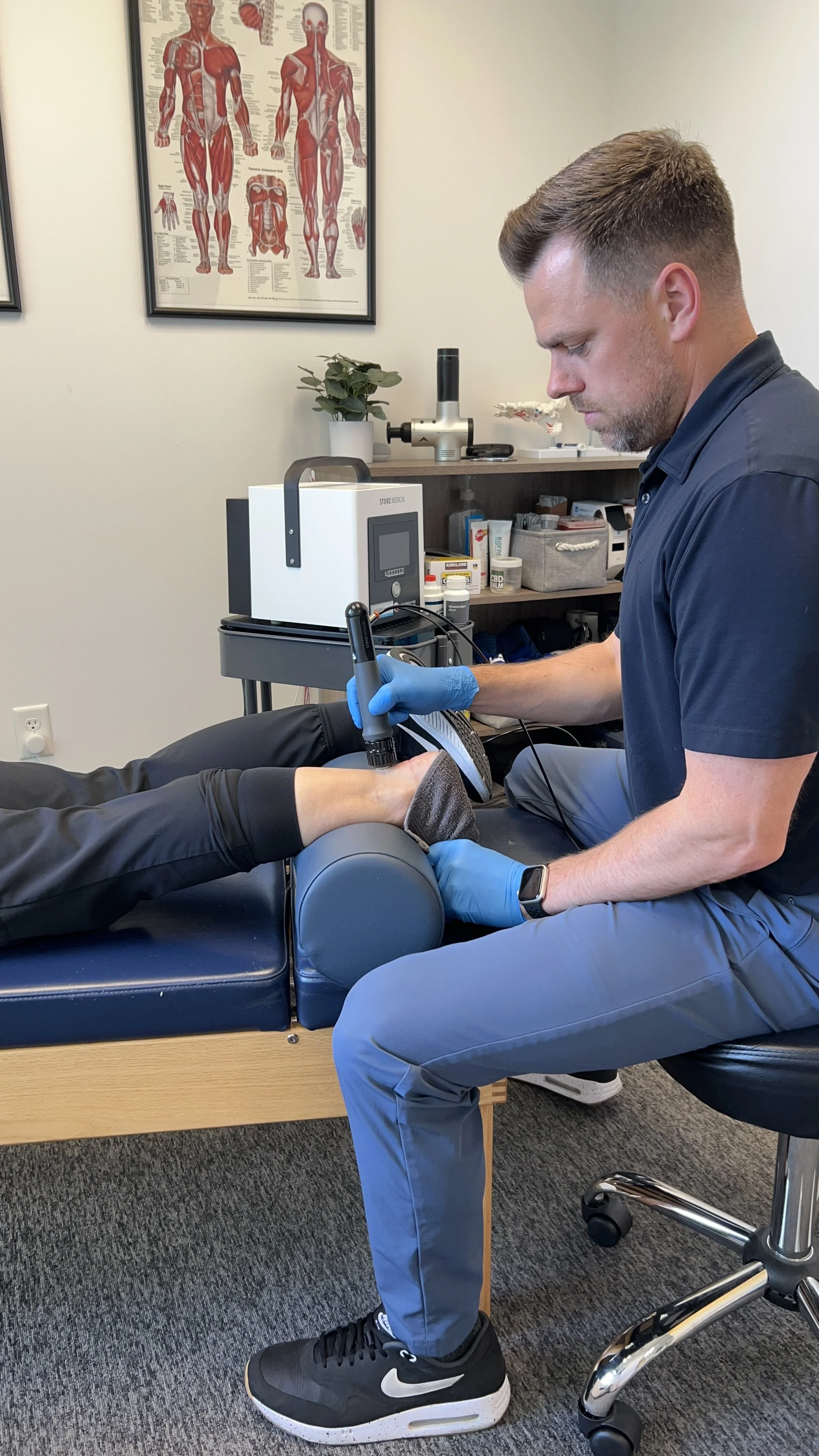
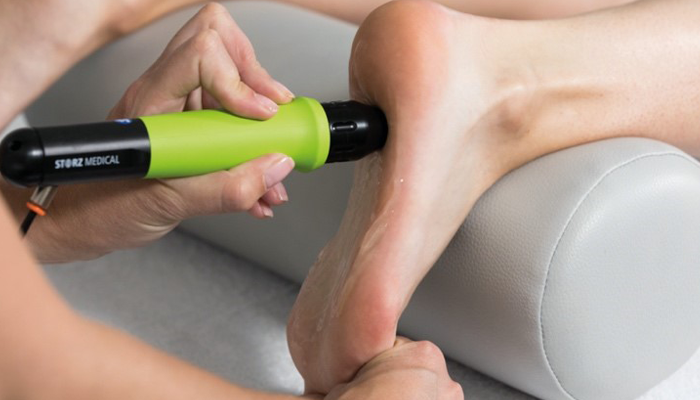
Soft Tissue: As we have reviewed the anatomy, we know that there is significant muscle ‘issues’ involved in runner’s knee. For this reason, this is where we start. How to decrease the tension and abnormal pull from muscles so that the patella tracks correctly and decreases joint wear is one part of the puzzle. There are numerous ways to achieve this and in our clinic, we find Dry Needling, Shockwave Therapy, IASTM - instrument-assisted soft tissue mobilization, and cupping therapies to provide the best, and quickest, results.
Joint Mobility & Stability: After the soft tissue is addressed, we look at the structure. As discussed in our second article, the mobility of the hip and ankle are vital to correcting and relieving runner’s knee pain. Manipulation is designed to restore normal motion to a joint that is currently not moving properly. Over time, restored joint motion can improve running mechanics and decrease strain and stress placed on the surrounding muscles.
Rehabilitation Exercise: Lastly, once we have the muscles and joints under control, a building back up must occur in two ways. One, we must create stability and control of the joint through muscle strength. Two, training volume must begin to ramp up, slowly and controlled, which we discussed in the third article of this series. To further address part one, rehabilitation exercises need to be explained and directed.
Below is a basic 3-phase rehabilitation program aimed at relieving patellofemoral pain while helping to rebuild strength and prevent future occurrences.
Phase 1: During the first phase of care, our exercise prescription is aimed at pain relief and improved mobility. These exercises should be performed 3-5 times per week, preferably as part of your running warm-up if we are able to continue training through care. We start with 1 set of 10 reps for each exercise and 30 seconds for the wall sit, working up to 2 sets over the course of this phase of care, which is typically 2-4 weeks.
Phase 2: The second phase of care focuses on returning to your full running volume while building strength and stability. We expect to perform these exercises 3-5 times per week again, preferably before running, but we will start with 1 set of 15 for each exercise and a 45-second hold for the wall sit. Over the 2-4 weeks of this phase, we will work up to 2 sets of each exercise.
Phase 3: The third phase focuses on strength and injury prevention. At this time, we move to self-care as the patient is released from active care. Our goal is to perform 2-3 sets of 10-15 reps for each exercise as a warm-up before each and every run.
RETURN TO RUNNING
Once we work through care and training is gradually ramping back up, or you have been consistent with home care, how do you know you are ready to return to full, unrestricted running? To help determine whether you can get back out there and get after it, we use our return-to-running assessment. Our goal here is to complete all five exercises without pain. In this assessment, each exercise must be completed for 60 seconds, with as many repetitions as possible.
Finally, we have covered more information than you could ever want to know about runner’s knee - patellofemoral pain syndrome. Hopefully this has been enough information to keep you out of our office, but... runners have many other issues and injuries to face, and Runner's Knee is but one of them. Until next time...
Train Smart, Recover Well, Race Great!
-Dr. Reheisse
Dr. Reheisse is a Board-Certified Chiropractic Sports Physician practicing in Murray, Utah. Revive Sport & Spine provides evidence-supported chiropractic care and conservative sports injury management.

Runner's Knee Part 3: Training Modification & Self-Care
Over the last two weeks, we have discussed the ins and outs of what Patellofemoral Pain Syndrome is, the anatomy involved, how adjacent joints (hip and ankle) can lead to maltracking issues, and why runner’s are specifically susceptible to this common overuse injury. You can read Part 1 & Part 2 here.
Now it’s time to talk self-treatment and training modification. Our goal is to maintain training (load) if possible when you find Runner’s Knee settling in, but more times than not, rest and self-care is needed while also modifying our training volume and intensity until symptoms recede.
Over the last two weeks, we have discussed the ins and outs of Runner’s Knee - Patellofemoral Pain Syndrome, the anatomy involved, how adjacent joints (hip and ankle) can contribute to maltracking, and why runners are particularly susceptible to this common overuse injury. You can read Part 1 & Part 2 here.
Now it’s time to talk about self-treatment and training modification. Our goal is to maintain training (load) if possible when you find Runner’s Knee settling in, but more often than not, rest and self-care are needed while also modifying our training volume and intensity until symptoms recede.
TRAINING MODIFICATION FOR RUNNER'S KNEE
Let's get the big one out of the way first! One of the reasons many runners try to avoid visits to a doctor’s office about one pain or another is the fear that the physician will tell them to stop running. Depending on the injury, how long it has been ongoing, current severity, and other factors, some runners are able to continue training during treatment and rehab, albeit in modified form.
Without getting too technical, we first need to understand the concept of 'load' and how it changes when we are injured. As runners, we have a specific language, so I am going to explain it in those terms. When our training is on and we are injury-free and fit, long runs, speed work, tempo runs, and intervals go well and help us improve. The load on the knee (and other joints) is well managed, and there is ample time to recover. Now, let's say you decide to sign up for a race that is in 6 weeks, and your training base is less than optimal. In hopes of having a good race, you ramp up quickly, doing hard days back-to-back, pushing it to your goal race pace for a good portion of your long run, etc., and now...BOOM, knee pain! What has happened here is that you exceeded the load threshold your body can handle and recover from.
For an interesting read, look into Scott Dyes work. This is what is commonly referred to the ‘envelope of function’ in the coaching and physician world.
Jumping back in...now that we are injured, our load threshold is lower. This is why a 5-mile run is painful halfway through when just 2 weeks ago, you were cruising through 10 miles with a few pickups. If you continue down this path, patellofemoral pain can become so severe that just getting out of bed and navigating stairs is difficult. When we encounter a runner in this position, we need to sit down and talk about a training plan, race expectations, and our long-term goals.
While it is never our goal to shut a runner down in the middle of a training cycle, the athlete's long-term health and ability are top of mind. Because of this, when discussing training, we tend to cover three things.
Can we gradually ramp up training while continuing to respond to treatment?
When we begin treatment, we have to start with a baseline. That may be 2 miles, 5 miles, or No miles before the pain sets in. That is our starting spot. As we follow-through with the suggested treatment plan, this load threshold must also go up. Rarely does pain go from 100 to 0, meaning, the pain goes from beginning at mile 2, then mile 4, then we find ourselves back up to 8-10 miles with no pain. This is the progress we look for.
Initial volume should decrease by 50% for the first 2 weeks.
If you are coming to us for knee pain, make a conscious effort to dial it back for a few weeks. This allows you to keep training, but also a little more rest than normal while we get through the first few treatment session.
Intensity, or pain-provoking runs, need to take a full break until volume can increase without pain.
With runner’s knee, we find that the harder, hillier efforts cause the most problems. While we want to maintain load on the knee while we treat, easy runs are the plan for the first few weeks. Looking at what we just talked about with gradually ramping up, we need to make sure you can handle a good distance without pain before we start pounding out the speed-work and hill repeats. And this goes for downhill too!
SELF TREATMENT OPTIONS FOR RUNNER'S KNEE
Now that we have discussed training modification, what can you start doing at home to help with Runner’s Knee? Honestly, you should be doing all of this already, but pain is a much better reminder to break out the foam roller than a good run. Your relationship with your foam roller needs to be strong. Your diet needs to be on point. Your bedtime needs to be early. Lastly, you need to realize that weight training is your friend.
Let's discuss a few of the easiest and most common self-treatment options.
Foam Rolling:
I don’t need to further detail my love for foam rolling over stretch or the benefits that regular foam rolling can provide for a runner. As we address runner’s knee, rolling needs to be frequent, short bursts throughout the day. Meaning, roll the quadriceps, hamstrings, and posterior hip muscles 3-5 times per day. Again, these are short 2-3 minute sessions. 10-15 rolls up and down over each area. Check the video!
Hip Mobility Drills:
As runner’s, our knee functions is highly influenced and controlled by what is happening at the hip. If your hip range of motion is limited, this will eventually show up at the knee. Check the video!
Ankle Mobility Exercises:
As a practitioner, I’m typically a ‘ground-up’ person when it comes to runners. While the hip controls the show, if the ankle does not move properly, it can not react properly or efficiently when the foot hits the ground causing problems up the chain. Studies show that just a few degrees difference between ankles is a good indicator of future injury. Work on your ankle mobility - Check the video!
This is a bit controversial. As you will hear me say in the demonstration below, the effect of taping is hard to prove. Don’t get me wrong, I love taping, in the short-term. It is by no means a long term fix for any injury! With that, you can also find 500 runners at the upcoming Big Cottonwood Marathon or the St. George Marathon that have their knees, shins, hips, and ankles taped that will absolutely swear by it. With all of that, I just don’t have solid evidence that proves any of that...but placebo is a powerful tool and I do appreciate taping as a means to help someone recovery and cue good movement patterns. If anything, the tape is a visible reminder to roll, stretch, and rest more. Check the video!
Body-Mass Index:
BMI has to be briefly discussed her because whatever weight we are carrying around affects our knees! Remember from the part of this series we mentioned that during running, the knee takes on 5-6 x’s your body weight during each step. While many people us running for weight loss, and other avoid it due to weight, the fact is, those with knee pain will benefit from weight loss if they are in the higher BMI category. I am not a dietician, we do not push weight-loss in our office, and I can’t tell you how many ‘Clydesdales’ category runners that can kick my tail in a race. Health is more than just pounds, but Runner’s Knee can be helped by a better BMI.
Psychosocial Influences:
Lastly, psychosocial factors. Runner’s are among the worst when it comes to injuries and the doom and gloom that comes with it. Some are severe enough that I have referred out to a professional for guidance. This is not something to be ashamed of and can actually help your recovery and performance. We now understand pain a bit better than we did 20 years ago, we still have a long way to go, but we know one thing to be true, if you do not think you will get better, you won’t. You have to buy into the plan, think positive, take the little wins, and know that this will not last forever. Any injury will last longer than we want it to, but you have to realize that by pure running statistics, you will get hurt at some time if you are training consistently, but it will also pass.
Hopefully, this article cleared up a few things regarding your training and the ability to continue through treatment, as well as a few ways to care for Runner’s Knee yourself. Ideally, you can manage this yourself, learn from it, and prevent it from recurring. As runners, we are prone to injury; that is just the way it is. But, we want to make sure you have the necessary knowledge and tools to help yourself before you give up, stop running, and then drag yourself into a sports physician's office.
LET'S REVIEW TODAY’S INFORMATION
When faced with Runner's Knee, training modifications are a must. We typically cut the training volume by 50% and avoid intense workouts (intervals, hills, tempo) for the first 2 weeks.
Self-care is a must. It not only helps speed your recovery over your treatment plan, but it can also help prevent future injury.
Self-care can be as simple as foam rolling a few times per day or running specific mobility, stability, and strength exercises.
Stay tuned for part 4 of our runner’s knee series, where we will discuss when to seek treatment and how we treat Runner’s Knee in our office, as well as a few examples of our suggested rehabilitation exercises.
Train smart, recover well, race great!
Dr. Reheisse is a Board Certified Chiropractic Sports Physician practicing in Murray, Utah. Revive Sport & Spine provides evidence-supported chiropractic care and conservative sports injury management.

Runner's Knee Part 2: Hip & Ankle Mobility - How It Relates To Patellofemoral Pain Syndrome
In part 1 of our runner’s knee series, we discussed the specific anatomy involved, how and why we experience pain over/in the front of the knee, and most importantly, how running, and specifically downhill running, can hasten your onset of patellofemoral pain syndrome. ->Read Part 1 Here <-
Today, in part 2, we are going to move away from the knee and look at the friendly joints above and below. As we know, and you will soon find out, the hip and the ankle are in control of the knee and more times than not, pain at the knee is caused by faulty mechanics, immobility, or strength and stability deficiencies at either or both of these joints. Read on!
In part 1 of our runner’s knee series, we discussed the specific anatomy involved, how and why we experience pain over/in the front of the knee, and most importantly, how running, and specifically downhill running, can hasten the onset of patellofemoral pain syndrome. ->Read Part 1 Here <-
Today, in part 2, we are going to move away from the knee and look at the friendly joints above and below. As we know, and you will soon find out, the hip and the ankle are in control of the knee, and more often than not, pain at the knee is caused by faulty mechanics, immobility, or strength and stability deficiencies at either or both of these joints. Read on!
HIP FUNCTION IN RUNNING AND ITS RELATION TO KNEE PAIN
So that we have a starting point, we are going to travel from the hip down. Mainly because it is more commonly the culprit of running-associated knee pain (my own clinical experience), but also because it is the bigger joint with more opportunity for complications.
To help explain how the hip acts on the knee, I commonly tell patients in the clinic that we have no ‘knee muscle’, but that everything controlling the knee comes from the hip. While this is not exactly true, we have some very important muscles, like the VMO and popliteus, that act strongly on the knee without originating from the hip. Hopefully, you can read through that and see my point here. Control at the knee is primarily governed by the hip.
When we encounter a runner with patellofemoral pain, we will ‘treat’ the knee… but the majority of our work is spent on improving hip mobility, strength, and stability. We find that issues here can lead to compensations, deficiencies, and imbalances that contribute to Runner’s Knee.
IT band tightness pulls on the patella causing it to track laterally, or to the outside.
Hip tightness can cause an anterior pelvic stance. This can inhibit and tighten the hamstrings causing an altered gait that is ‘quad heavy’. This tilt and tightening can lead to altered mechanics at the knee and also lead to patellofemoral pain.
Hip drop due to a weakness of the glute muscles can lead to what we are now calling the Miserable Malalignment Syndrome.
Let's talk about that last one for a minute as this is becoming more and more common in running associated knee pain. Miserable Malalignment Syndrome is the name now given to the cascading breakdown when the hip and ankle fail. Essentially, when our foot is planted, the glute medius muscle of the foot planted holds our pelvis level. When this weakens, the hip drops, causing the other side to respond. This response causes an inward rotation of the femur bone, an outward rotation of the tibia (shin bone) in an attempt to compensate, and lastly, a turning out of the foot resulting in a crashing in of the inside of the foot.
Guess which joint is in the middle taking all of that rotation torque?
I explain this in the video and picture below. Now, this condition got its name, not necessarily for runners, but for those who sit too much and exhibit the same pattern, but it fits here. If anything, this helps explain how important our hip mobility and strength is to the health of our knees. If you remember, as runners, we load the knee with 5-6 times our body weight with each and every step. Rotation in a joint NOT designed for rotation is destined to cause problems.
ANKLE FUNCTION IN RUNNING AND ITS RELATION TO KNEE PAIN

Now that we better understand the hip and its relation to knee pain, let's travel down the road a little to the ankle joint. Without getting into the kinematics of the ankle and the joints that make up this complex area of the body, let's just try to understand one thing...DORSIFLEXION.
Dorsiflexion is your ability to bring the top of your foot toward your shin. When we run, dorsiflexion allows us to strike the ground, react, and toe-off properly, pushing from our big and second toes. To help understand this, lets picture what poor dorsiflexion looks like. The next time you are walking around, look for someone who walks with their feet turned outward. What is usually happening here is that their hip tightness causes their posterior hip muscles (glutes, piriformis, etc.) to pull on the femur, resulting in an outward turned leg and foot. And...Unless they rode in on a horse, they are not walking with their kneecaps over their feet in this position which leads us to what we just discussed, the foot crashes inward, the kneecap points a different direction of the foot, and we now have pain. You can now imagine that there is no way this person is walking properly, meaning they are not actually toeing off correctly, but the inside of their foot, now...IMAGINE THIS PERSON RUNNING.
You may have realized that poor ankle dorsiflexion and the lack of hip mobility and stability can cause the same problem. The truth is, they tend to run together. While we will always treat any and all problems presented to us, it is my job to find the key that unlocks the whole system and more times than not, it is the hips!

TIME TO REVIEW WHAT WE LEARNED TODAY
Most of the muscular control of the knee comes from the hip. Lack of mobility and strength here can contribute to patellofemoral pain syndrome.
Lack of ankle dorsiflexion (the ability to bring the foot toward the shin) can cause outward rotation of the foot and undue rotational strain on the knee.
Issues at the hip and knee can lead to what we are now calling the Miserable Malalignment Syndrome. Essentially, when we run, our hips drop, causing an inward rotation of the femur, a counter-outward rotation of the shin bone, turning out of the foot, and caving in of the inner foot, leaving the stress on the knee.
To properly address runner’s knee, we must address these deficiencies at the hip and ankle.
Once you have digested the information we discussed in these last two articles, keep your eyes peeled for part 3 next week, as we will begin discussing what to do if you already have patellofemoral pain and when you should seek care so you can continue, or return to, training.
Dr. Reheisse is a Board-Certified Chiropractic Sports Physician practicing in Murray, Utah. Revive Sport & Spine provides evidence-supported chiropractic care and conservative sports injury management.