
By now you know the theme of this series: knee osteoarthritis (OA) is a whole-joint condition, and the goal of care is to restore the joint’s capacity to move and load comfortably. Hands-on care plays an important role, especially early on, by calming pain and stiffness enough that you can move, strengthen, and get back to the things you value. At Revive Sport & Spine in Murray, UT, three tools feature prominently in our management of knee OA: soft-tissue therapy, joint manipulation and mobilization, and shockwave therapy. Here’s what each does and what the research says.
Soft Tissue Therapy for Knee Osteoarthritis
An arthritic knee rarely hurts in isolation. The muscles and connective tissue that cross the joint (the quadriceps, hamstrings, calf, and the iliotibial band and hip muscles above) often become tight, guarded, and tender as the body protects a sore and irritated joint. That protective tension changes how the knee tracks and loads, and it can become a source of pain in its own right.
Soft tissue therapy, including targeted muscle release techniques, instrument-assisted work, and myofascial techniques, aims to reduce muscular guarding, improve tissue mobility, and reduce pain sensitivity, allowing the joint to move more freely. Soft tissue approaches have been shown to improve pain and function in knee OA and are low-risk.4 We use soft tissue work not as a stand-alone ‘fix’ but as a way to make movement and loading more comfortable, which sets up everything else we do.
Joint Manipulation and Mobilization for Knee Osteoarthritis
Osteoarthritic knees frequently feel stiff and restricted, and that restriction isn’t only in the main hinge of the knee; it often involves the kneecap, the small tibiofibular joint, and the neighboring hip and ankle. Skilled joint manipulation and mobilization apply controlled, specific movement to these joints to restore glide, reduce stiffness, and improve range of motion.
The evidence here is encouraging, particularly when manual therapy is combined with exercise. A systematic review with meta-analysis found that adding manual therapy to an exercise program produced greater improvements in pain and function for people with knee or hip OA than exercise alone. 1 Broader overviews conclude that manual therapy for the knee is generally clinically effective and safe, while noting that the quality of individual studies varies, a good reason to use it as one part of a comprehensive plan rather than the whole plan. 2 In practice, we use manipulation and mobilization to open up comfortable movement quickly, then reinforce those gains with rehab so they last.
Shockwave therapy for Knee Osteoarthritis
Extracorporeal shockwave therapy (ESWT) delivers focused acoustic pressure waves to the tissues around the knee. It is thought to work by stimulating local blood flow, modulating pain signaling, and encouraging the body’s tissue-repair responses. It is non-invasive, performed in the office in a few minutes, and requires no medication or downtime.
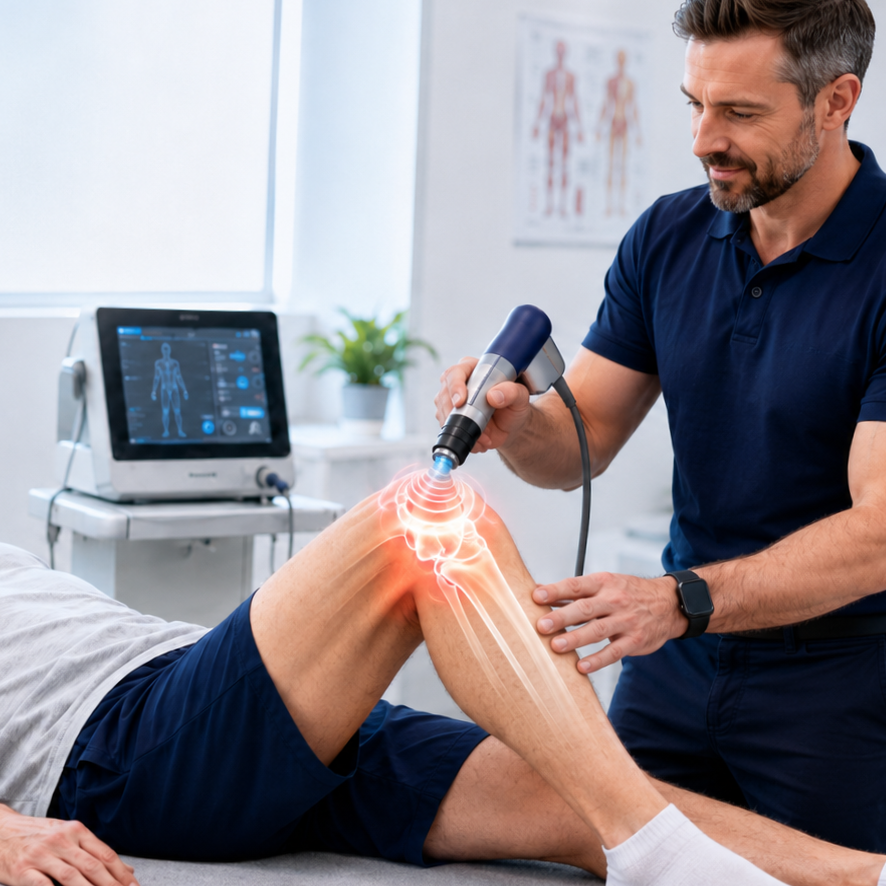
The research on shockwave for knee OA is genuinely promising. A systematic review and meta-analysis of randomized trials found that ESWT significantly improved pain and function in people with knee osteoarthritis, with an average pain reduction on the VAS scale, meaningful improvements in WOMAC function scores, and better range of motion, all with few minor side effects. 3 The strongest effects were seen in the short to medium term, which fits how we use it: as a way to reduce pain enough that you can engage fully in strengthening and return to activity.
Best Knee OA Treatment: Why We Combine These and Always Add Exercise
Each of these tools can reduce pain and improve movement, but none of them, on their own, rebuilds the strength and capacity an arthritic knee needs for the long haul. That’s why we treat them as a bridge. Soft tissue therapy, joint manipulation, and shockwave therapy calm the joint and restore comfortable motion; exercise rehab then builds the durable strength and control that keep symptoms down and help reduce future flare-ups. International guidelines are clear that active, exercise-based management belongs at the center of knee OA care, with hands-on modalities as valuable supporting players. 5
This combination of treatment modalities to relieve, restore, and rebuild is the backbone of how we approach knee osteoarthritis at Revive Sport & Spine. In Part 4, the final article in this series, we get specific about the exercise rehab that manages the condition long-term and keeps you doing what you love.
Key Takeaways Before We Progress to Part 4
✓ Our in-clinic care targets the painful, sensitized tissues around an arthritic knee to restore comfortable movement.
✓ Adding manual therapy to exercise improves pain and function more than exercise alone for knee OA. 1
✓ Manual therapy for the knee appears clinically effective and safe, though study quality varies, which is why we pair it with exercise. 2
✓ Shockwave therapy can improve pain, function, and range of motion in knee OA in the short term with few side effects. 3
✓ These hands-on tools work best as a bridge into the active rehab plan covered in Part 4.
Ready to get your knee moving with less pain? We’ll assess your knee, explain which of these tools fit your situation, and combine them with a rehab plan built around your goals. Stop waiting for the pain to just ‘go away’; schedule your appointment today
Frequently Asked Questions About Knee Osteoarthritis
Can a chiropractor help with knee osteoarthritis?
Yes. Sports chiropractic care for knee OA typically combines soft tissue therapy, joint manipulation and mobilization, and often shockwave therapy, all paired with exercise rehab. Adding hands-on manual therapy to exercise improves pain and function more than exercise alone. 1
Does shockwave therapy work for knee arthritis?
Evidence from randomized trials shows that extracorporeal shockwave therapy can significantly reduce pain and improve function and range of motion in knee osteoarthritis in the short- to medium-term, with few minor side effects. 3 It works best combined with a strengthening program.
Is joint manipulation safe for an arthritic knee?
Manual therapy, including joint manipulation for the knee, is considered generally safe and clinically effective, especially when combined with exercise. We tailor the techniques to your comfort and stage of osteoarthritis. 1 2
How is soft tissue therapy helpful if the problem is the joint?
An arthritic knee is guarded by tight, tender muscles and connective tissue that increase pain and alter how the joint loads. Soft tissue therapy reduces that guarding and sensitivity, making movement and strengthening more comfortable. 4
Will these treatments cure my osteoarthritis?
No treatment reverses established osteoarthritis, but this combination can substantially reduce pain, improve function, and, alongside exercise, help you manage the condition and prevent flare-ups long term. 5
REFERENCES
1. Anwer S, et al. The Benefits of Adding Manual Therapy to Exercise Therapy for Improving Pain and Function in Patients With Knee or Hip Osteoarthritis: A Systematic Review With Meta-analysis. JOSPT. 2022. https://www.jospt.org/doi/10.2519/jospt.2022.11062
2. Feng Q, et al. Effectiveness and safety of manual therapy for knee osteoarthritis: An overview of systematic reviews and meta-analyses. Frontiers in Public Health. 2023;11:1081238. https://www.frontiersin.org/journals/public-health/articles/10.3389/fpubh.2023.1081238/full
3. Avendaño-Coy J, et al. Extracorporeal shockwave therapy improves pain and function in subjects with knee osteoarthritis: A systematic review and meta-analysis of randomized clinical trials. International Journal of Surgery. 2020;82:64-75. https://pubmed.ncbi.nlm.nih.gov/32798759/
4. Xu Y, et al. The Efficacy of Manual Therapy in Patients with Knee Osteoarthritis: A Systematic Review. Medicina (Kaunas). 2021;57(7):696. https://pmc.ncbi.nlm.nih.gov/articles/PMC8304320/
5. Bannuru RR, et al. OARSI guidelines for the non-surgical management of knee, hip, and polyarticular osteoarthritis. Osteoarthritis and Cartilage. 2019;27(11):1578-1589. https://pubmed.ncbi.nlm.nih.gov/31278997/