
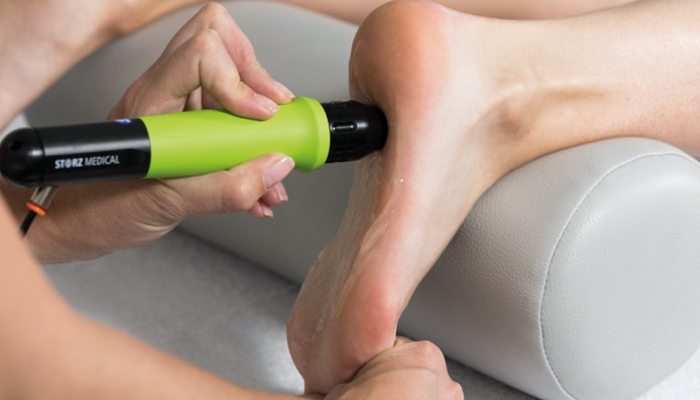
If you have been dealing with stubborn heel pain, Achilles pain, tendon pain, or a nagging sports injury that will not fully calm down, shockwave therapy may be a helpful option. At Revive Sport & Spine in Murray, Utah, we use shockwave therapy as part of a conservative, evidence-informed treatment plan to help active people recover from chronic soft tissue injuries and get back to the things they enjoy.
Shockwave therapy is not an adjustment, massage, or injection. It is a non-invasive treatment that uses acoustic pressure waves to stimulate a healing response in irritated or injured tissue. For many patients in Murray, Salt Lake City, Holladay, Midvale, Sandy, Cottonwood Heights, and Millcreek, shockwave therapy can be a helpful tool when pain has been hanging around for weeks or months despite rest, stretching, or basic rehab.
What Is Shockwave Therapy?
Shockwave therapy, also called extracorporeal shockwave therapy (ESWT) or acoustic wave therapy, is a non-invasive treatment that uses high-intensity sound waves to stimulate the body's natural healing process. It was originally developed to break up kidney stones, but decades of research have shown it is highly effective for treating chronic musculoskeletal pain.
Despite the name, shockwave therapy does not involve electrical shocks. The treatment sends mechanical pulses into the targeted tissue. These pulses create a controlled stimulus that may help improve blood flow, reduce pain sensitivity, and encourage tissue remodeling. ‘Extracorporeal’ simply means that the treatment is applied from outside the body.
Unlike medications that mask symptoms or surgery that requires weeks of recovery, shockwave therapy triggers a biological repair response in the injured tissue itself. It is widely used in sports medicine and orthopedic care and is supported by strong clinical evidence for conditions such as plantar fasciitis, Achilles tendinopathy, golfer’s and tennis elbow, runner’s knee, knee pain from osteoarthritis, and rotator cuff tendinopathy.
At Revive Sport & Spine in Murray, Utah, we use shockwave therapy as a cornerstone of our active recovery approach, helping runners, hikers, golfers, and everyday active people get back to what they love without relying on painkillers or unnecessary invasive procedures.
How Does Shockwave Therapy Work?
Many chronic tendon and soft tissue injuries are not simply “inflamed.” Often, they involve poor tissue tolerance, reduced healing response, and sensitivity that builds over time. This is common with injuries like plantar fasciitis, Achilles tendinopathy, patellar tendinopathy, and tennis elbow.
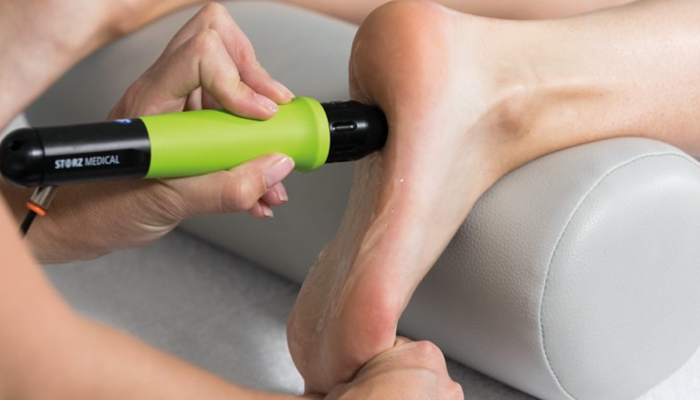
Shockwave therapy works by delivering controlled acoustic pulses through a handheld transducer into the injured area. A conductive gel is applied to the skin, and the device sends targeted sound waves that travel through the skin and soft tissue to reach the damaged tendon, fascia, or muscle. The mechanism of action is where the real science comes in. Here is what happens inside your body after a shockwave treatment:
1. Increased Blood Flow (Neovascularization)
The acoustic waves stimulate the formation of new blood vessels in the treated area. This process, called neovascularization, brings oxygen and nutrients to damaged tissues with poor blood supply, a key reason some tendon injuries fail to heal on their own. Research has shown that shockwave therapy enhances angiogenesis by activating VEGFR2, essentially signaling your body to build a new blood supply to the injury site.
2. Collagen Production and Tissue Remodeling
Shockwaves activate fibroblasts, the cells responsible for producing collagen. Over the weeks following treatment, your body works to reorganize disorganized scar tissue and lay down new, stronger collagen fibers in proper alignment. This is why shockwave therapy doesn't just reduce pain in the short term; it actually changes the tissue's structural integrity.
3. Pain Signal Disruption
Interestingly, many patients feel immediate pain relief after a session, even before the tissue has healed. This is due to something called the "analgesic effect," where the high-energy pulses temporarily disrupt pain signal transmission at the cellular level, giving patients relief while the deeper healing process gets underway.
4. Breakup of Calcific Deposits
For conditions like calcific tendinopathy of the shoulder, the acoustic energy can physically break up calcium deposits that have formed in the tendon, allowing the body to clear them naturally over time.
5. Anti-Inflammatory Modulation
Contrary to what you might expect, the initial response to shockwave therapy is actually pro-inflammatory. The treatment creates a controlled micro-trauma that restarts your body's healing process, recruiting immune cells, clearing out degenerated tissue, and signaling repair pathways. This is a key reason why you should NOT take anti-inflammatory medications in the 48 hours after treatment, as it would cut off the very process that the shockwave just activated.
Shockwave therapy works best when it is paired with the right rehab plan. The goal is not just to make the area feel better for a few days. The goal is to help the tissue become stronger, more resilient, and better prepared for running, lifting, walking, golf, hiking, or sports.
Conditions We Treat with Shockwave Therapy
Shockwave therapy is most effective for chronic tendon and soft tissue conditions, injuries that have been lingering for weeks or months and haven't responded to rest, stretching, or other conservative care. Here are some of the most common conditions we treat at our Murray, Utah, sports chiropractic clinic:
This is the condition with the strongest evidence base for shockwave therapy. Plantar fasciitis affects the thick band of tissue on the bottom of the foot and can be notoriously stubborn to treat. Multiple studies and meta-analyses show shockwave therapy produces significant pain reduction in patients with chronic plantar fasciitis, often after just 2-3 sessions.
Whether you are a runner logging 40-mile weeks or a weekend warrior, Achilles pain can derail your entire season. Shockwave therapy targets degenerated tissue in the mid-portion of the tendon and stimulates new collagen formation, with studies showing that 60-80% of patients achieve good-to-excellent results.
Tennis Elbow / Golfer's Elbow (Lateral and Medial Epicondylitis)
These common overuse injuries of the elbow respond well to shockwave therapy, particularly when the condition has been present for more than three months. Repeated studies have shown that shockwave therapy is more effective than corticosteroid injections for long-term outcomes in lateral epicondylitis.
Patellar Tendinopathy (Jumper's Knee) and Runner’s Knee
A common issue for basketball, volleyball, and running athletes. Shockwave therapy has shown strong results in published systematic reviews, particularly when combined with eccentric loading exercises.
Rotator Cuff Tendinopathy / Shoulder Impingement
For shoulder pain not caused by a full-thickness tear, shockwave therapy can reduce pain and improve function by stimulating repair of the rotator cuff muscles and tendons.
Shin Splints (Medial Tibial Stress Syndrome), IT Band Syndrome, and Hamstring Tendinopathy
All of these conditions benefit from the increased blood flow and tissue remodeling that shockwave therapy promotes.
Shockwave therapy is not always the right treatment option. Acute tears, fractures, infections, certain nerve conditions, blood clotting issues, pregnancy, and other medical conditions may require a different approach. That is why we always start with a proper evaluation before recommending shockwave therapy.
What to Expect During Shockwave Treatment: Timeline and Soreness
One of the most common questions patients ask is, "Will it hurt?" Here is an honest answer and a realistic timeline so you know exactly what to expect.
During Treatment
A typical session lasts 5 to 15 minutes, depending on the area being treated. The sensation varies; some patients describe it as a deep, tapping pressure, while others feel brief, sharp pulses. The intensity is adjustable, and we work with you to find a level that is both effective and tolerable. No anesthesia or pain medication is needed.
Immediate Aftermath (0 to 48 Hours)
Many patients experience immediate pain relief due to the analgesic effect of the acoustic waves. However, as that wears off (usually within a few hours), you may feel a dull ache or soreness in the treated area, similar to the feeling after a heavy workout. Some mild swelling and tenderness are normal.
Critical: do NOT take NSAIDs for at least 48 hours after treatment unless directed to do so by your primary medical provider. These medications interfere with the inflammatory healing cascade that the shockwave just activated. Similarly, avoid icing the treated area; ice constricts blood flow and can blunt the healing response.
Light activity is fine, but avoid high-impact exercise or heavy lifting for 48 hours to let the tissue settle.
Weeks 1 to 4: The Cumulative Effect
Most patients need a series of 4-12 sessions, spaced 7-10 days apart. Healing is rarely a straight line; you may feel better after one session, sore after the next, then better again. This fluctuation is normal. Research shows that approximately 80% of patients report significant pain reduction after their third session.
Each session builds on the last, progressively breaking down damaged tissue and stimulating the production of healthy new tissue.
3 Months: Maximal Recovery
Here is what many patients don't realize: while you may feel significantly better within the first month, the biological remodeling of the tendon or fascia continues for several months. The tissue is literally rebuilding itself at the cellular level. Maximal recovery, where the tissue has fully matured and strengthened, typically occurs around the 12-week mark.
This is why we always pair shockwave therapy with corrective exercises and a rehab plan. The treatment creates the healing environment; the exercises retrain the tissue to handle the loads you need it to handle.
Why Choose Revive Sport & Spine for Shockwave Therapy in Murray?
At Revive Sport & Spine in Murray, UT, we use shockwave therapy for runners, golfers, lifters, youth athletes, and active adults who want to stay moving without relying only on rest, medication, or repeated short-term fixes.
Our approach is simple: find the source of the problem, treat the irritated tissue, build a plan around your goals, and help you return to the activities you enjoy.
If you are in Murray, Salt Lake City, Holladay, Midvale, Sandy, Cottonwood Heights, or Millcreek and have been dealing with chronic heel pain, Achilles pain, tendon pain, or a sports injury that will not go away, shockwave therapy may be worth considering.
Call Revive Sport & Spine at 801-944-1855 or schedule an appointment online to see if shockwave therapy is a good fit for your injury and your goals.
SOURCES:
Frontiers in Cardiovascular Medicine. "Extracorporeal Cardiac Shock Wave Therapy Modulates Post-Infarction Neovascularization via CAC-Mediated Pro-Angiogenic Effects and Modulation of the S100A4/CSF2/FOXO1 Protein Network." 2026. https://www.frontiersin.org/journals/cardiovascular-medicine/articles/10.3389/fcvm.2026.1839337/full
Frontiers in Immunology. "The Effectiveness of Shockwave Therapy on Patellar Tendinopathy, Achilles Tendinopathy, and Plantar Fasciitis: A Systematic Review and Meta-Analysis." 2023. https://www.frontiersin.org/journals/immunology/articles/10.3389/fimmu.2023.1193835/full
Hatanaka, K., et al. "Molecular Mechanisms of the Angiogenic Effects of Low-Energy Shock Wave Therapy: Roles of Mechanotransduction." American Journal of Physiology-Cell Physiology, 2016. https://doi.org/10.1152/ajpcell.00152.2016
Huang, T.H., et al. "Shock Wave Therapy Enhances Angiogenesis through VEGFR2 Activation and Recycling." Molecular Medicine, vol. 22, 2016, pp. 850–862. https://pmc.ncbi.nlm.nih.gov/articles/PMC5263055/
Journal of Orthopaedic Surgery and Research. "Extracorporeal Shockwave Therapy in Musculoskeletal Disorders." vol. 7, no. 11, 2012. https://link.springer.com/article/10.1186/1749-799X-7-11
Materia Socio-Medica. "Effectiveness and Safety of Shockwave Therapy in Tendinopathies." vol. 30, no. 2, 2018, pp. 131–146. https://pmc.ncbi.nlm.nih.gov/articles/PMC6029898/
Molecular Medicine. "Extracorporeal Shock Wave Therapy Mechanisms in Musculoskeletal Regenerative Medicine." Journal of Clinical Orthopaedics and Trauma, vol. 11, Suppl. 3, 2020, pp. S309–S318. https://pmc.ncbi.nlm.nih.gov/articles/PMC7275282/
Biomedicines. "Use of the Shock Wave Therapy in Basic Research and Clinical Applications — From Bench to Bedside." vol. 10, no. 3, 2022, 568. https://pmc.ncbi.nlm.nih.gov/articles/PMC8944950/