
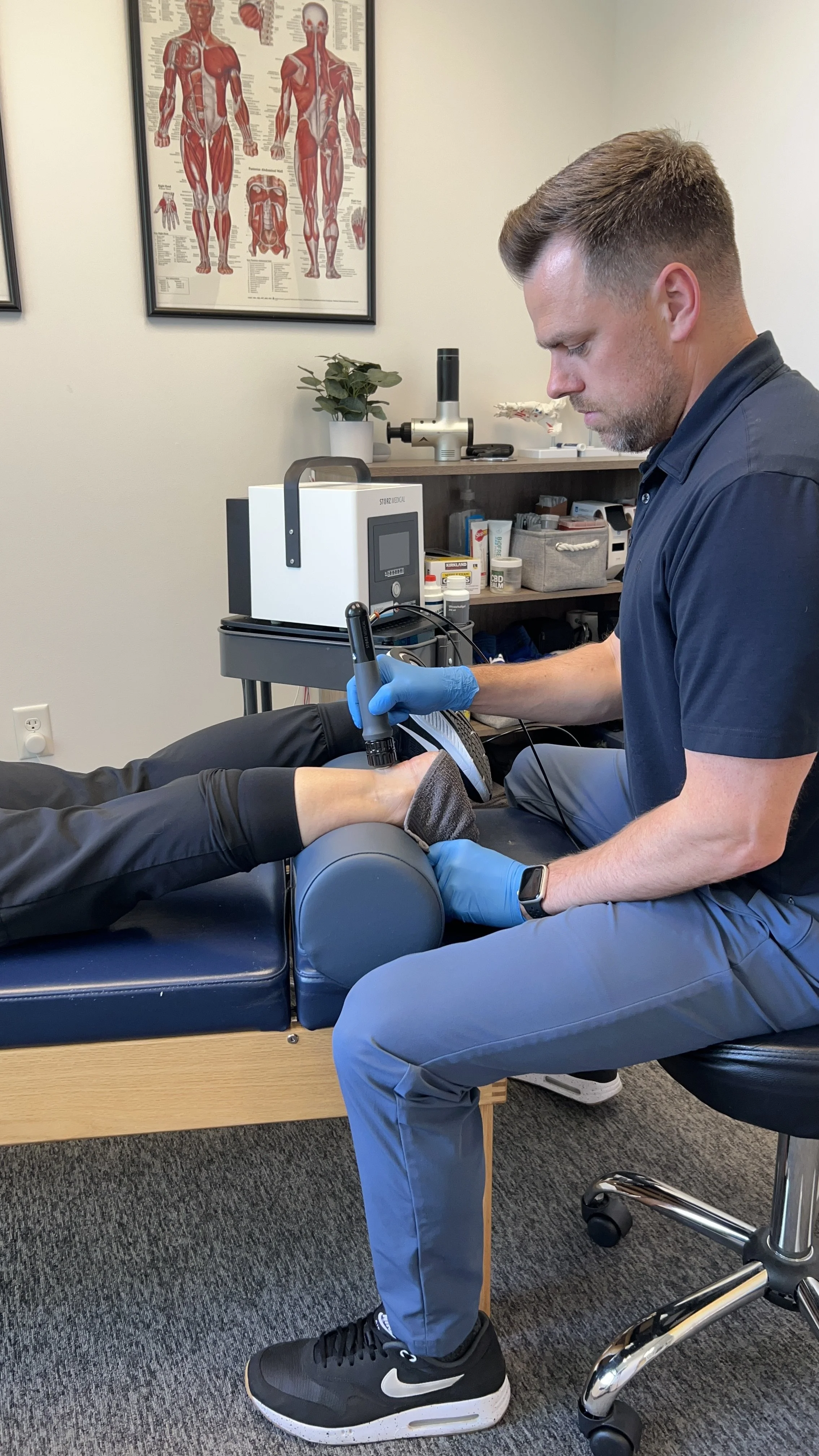
Persistent pain and stiffness in the back of your ankle can quietly derail your running, hiking, and training. Achilles tendinopathy is one of the most common overuse injuries in active adults, and it is notoriously slow to heal. The good news is that with the right combination of treatments, most people recover fully, and shockwave therapy to support exercise rehabilitation has become a central part of that plan.
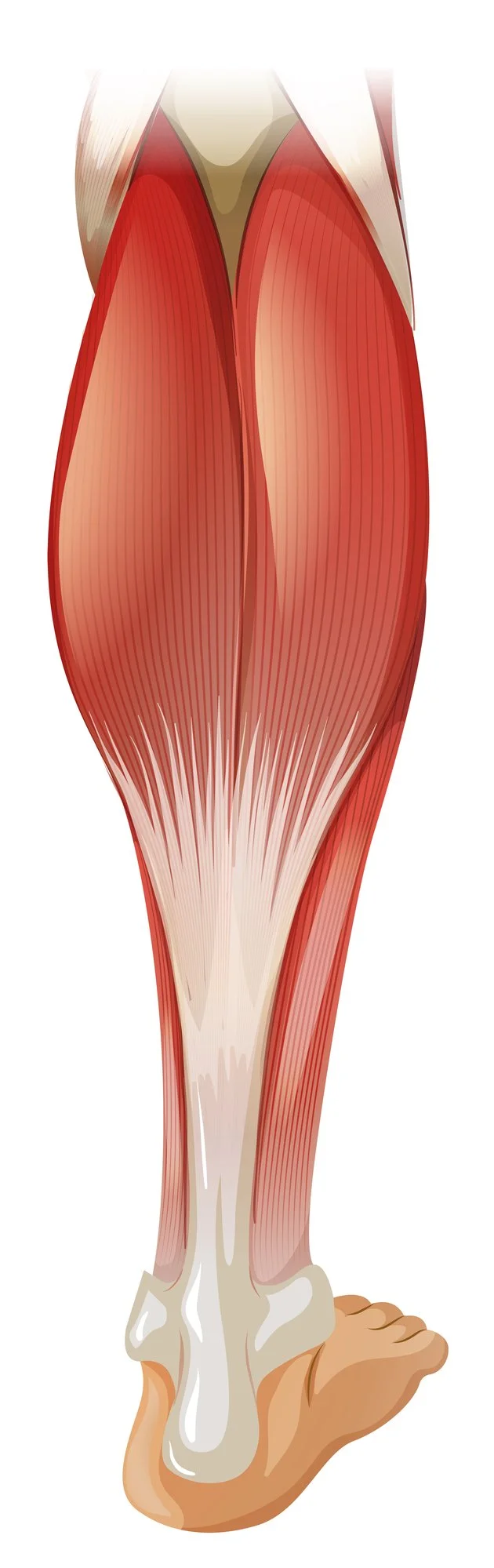
The Anatomy: What is the Achilles Tendon?
The Achilles tendon is the largest and strongest tendon in the human body. It connects your two calf muscles, the gastrocnemius and soleus, to your heel bone (calcaneus). Every time you push off to walk, run, or jump, the Achilles stores and releases enormous amounts of energy, acting like a spring. Clinicians divide Achilles tendinopathy into two types by location: midportion tendinopathy, which occurs a few centimeters above the heel, and insertional tendinopathy, which occurs right where the tendon meets the bone.
How Does Achilles Tendinopathy Occur?
Like other tendon overuse conditions, Achilles tendinopathy is primarily a degenerative process rather than simple inflammation. The tendon's collagen fibers become disorganized, small areas thicken, and the normal healing response falls behind the damage.
Achilles tendinopathy develops when the load placed on the tendon exceeds its capacity to adapt. Frequent culprits include rapid increases in running mileage or intensity, adding hills or speed work too quickly, tight or weak calf muscles, limited ankle flexibility, worn-out or improper footwear, and training on hard or uneven surfaces. Age-related decline in tendon elasticity and certain medications can also raise risk. Athletes in running, basketball, tennis, and soccer are especially prone.
How Achilles Tendinopathy Limits Your Favorite Activities
The condition usually starts with morning stiffness and mild pain that improves with activity, then worsens afterward. As it progresses, the pain lingers longer and starts to interfere with the push-off phase of your stride. Runners lose speed and distance. Hikers feel every step on the descent. Even walking up stairs or standing on your toes can become uncomfortable. Because the Achilles is central to nearly all lower-body movement, an unresolved case can force people to abandon their fitness routines entirely. A weak tendon is a sensitive and often painful tendon.
Why Shockwave Therapy, with Strength Rehab, Is a Leading Option
Extracorporeal shockwave therapy (ESWT) has become one of the most evidence-supported non-surgical treatments for chronic Achilles tendinopathy. ESWT delivers acoustic pressure waves into the tendon that stimulate blood flow, promote collagen synthesis and tissue remodeling, and reduce pain by modulating local nerve activity, essentially prompting a stalled tendon to resume healing.
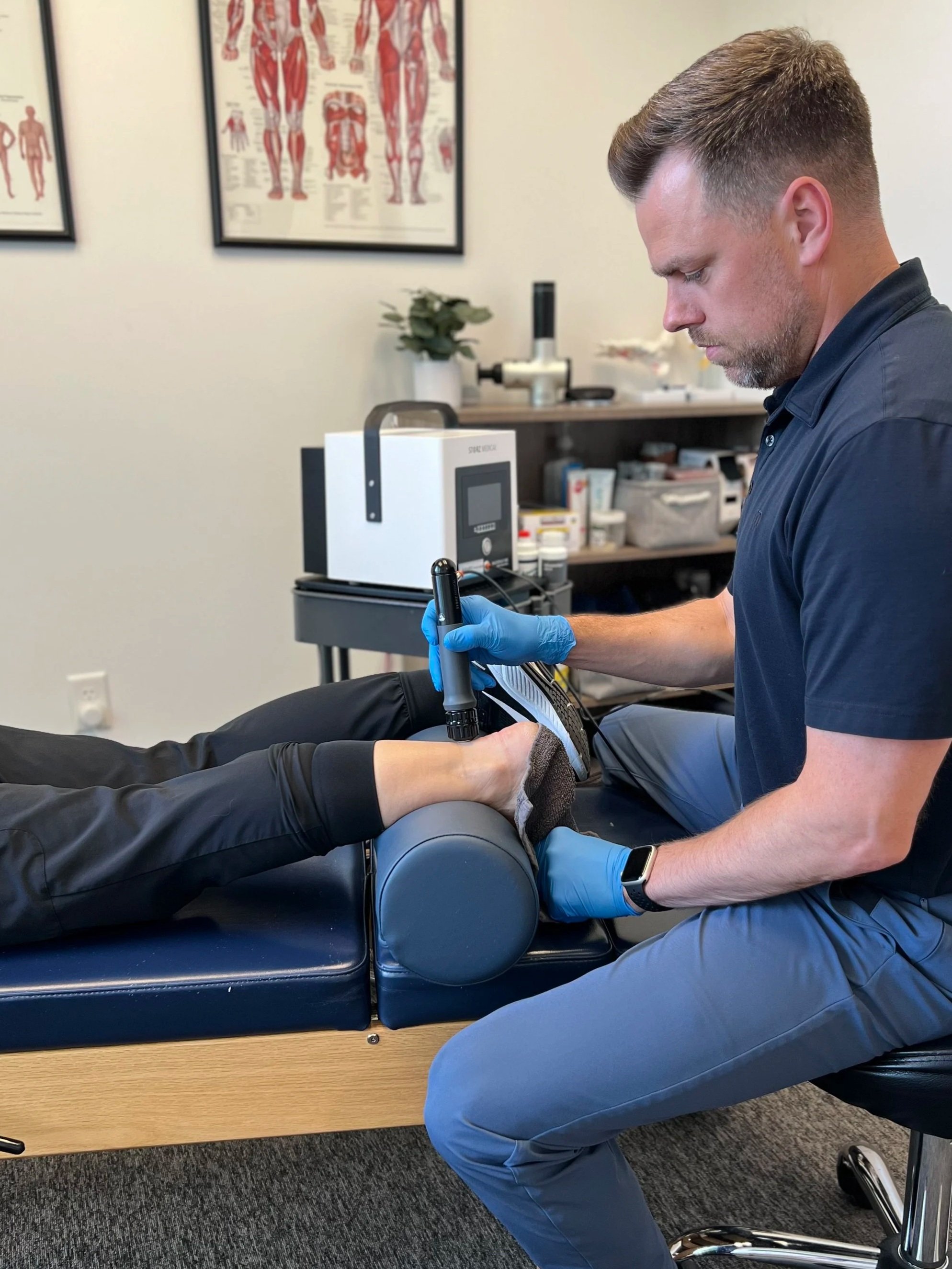
The research is compelling. In a landmark randomized controlled trial, Rompe and colleagues showed that adding shockwave therapy to an eccentric calf-strengthening program produced significantly better outcomes than eccentric exercise alone for midportion Achilles tendinopathy. [1] In a separate trial, the same group found shockwave therapy superior to eccentric loading for insertional Achilles tendinopathy, a form that responds poorly to exercise alone. [2] A third randomized trial confirmed that eccentric loading plus shockwave beat eccentric loading by itself for midportion cases. [3] Systematic reviews of the lower-limb tendinopathy literature reinforce these findings. [4] [5]
These studies point to a key principle: shockwave works best alongside a structured loading program, not instead of one. At Revive Sport & Spine, we pair ESWT with progressive calf loading (including eccentric and heavy slow resistance exercise), mobility work, and a gradual return-to-run plan. This combination supports both tendon healing and its long-term capacity to handle load.
What to Expect After Shockwave Therapy for Achilles Tendinopathy
Each shockwave session takes roughly 10 minutes with no anesthesia and no downtime. Most patients complete 8-10 sessions spaced about a week apart, with improvements continuing for weeks afterward as the tendon remodels. You may feel a firm tapping during treatment, and intensity can be dialed to your comfort. To support your body's healing cascade, try to limit OTC anti-inflammatory medications and icing for 48 hours after each session. Contact your PCP for any medical prescription concerns.
Key Takeaways
✓ The Achilles is the body's largest tendon, connecting your calf muscles to your heel and acting like a spring with every step.
✓ Achilles tendinopathy is a degenerative overload condition, not simple inflammation, and it comes in midportion and insertional forms.
✓ Adding shockwave therapy to a calf-loading program outperforms exercise alone for midportion tendinopathy. [1]
✓ Shockwave is especially valuable for insertional Achilles tendinopathy, which often resists exercise on its own. [2] [4]
Don't let Achilles pain shorten your runs or keep you from the activities you enjoy. Call Revive Sport & Spine at 801-944-1855 or schedule your appointment online. We are located at 1996 E 6400 S, Suite 260, in Murray, Utah, serving Salt Lake City, Holladay, Midvale, Sandy, Cottonwood Heights, Millcreek, and the greater Salt Lake Valley.
Frequently Asked Questions About Shockwave Therapy and Achilles Tendinopathy
How long does it take to feel better?
Many patients notice gradual improvement over 8 to 12 weeks. Tendons heal slowly, so consistency with your exercises is essential.
Does shockwave work for both types of Achilles tendinopathy?
Yes. Evidence supports ESWT for both midportion and insertional tendinopathy, and it is especially valuable for insertional cases that resist exercise alone. [2]
Will I have to stop training completely?
Usually not. We typically modify your activity rather than shut it down, keeping you moving while the tendon recovers.
What is the best exercise for Achilles tendinopathy?
There is no single best exercise for every Achilles injury. Most rehabilitation plans use progressive calf loading, beginning with an amount you can tolerate and advancing toward heavier single-leg raises and sport-specific work. The right progression depends on whether the problem is in the mid-portion of the tendon or at its attachment to the heel, your current strength, and your activity goals.
How often should I do Achilles tendon strengthening exercises?
The schedule depends on the exercise and your response, but you usually do strengthening consistently throughout the week rather than as a one-time effort. Start with a low volume and adjust as your symptoms, strength, and next-day response change. More exercise is not automatically better because the tendon needs enough recovery between challenging sessions.
Should I stretch my calf if I have Achilles tendinopathy?
Calf stretching may help some people, but it is not a replacement for progressive strengthening. For insertional Achilles pain, deep calf stretching can increase compression where the tendon attaches to the heel and may need to be modified. We typically recommend calf rolling over stretching.
Can I keep running while rehabbing Achilles tendinopathy?
Many people can keep running while rehabbing, but the amount will likely need to change. Reducing hills, speed work, mileage, or back-to-back running days can lower tendon load while strength improves. Pain during activity and the following morning should guide progression. A sudden increase in symptoms may indicate that training load is advancing too quickly.
How long does Achilles tendinopathy rehabilitation take?
Improvement often takes weeks to months, not a few days. The timeline depends on symptom duration, tendon location, strength deficits, training load, sleep, and consistency with the rehabilitation plan. Pain may improve before the tendon has regained full capacity, so returning to unrestricted sport should include strength and activity testing rather than pain relief alone.
Can shockwave therapy heal a torn Achilles tendon?
Shockwave therapy is not a substitute for evaluation and treatment of an acute Achilles tear or rupture. A suspected tear, sudden popping sensation, marked weakness, swelling, or difficulty pushing off requires prompt medical assessment. Shockwave may be considered for selected chronic tendinopathies after a diagnosis and treatment plan are established, but it is not appropriate for every tendon injury.
What is the difference between mid-portion and insertional Achilles tendinopathy?
Mid-portion Achilles tendinopathy usually affects the tendon a few centimeters above the heel, while insertional tendinopathy affects the area where the tendon attaches to the heel bone. The two conditions can require different exercise ranges and load-management strategies. For example, deep ankle dorsiflexion and aggressive calf stretching may be more irritating when symptoms are located at the tendon’s insertion. Insertional Achilles Tendinopathy typically takes twice as long to recover and return to unrestricted activity as mid-portion Achilles Tendinopathy.
REFERENCES
[1] Rompe JD, Nafe B, Furia JP, Maffulli N. Eccentric loading, shockwave treatment, or a wait-and-see policy for tendinopathy of the main body of tendo Achillis: a randomized controlled trial. The American Journal of Sports Medicine. 2007;35(3):374-383. https://pubmed.ncbi.nlm.nih.gov/17244902/
[2] Rompe JD, Furia J, Maffulli N. Eccentric loading compared with shock wave treatment for chronic insertional Achilles tendinopathy: a randomized, controlled trial. The Journal of Bone and Joint Surgery (American). 2008;90(1):52-61. https://pubmed.ncbi.nlm.nih.gov/18171957/
[3] Rompe JD, Furia J, Maffulli N. Eccentric loading versus eccentric loading plus shockwave treatment for midportion Achilles tendinopathy: a randomized controlled trial. The American Journal of Sports Medicine. 2009;37(3):463-470. https://journals.sagepub.com/doi/10.1177/0363546508326983
[4] Mani-Babu S, Morrissey D, Waugh C, Screen H, Barton C. The effectiveness of extracorporeal shock wave therapy in lower limb tendinopathy: a systematic review. The American Journal of Sports Medicine. 2015;43(3):752-761. https://pubmed.ncbi.nlm.nih.gov/24817008/
[5] Korakakis V, Whiteley R, Tzavara A, Malliaropoulos N. The effectiveness of extracorporeal shockwave therapy in common lower limb conditions: a systematic review including quantification of patient-rated pain reduction. British Journal of Sports Medicine. 2018;52(6):387-407. https://pubmed.ncbi.nlm.nih.gov/28954794/