THOUGHTS ON:
Training, Rehabilitation,
&
Best Care Practices

5 Areas To Develop Great Habits That Will Improve Your Health
With the continuation and exacerbated condition of the COVID-19 pandemic, this might be a challenging question to answer. You may feel physically well. Heck, you may even be one of the strong ones, unphased by the "stay home" orders and are socially and mentally doing well also.
Regardless of how you respond to the initial question, I have one response for you.
It is April 5th, 2020, and I have one question for you.
How are you?
With the continuation and exacerbated condition of the COVID-19 pandemic, this might be a challenging question to answer. You may feel physically well. Heck, you may even be one of the strong ones, unphased by the "stay home" orders and are socially and mentally doing well also.
Regardless of how you respond to the initial question, I have one response for you.
Developing healthy habits I hope!
Like every other email, letter, and news article I have read lately, let me start by saying that I genuinely hope that you are safe, well, and maintaining some sort of routine that allows some hint of normalcy.
Now that we have handled the essential "well-being" statement, I hope that you are using this time wisely.
If you think as I do, this will relate… I've always wondered how much I could get done if I were granted an unlimited amount of time. Could I get all of those projects done? Spend more time with my family? Learn a new skill? Improve my health and fitness? Grow stronger in the ways I see myself when not restricted by the finite resource of time?
That request has been granted, and I'm going to test the limits of my productivity. I urge you to do the same.
Below are the most important five areas in my life right now. I want to discuss ways we can improve in these areas, and I will share what I am individually working on during our 'down-time.' Until next time, stay safe, protect your family, and let's all come out of this with improved habits and as a better version of ourselves.
PHYSICAL HEALTH

The number one hurdle to improving your physical health is TIME. Since you have it, start a routine. Walk once per day. Make it fun and have challenges within your home or online. Commit to doing one thing each day that is positive for your physical health.
Our family's goal is to do something active after each meal. It may be a walk, basketball game, playing catch, or having a wall-sit/push-up/plank challenge.
I'm working up to running 5-6 days per week, typically in the morning, and strength training 3-4 times per week, usually at night. With the extra time, having 90-120 minutes each day to exercise is doable. Remember, once fitness is obtained, it is easier to maintain. Meaning, when we have to go back to the usual grind of work and life, exercising a few times each week will keep what you earn during this downtime.
FAMILY HEALTH
What has your kid's been begging you to do? Unless it is going to Disneyland, you have the time to do it. Take time each day to do what one of your kids wants to do, minimal restrictions. Their imagination might prove to be a refreshing break from our turbulent times.
We have committed to playing a family game every day. Right now, we are really into Ticket To Ride and Cover Your Assets.
PROFESSIONAL HEALTH

What work project, or side hustle, have you been dreaming about getting started, or finished, but just haven't had the time. Commit to it, and DO IT!
My big three to accomplish during this downtime are 1. Catch up on all of our blog posts and exercise videos. 2. Automate many of the technical processes in our office. 3. Update our website. Bonus: LEARN - Currently, I'm working through a strength and conditioning certification and a golf-specific stretch program.
MENTAL HEALTH
Improvements in mental health are hard and take chunks of time. Which is why many people don't work in this area of their well-being. We can meditate, read, journal, pray, explore nature, etc. What helps you be at ease? Do that!
I have committed to journaling 15-minutes each morning and ending my day with 30-minutes of reading something inspirational. Right now, I'm reading 'The Courage To Be Disliked.'
As a bonus, I'm learning the piano, but that may hinder my mental health progress. Ha!
SOCIAL HEALTH

Since we are supposed to be social distancing, though I will argue it is physical distancing, this area needs attention. We are human, and the only way we have survived this long and will continue to do so is by social interaction. We have unlimited technology, so find one person each day and call them, write to them, spend all day texting with them, just be sociable.
Outside of spending time with my family, I have committed to calling one friend each day. Using my journal as inspiration, which starts with gratitude, I'm writing one or two people each day. Maybe you will get a letter from me?
In times of challenge, the robust and adaptable will prosper. Inside our clinic, we deal with the physically afflicted, but there is so much more to your overall health. Physical limitations can have an impact on each of these areas, but when the physical restriction is remedied, you still have to work on these other areas.
Wishing you all the very best in health and safety! We look forward to seeing you, talking with you, and helping you in the future.
-Dr. Reheisse
Dr. Reheisse is a Board Certified Chiropractic Sports Physician practicing in Cottonwood Heights Utah. Revive Sport & Spine provides evidence-supported chiropractic care and conservative sports injury management.

New Year - New Goals: Setting & Achieving Your Goals This Year.
If you are like me, you love to set goals, spend hours on action plans to achieve those goals, and ponder on the impact and improvements you can make to yourself, your company, your family, your health, and everything else around you.
Fast forward from when we originally posted this blog, it is now 2020! Wow!
If you are like me, you love to set goals, spend hours on action plans to achieve those goals, and ponder on the impact and improvements you can make to yourself, your company, your family, your health, and everything else around you.
While you will not find a shortage of articles telling you how to set goals. Or how by February 1st, over 80% of people will have already abandoned their resolutions, let’s just keep this short and to the point in hopes that you are aiming to be part of the 20% who holds on, pushes through, and progresses not just your life, but your family’s, and everyone you interact with.
When gearing up for the new year, or getting back on track, set your aim high and work these 3 steps.
BE SMART
We have all heard of the ‘SMART’ acronym about goal setting.
Specific: Be as specific as possible with your goals, they are easier to break up and achieve if they are clearly defined.
Measurable: This is usually the easiest part. How will you know when you have achieved your goal? When you hit your mark. 1000 miles running - $100K in growth - 2 full weeks of vacation time with your family. Put a number to it!
Attainable: Don’t make your goals too easy. Set your goals just at the end of your reach. Goals that make you work and dig down deep create the best feelings of accomplishment when completed.
Relevant: Is this goal important to you? Does it help you become a better person? Can accomplishing this goal help and serve others?
Time-Based: Every goal must have a deadline, or it is just a thought; a dream; an everyday task.
Break down each goal you have set into smaller, workable, SMART pieces.
THE ONE THING - BUILD YOUR FOUNDATION
Studies have shown that we are incapable of multi-tasking! Don’t believe me, just try to do three things at once and see how well they are completed, if at all. The new year brings about much excitement about the possibilities and opportunities ahead, but if our focus shifts to too many things at once, it will all quickly fall apart. Start by reading ‘The One Thing’ by Gary Keller and focus all of your attention on one goal at a time. See it through to completion and then move on to the next.
When I sit down to plan out my year, quarter, or week, I review my One Thing, that big goal for the year. But, it has to be broken down further than that. Humans simply can’t focus on one thing for an entire year! You know the saying, ‘The way to eat an elephant is one bite at a time,’ it’s true. If you want to reach your BIG goal, break it down.
I have shifted my life, personal and professional, to ROCKS. This isn’t a fancy acronym, but I do like to think of these rock as the material needed to build the foundation of what I hope to achieve and provide to the world during my life. ROCKS are 2-3 small steps that can be taken each 90 days that move you a step closer to your ONE BIG THING. Science has shown us that the extent of our ability to focus on a task is 90 days, so this method works perfectly. Break your big goal down into 10-12 steps and put all your focus into 2 or 3 of them every quarter.
This works the same in business as it does running—every quarter, you have to change cycles. You may want to run a 3:30 marathon this year. You have four macrocycles of training to complete this year, each composed of 2-3 microcycles. Just going out and haphazardly running will not get you to your goal, you have to plan and focus.
10X EVERYTHING
Look at your goals. Look at the energy, time, commitment, and focus it will require, and 10 X it! In Grant Cardone’s ‘The 10X Rule’, he discusses that anything worth accomplishing will require ten times more time, energy, and resources than you initially thought. How do you attack this, with massive action.
In summary, take an hour this week, work through your goals and develop an action plan. Assure they are SMART, begin by focusing on just one, and TAKE MASSIVE ACTION!
- Happy New Year -
Dr. Reheisse is a Board Certified Chiropractic Sports Physician practicing in Cottonwood Heights Utah. Revive Sport & Spine provides evidence-supported chiropractic care and conservative sports injury management. If you have an injury that is preventing you from doing the things you enjoy, call or schedule now.

Hamstring Injury - Part 1: Anatomy & Runner's Risk
It’s the start of a beautiful day. You were able to get to the track around 6:00 am for a solid speed workout, your favorite. You warm-up, go through your stretching and dynamic movement routine, and besides a little early morning stiffness, you feel great. Then it happens, you are on number 5 or 12 200 meter repeats, and the back of your leg cramps up something fierce! You stop, stretch, massage, but nothing helps…now you can’t run - workout over.
It’s the start of a beautiful day. You were able to get to the track around 6:00 am for a solid speed workout, your favorite. You warm-up, go through your stretching and dynamic movement routine, and besides a little early morning stiffness, you feel great. Then it happens, you are on number 5 or 12 200 meter repeats, and the back of your leg cramps up something fierce! You stop, stretch, massage, but nothing helps…now you can’t run - workout over.
If this sounds familiar, you know that hamstring injuries are terrible. They are hard to predict, difficult to treat, and can sideline a running longer than a stress fracture. As distance runners, this is a less common injury when compared to Runner’s Knee, Shin Splints, and IT Band Syndrome…but they can be much more complicated and stubborn to bounce back from.
As a Salt Lake City-based runner myself, I have had a few minor (luckily) hamstring injuries back in my hurdling days. Now, as a primarily distance runner, spending more time on the trails of the Wasatch Mountains, my hamstrings have felt strong and resistant to stress. But as we will discuss in this series, that doesn’t mean it can’t all go south tomorrow.
If you have ever watched a runner IMMEDIATELY pull-up in a race and can see the grimace on their face; you can almost feel their pain. If you have been unfortunate enough to experience this yourself, you don’t want to ever think about that moment again…so let’s move on!
We are here to take a deep look at and discuss hamstring injuries. What they are, how they happen, the different types of hamstring injuries we experience as runners, what you can do about them, how to rehab a hamstring injury, what the return to running process looks like, and eventually how we can prevent a dreaded hamstring injury.
Hamstring Anatomy & Function
Hamstring Anatomy Review
Before we dive in to the function of the hamstring, how it responds during the running gait, and the injuries common among the running group, lets have an anatomy review, shall we?
The hamstring group is made up of 3 muscles, one of which has two heads, meaning we have 4 areas to concern ourselves with. The muscles and their actions are as follow:
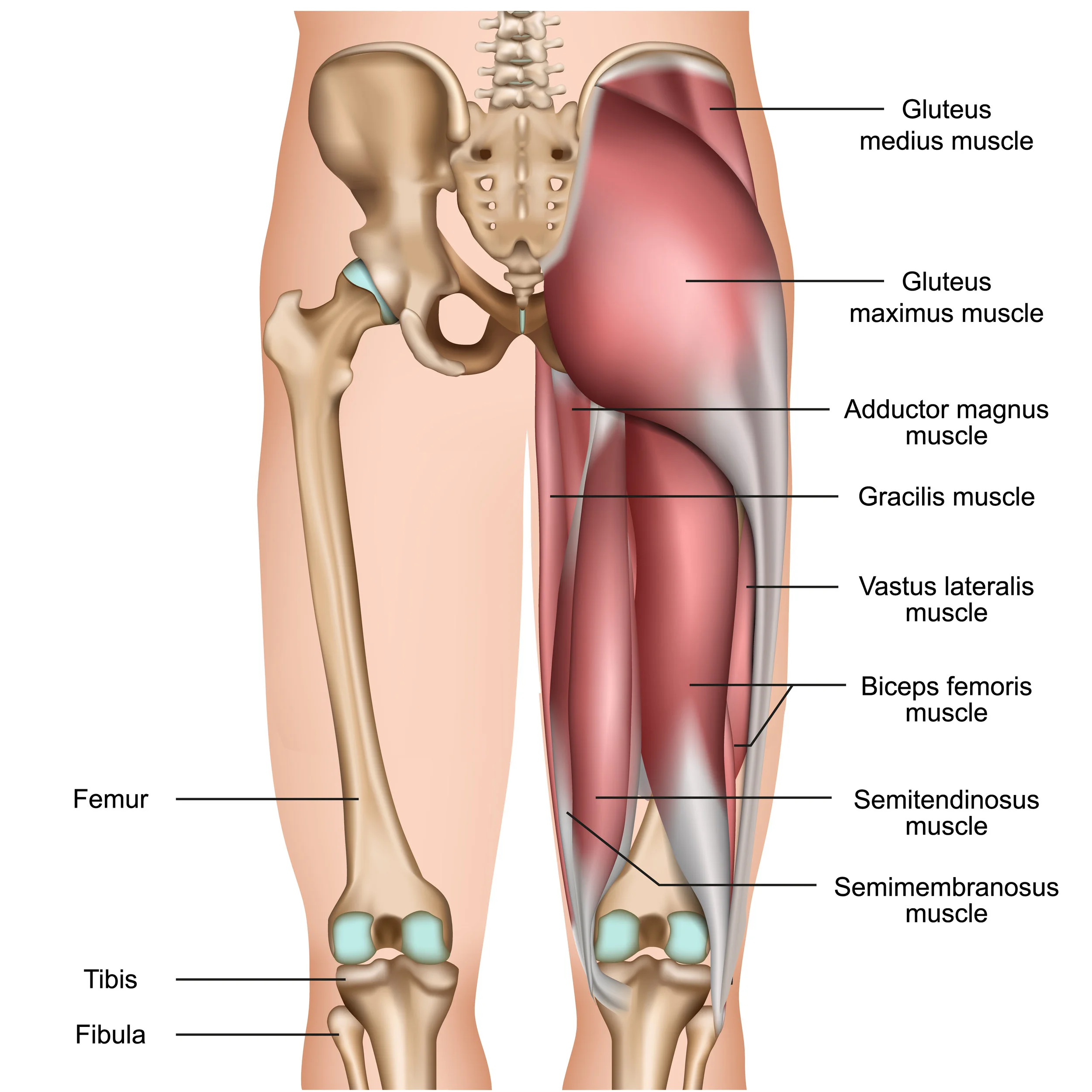
Semitendinosis: The semitendinosis mucles originates from the ischial tuberosity (sit bone) and inserts below the knee on the medial side of the tibia. This orientation causes it to act on two joints meaning it is both a Knee Flexor and Hip Extender. Due to its insertion on the inside of the tibia bone, it can internally/medially rotate the tibia when the knee is bent and also internally rotate the femur when the knee is extended.
Semimembranosis: The semimenbranosis muscle originates and inserts very closely to the semitendinosis and acts similarly as a knee flexor and (poor) hip extender. There are subtle differences in the two ‘semi muscles’ but it’s claim to fame is more along the lines that is may play a role in knee stability given it is suspected to have a functional relationship with the popliteus muscle on the back of the knee and a few fibers supporting the MCL. We learn more about the body everyday, so this may change.
Biceps Femoris: The Biceps Femoris has a similar function as the ‘Semi muscles’ in that it assists in knee flexion, and lower leg deceleration during the runners gain cycle, but it is somewhat special. The biceps femoris muscle has two heads that attach to two different places. The long head comes all the way from ischial tuberosity like the ‘semi brothers’, crossing the hip joint, making it a hip extender. But the short head, it comes off the back of the femur at a spot called the linea aspera. The short head does not cross the hip joint so it does not extend the hip, but it does have a special power. If you are unfortunate enough to experience an avulsion of the hamstring origin off the ischial tuberosity, the short head is still attached and allows you to, albeit weakly, flex the knee. This allows you to maintain some ability of ambulation. Our bodies are smart!
Basic Function Of The Hamstrings In Running
The hamstrings have a very important role in the running gait cycle, but it may not be what you think. As distance runners, our hamstrings are not as strongly used as in our sprinting counterparts, but as we all know after a good speed work session, they are back there serving ther purpose.

To keep this simple. The hamstrings job is to ‘slow’ down the leg as it swings forward. WHAT? SLOW DOWN? Yes! And the faster you run, the harder it works to slow down the leg.
It does this in what is called an eccentric contraction. Simply put, the hamstring fires as the leg swings forward so that your foot and lower leg do not go flying out, causing the knee to fully extend, and then you land on a locked knee. This would cause many injuries, and runners with a lack of control here often have knee and hamstring injuries.
Okay, so lets go a little deeper…nerd-out if you will.

For a great review of the gait cycle, check out the Biomechanic.
When the leg is planted in the stance phase, the hamstring contracts with the quads and adductors to create a stable platform inwhich we can use our momentum to continue to propel forward.
As the leg moves into the toe off phase, the hamstring supports by contracting more concentrically aiding in the push-off that propels us forward..but here is where it gets fun.
During the mid part of the swing phase, the hamstring is passive as the quads and adductors do most of the work bringing the leg foward. The hamstring does work to pull the heel toward the butt in good form, but they do more stretch than anything as studies suggest the hamstring stretches from 50% length to 90% length during this time.
Once we start moving from mid swing to heel contact, the hamstring kicks in eccentrically, and puts the brakes on the lower leg, allowing for a stable platform to land and maintain during the new stance phase.
What Do The Hamstring Do For Distance Runners?
As distance runners, we work through all of theses running phases, just less draumatically than our explosvie sprinter friends. The hamstrings act more in the stability and concentric role during our long outings, which leads way to one theory as to why distance runners deal with more tendinopathy injuries (generally overuse) than strains and avulsion injuries (dynamic and powerful contractions).
What Types Of Hamstring Injuries Do Runners Experience?
Acute Hamstring Strains In Runners:
This is one of the most common overall injuries to plague athletes, for running, it is usually a problem for the sprinter of the group. A muscle strain, or pulled muscle, occurs when a muscle is suddenly overstretched, resulting in the tearing of some of the fibers within the fascicles that make up the larger muscle as a whole. This can be a very small percentage which only causes mild tightness, to a more prominent injury that can range from mild swelling, to complete immobility with bruising and severe swelling.
As a runner, if you are to experience a hamstring injury, a mild strain is preferable. Typically, we can get back out and perform modified running in 2-4 weeks with full healing and return to play in 4-8 weeks.
Hamstring Tendinopathy In Runners:
This is what we see most. As distance runners, we typically run far, make us prone to overuse injuries. Those injuries typically start with a little tightness that goes unaddressed because we are able to continue running. Over time, that muscle tightness begins to place an overload on the tendon, and that tendon begins to get irritated. In can inflame, dehydrate, become sensitive, and eventually make it difficult to run, walk, or sit for long periods.
There are two places this can occur, the lower tendon insertion, which we typically see acutely after a race, fall, or a big downhill effort. This area is often where we see a rupture in sprinters. If you have ever watched a 100m or 200m race and seen a running pull up very quickly and then fall or start hopping, this is what they experienced, and it can be career-ending at the highest level of the sport.
Now, for the upper tendon origin. High hamstring tendinopathy is so common and so frustrating, it has been listed in the runner’s guide of forbidden phrases. High hamstring injuries suck…there is no way around it. These injuries take TIME and often require some time off from running. I told you it was a forbidden term.
High hamstring tendinopathy typically takes 3-6 months for a full recovery and complete release to high volume and high intensity running. Care involves a strict plan for in-office and home care…and even with that, we still send out a good percentage for co-management with an orthopedist.
To summarize this injury. Don’t ignore your hamstring tightness or an injury you believe to be a mild strain. Give it attention, seek help, and rest if necessary. Unfortunately, some runners will press on, and the outcome is very unfortunate.
Hamstring Avulsion Injuries In Runners.
This is a tough one that typically requires surgical intervention. An avulsion injury is when the hamstring tendon pulls away from its attachment on the bone and takes part of the bone with it. These are uncommon without a significant mechanism of injury, we don’t typically see this from just running, but it has happened. This injury will cause severe pain, swelling, and bruising and should be examined by an orthopedist as soon as possible as the muscle can begin to ‘roll-up’ and atrophy shortly after the injury.
Dr. Reheisse is a Board Certified Chiropractic Sports Physician practicing in Cottonwood Heights Utah. Revive Sport & Spine provides evidence-supported chiropractic care and conservative sports injury management.
If you are in the greater Salt Lake City, Utah area and are a runner dealing with a nagging hamstring injury, we are here to help. Click the link below to schedule a consultation appointment and lets get you back out and running.

Youth Running: Benefits, Risks, & Considerations
Running is one of the best (coming from a runner) and easiest sports to take up in the world. Running is a major part of nearly every sport on the planet, making it an excellent option for our school-aged athletes. In 2017, almost 500,000 runners ran XC, and over 1 million athletes ran track. With the ease of access and a million different training techniques and training theories comes the risk of adverse effects. Over the last 10 years, we have seen a 34% increase in injuries incidence among runners.
Running is one of the best (coming from a runner) and easiest sports to take up in the world. Running is a major part of nearly every sport on the planet, making it an excellent option for our school-aged athletes. In 2017, almost 500,000 runners ran XC, and over 1 million athletes ran track. With the ease of access and a million different training techniques and training theories comes the risk of adverse effects. Over the last 10 years, we have seen a 34% increase in injuries incidence among runners.

Shin splints can be an precursor to stress fractures in young runners. Check out our MTSS Blog Series to prevent and rehab this common injury.
It is estimated that 20-80% of runners will experience an injury in a given year. Random range, right? You try to find two studies that can agree on this! However, we do know that more than 50% of all pediatric sports injuries are due to overuse. We also know that overuse has is signs and symptoms and can be prevented.
What do we know about youth running? A lot actually. Let’s look at the facts and discuss how we can prevent future injuries so our young runners can enjoy a life-long relationship with this wonderful sport.
BENEFITS OF RUNNING FOR YOUTH ATHLETES
Great Cardiovascular Health.
Improved Cognitive Development.
Exercise increases metacognition, behavior regulation, and accelerates behavioral and emotional engagement.
Bone Health - Increased Bone Density
Positive Self Image & Emotional Wellbeing
Aids in Development of Total Athleticism.

Running injuries are common in youth-aged runners, but the benefits from frequent exercise, competition, and camaraderie far outweigh the risks. Learn more about beginning running for health and fitness here.
CURRENT TRENDS IN YOUTH RUNNING: INJURY RISKS
Accelerated Growth.
Peak height velocity (when children grow fastest, resulting in bones lengthen faster than muscles and tendons can keep up with) occurs around 12 for females and 14 for males.
Just before this rapid growth, bone mineral content is at its lowest, making bones and growth plates vulnerable to the load and stress of running.
Low Bone Mass For Age.
Affects 39% of female youth runners.
Might be the more likely cause of stress fractures than training load.
Low Energy Availability, Relative Energy Deficiency in Sports
Adolescence is a time of rapid growth with unmet energy demands…inadequate calorie intake with increased running demand can lead to abnormal menstrual function in females, bone mass depletion, and high risk of musculoskeletal injuries and stress fractures.
Males Commonly Suffer From Low Bone Mineral Density As Well.
Risk factors include being less than 85% weight for height, running over 30 miles per week, a history of stress fractures, and having a diet lacking in calcium-rich foods.
Answering ‘YES’ To The Following:
‘do you believe that being thinner leads to faster running performances?’
BIG RED FLAG
Increased Anxiety or Avoidant Coping Strategies Such As Denial.
Perfectionism-related thoughts are associated with higher rates of depression, anxiety disorders, obsessive-compulsive disorders, and eating disorders.
History Of Previous Running Injuries.
Strong indicators for in-season injuries are injuries during summer training (female) and history of previous running injury (males).

HOW CAN WE PREVENT INJURY IN YOUTH RUNNERS:
To prevent injury, cross training is necessary. Recent data suggest that shorter intense bouts of activity like sprinting, other sports, and neuromuscular training are better for developing motor skills compared with endurance running. Remember, though they grow, they are still kids and need time to play. Play outside, play other sports, rest from play. Don’t forget that.
Strength Training #1 - Improved Core And Pelvic Strength Led To Faster Race Times.
A 6 week strength program aimed at pelvic and core strength led to improved race times. Strength training also leads to better weight control, improved motor performance skills, improved cardiovascular health, and enhanced psychosocial well-being…oh, and less sports-related injuries.
Strength Training #2 - Spine & Hip Strengthening.
Exercises aimed at the spine and hip muscles helped injured youth runners rehab from injury faster and prevented future occurrences of common running injuries such as Achilles tendinosis, iliotibial band syndrome, runner’s knee, plantar fasciitis, and shin splints.
Strength Training #3 - Strength Training For Runners Program.
We have developed an instructional series around some of the best strength exercises for runners. You can check those out here.
Set Realistic Expectations - Know Age & Developmental Stage Capabilities.
Unrealistic expectations lead to athlete frustration, low self-esteem, burnout, and injury! This can lead to reclusiveness, depression, and loss of enjoyment.
Monitor Youth Runners For Signs Of Burnout.
Students athletes who withdraw from activities they previously enjoyed may be experiencing chronic stress and burnout from their sport. This leads to more complicated issues if unaddressed, like depression, obsessive-compulsiveness, and eating disorders.
If an athlete becomes more irritable, anxious, or struggles with perfectionism, they are demonstrating signs of burnout. They need time off or decreased self, coach, and or parental pressures related to their sports.
Coordination Of Care For An Athlete.
Extrinsic risk factors for injury include improper training volume, intensity, or progression, early sports specialization, poor footwear, and inefficient running form. These factors are better addressed when the athlete, parent, coach, and healthcare provider have open communication with the athletes BEST INTEREST at the forefront.
Modify Training Program To Allow Rest Periods
Injury can be reduced by developing a training plan that limits weekly and yearly participation time to reduce repetitive movements and increase scheduled rest periods within each week, season, and annual training cycle.
Suggested rest is at least 1 day per week, 1-2 weeks every 3 months, and participation limited to 9-10 months per year.
Avoid Early Sports Specialization (Bolded Based on IMPORTANCE)
Highly specialized youth athletes (those participating in one sport more than 8 months of the year) report more injuries than their peers, independent of age, sex, or training volume.
Early Sport Specialization is associated with unidimensional identity with the sport leading to the athlete feeling as like they lack control with their participation in that sport. This leads to burnout.

All Credit To The Authors & AJSM. No Copyright Violation Intended. Click Here To Access Full Article.
When To Seek Treatment
Now that we are aware of injury risks, YOU have to take preventive measures. For some, this means a little time off before training ramps up again. For others, it’s time to hit the gym, toss a ball around, shoot some hoops, and spend some time at the pool.

Early Care Is Crucial To Retruning To Running In a Resonable Time-Frame. Schedule Today.
Shin Splint Pain Relief -> CLICK HERE
IT Band Pain Relief -> CLICK HERE
Runner’s Knee Pain Relief -> CLICK HERE
When it comes to injuries, we know two things.
(1) Rest is rarely beneficial for sports injury recovery. Rehab needs to be active!
(2) The sooner you seek care with an injury, the sooner you will be back out and running.
If you or your child has been training for the upcoming cross country season but are continually being sidelined by injury and illness, it’s time to find help and get back on track. If you are a runner in the Salt Lake City area, Revive Sport & Spine is your go-to clinic to get you back up and running quickly, giving you the tools to help you run faster, farther, and more efficient than before.
Krabak et al. Youth Distance Running: Strategies for Training and Injury Reduction. American College of Sports Medicine. 2019. Current Sports Medicine Reports. www.acsm-csmr.org.
Dr. Reheisse is a Board Certified Chiropractic Sports Physician practicing in Cottonwood Heights Utah. Revive Sport & Spine provides evidence-supported chiropractic care and conservative sports injury management for the great people and adventurers of the Salt Lake City Valley.

Medial Tibial Stress Syndrome Part 3 - Treatment and Rehabilitation
So we have made it to this point. You have been rolling, stretching, warming up before your runs, but your nagging shin splint pain will not go away. Maybe it has improved 50%, but as you continue to train for your upcoming event, the pain has plateaued. Sound familiar?
So we have made it to this point. You have been rolling, stretching, warming up before your runs, but your nagging shin splint pain will not go away. Maybe it has improved 50%, but as you continue to train for your upcoming event, the pain has plateaued. Sound familiar?
I know it has for me. As we discuss treatment options here in part three of our Medial Tibial Stress Syndrome series, a few of the techniques we show that are commonly used here in the office were used to help me overcome my battle with shin splints when I was working toward my first marathon.
Just with any other injury, if you are truly doing everything you can (allowing ample time to warm-up before exercise, training within your limits and not hanging too long in the upper limits as you progress, you are stretching, rolling, and giving constant attention to recovery and rest) and you can not shake the pain after 10-14 days, YOU NEED HELP! Our goal with this series is to give you options, ideas, and a direct path of the things you should be doing, but if they don’t get you to where you need to be, or out of pain…that is why we are here!
Below are a few of the treatment options we typically utilize when caring for medial tibial stress syndrome, as well as a basic return to running rehab protocol that not only provides strength in needed areas but is aimed at preventing future injuries.
NOTE: The care we provide is adapted to each individual person and their presenting condition. What works for one athlete may not work for another. This is where the exam and functional analysis come in. If any of these exercises cause pain, STOP, and seek care from licensed professionals. (Like Us!)
SHIN SPLINTS: IN OFFICE TREATMENT
MYOFASCIAL RELEASE
IASTM - Instrument Assisted Soft Tissue Mobilization
DYNAMIC CUPPING THERAPY
DRY NEEDLING THERAPY
KINESIO TAPING
SHIN SPLINT REHABILITATION PROTOCOLS
Medial Tibial Stress Syndrome - Rehabilitation Exercises - Phase 1
Medial Tibial Stress Syndrome - Rehabilitation Exercises - Phase 2
Dr. Reheisse is a Board Certified Chiropractic Sports Physician practicing in Cottonwood Heights Utah. Revive Sport & Spine provides evidence-supported chiropractic care and conservative sports injury management.

Medial Tibial Stress Syndrome Part 2 - Self-Care For Shin Splints
In PART 1 of our Shin Splints series, we took a look at the anatomy associated with medial tibial stress syndrome as well as the factors that make runners especially susceptible to them, namely the repetitive nature of running compounded by most cases typically doing too much too soon. Here in PART 2, we are going to look at self-care options as well as some considerations for preventing repeate episodes of shin splints so that you can keep running and training for your goal races.
In PART 1 of our Shin Splints series, we took a look at the anatomy associated with medial tibial stress syndrome as well as the factors that make runners especially susceptible to them, namely the repetitive nature of running compounded by most cases typically doing too much too soon.
Here in PART 2, we are going to look at self-care options as well as some considerations for preventing repeate episodes of shin splints so that you can keep running and training for your goal races.
SELF CARE OPTIONS FOR MTSS-SHIN SPLINTS
Self Myofacial Release - 4 Ways To Care For Your Shin Splint Pain
Pre-Running Warm-Up For Shin Splints
Training Modifications, Gear Suggestions, & Other Prevention Considerations
Form, Cadence, & Ground Contact Time:
This is a tricky subject, honestly I’m not sure why I even mentioned it. One can go miles down the form training rabbit hole and come out the other side worse they they were before. However, I do want to mention three things that must be considered and worked into your training plan to help prevent shin splints and make you a more efficient and faster runner.
The ground fights back! The more time we spend in contact with the ground, the harder this battle will be. I’m not here to talk about heel-striking, forefoot running, etc., but I will mention cadence. The higher your cadence, the less time your foot spends on the ground. Meaning, the less ground reactive forces you absorb and the less stress on your body.
Again, I’m not here to correct form. But I do believe we can all be more efficient. Strength training helps us become more efficient for those later stages of the race. Please add strength training to your program, it is extremely useful.
Alter your surfaces. Don’t always pound the pavement. The track and trails are your friend…and your feet will thank you for it.
Shoes:
Shoes are something I get asked about frequently. My honest answer is this, ‘We have more shoe technology and selection than ever…we also have more injuries than ever.’ Take that for what it is worth but I do believe shoes should be rotated and changed frequently. I suggest a 2-3 pair rotation, avoid running in the same pair two days in a row, and switching out for a new pair every 200-300 miles depending on the shoe.
Warm-Up & Cool-Down:
This is SO BIG. In every injury we encounter and talk about, how you warm-up (if at all) and cool-down has a direct impact on your injury risk, and recovery speed from injury. Warming up prepares your body for the task ahead, giving it the best chance to avoid injury. Colling down helps work out those tight spots after training while encouraging faster recovery.
Dr. Reheisse is a Board Certified Chiropractic Sports Physician practicing in Cottonwood Heights Utah. Revive Sport & Spine provides evidence-supported chiropractic care and conservative sports injury management.

Medial Tibial Stress Syndrome Part 1 - What Are Shin Splints and Why Runners?
Springtime is here! The weather is warming up, the sun is starting to shine on those early morning runs, and we can finally shed many of those heavy layers of clothes for our preferred running shorts and singlet top!
But…spring time also means something else for runners.
Springtime is here! The weather is warming up, the sun is starting to shine on those early morning runs, and we can finally shed many of those heavy layers of clothes for our preferred running shorts and singlet top!
But…spring time also means something else for runners.
For most runners, it means it is time to come out of the pain cave, get off the globogym cardio theater dreadmill, and start hitting the roads again. For some, it means it is time to come out of hibernation and begin training again. While this all seems well and good, the road can cause some aches and pains that the somewhat forgiving treadmill or cushy couch hid from you all winter long.
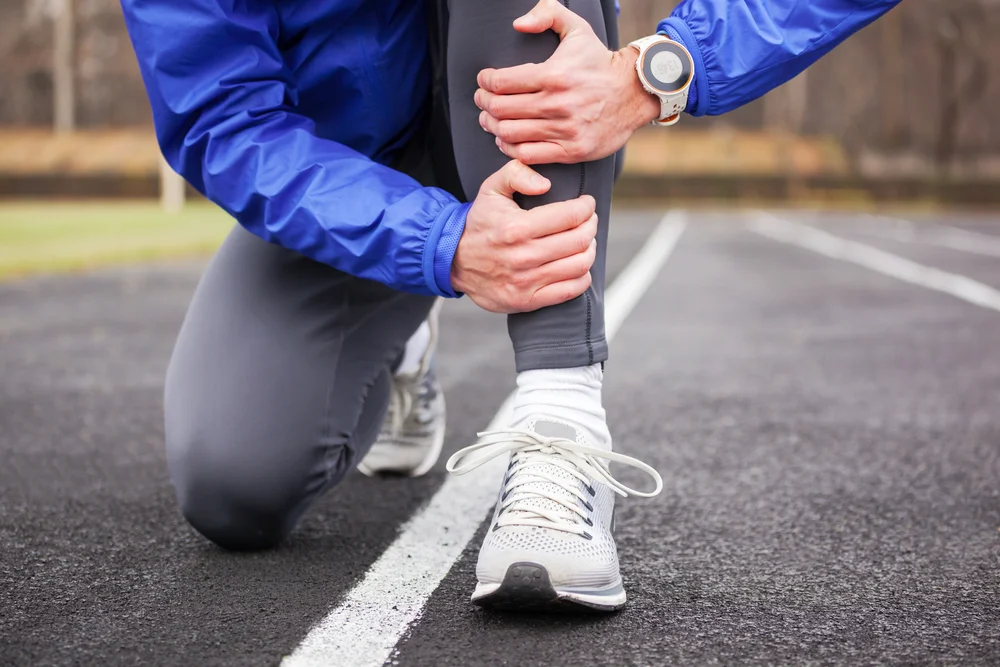
You know what I am talking about. That all too familiar pain down the inside of shin bone that can also sometimes radiate into the foot and seems to intensify with every run. Road running in the spring can be wonderful, but it can also be painful. The road is an unforgiving surface (part of the reason our treatment plans include running on a track or trail) that can bring even a veteran runner to their knees in frustrating agony with each run.
Yes, I’m talking about Shin Splints!
Today we are beginning our Shin Splint Relief & Prevention series by discussing what ‘shin splints’ are, how they occur, who is more likely to experience shin splints, as well as a few other complicating factors. We will follow this up with self-care in Part 2, and Treatment & Rehabilitation options in Part 3.
WHAT ARE SHIN SPLINTS: MEDIAL TIBIAL STRESS SYNDROME
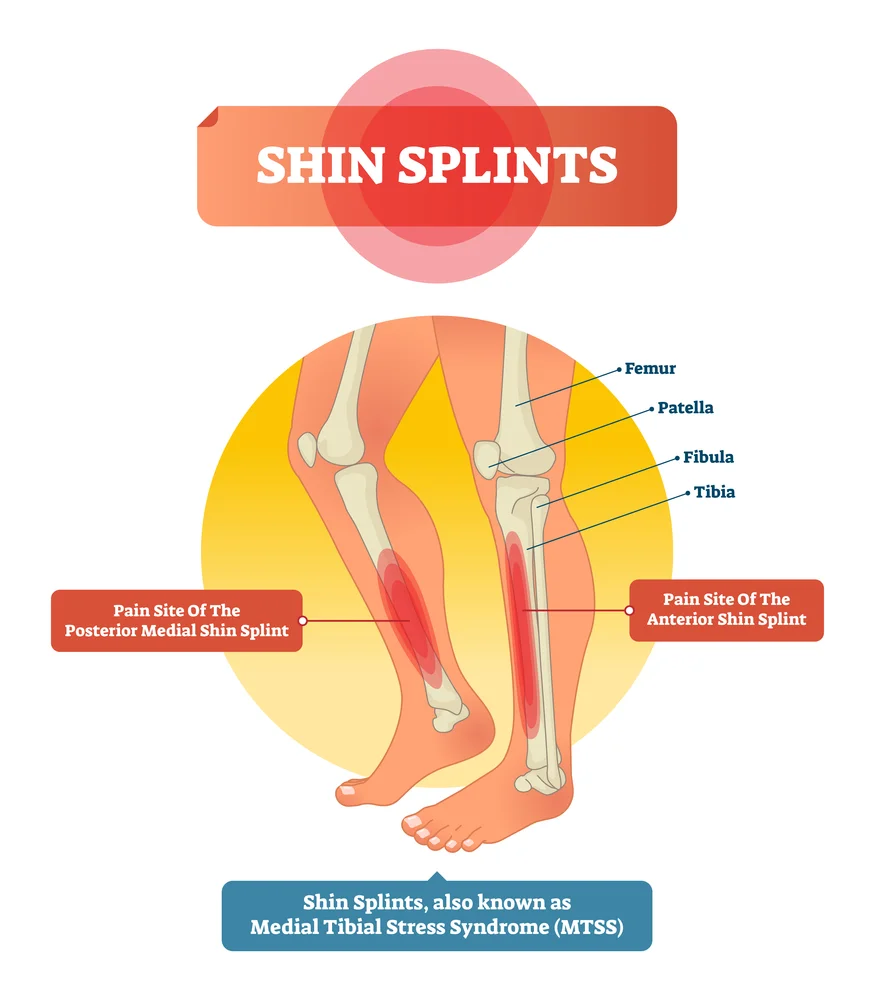
From an anatomical perspective, shin splints are a condition where there is pain, tenderness, and sometimes swelling along the middle, inside of the tibia (shin) bone. While the cause is debated as to whether this pain comes from a muscle and tendon response to doing too much too soon, the tibia bones inability to handle the stress and pounding from running, or damage to the connective tissue that wraps and supports all of these structures in the lower leg and foot.
The hallmark sign of Shin Splints is the extreme tenderness along the inside of the shin that seems to improve as a runner warms up, but begins to worsen, last longer, and eventually prevent running as time passes without care. From this, this condition is more aptly named Medial Tibial Stress Syndrome.
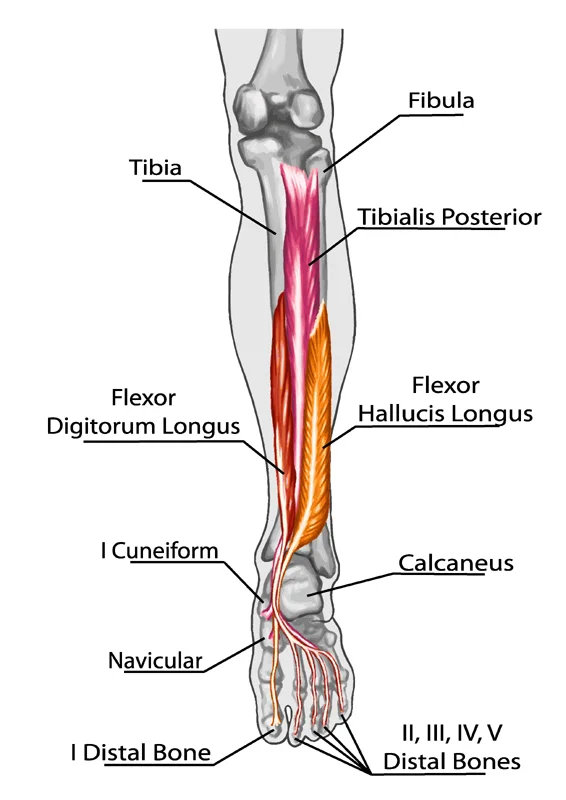
Before we discuss why this condition plagues runners, and what we in the medical community think is actually happening, let’s look at the important anatomy involved.
WHY RUNNERS & WHAT FACTORS LEAD TO SHIN SPLINTS
Running injury statistics are horrifying, with studies estimating that anywhere from 40-80% of runners experience an injury EVERY YEAR. I am not going to bother trying to track down the actual number because it changes montlhy as new research comes out, but the fact is that as runners, we run a high risk of injury. From that, it is estimated that 1 in 5 are dealing with shin splints. Since this is such great news, let’s look at some reasons why this injury is so common and who could be at higher risk.
New Runners - If you are truly new to running, Shin Splints are almost a right of passage. In the process of your body adapting to this new stress, figuring out your form, and slowly increasing your mileage, your body will get to the point where it starts to scream…’why are you doing this to me’. As we progress through this series, you will find ways to build up your body, more specifically your legs, so that it can handle this new stress of running.
Running Biomechanics - The Tibia bone is believed to absorb 2-3x’s your body weight with each step. Take into account that the average runner has a cadence (steps per minute) of 140-180, it is no wonder we begin breaking down at the tibia.
Higher BMI/Body Weight - Looking at the last statement, if you have higher body weight, and you are new to running, forcing your tibia to withstand the pounding from running should be a slow process with ample recovery.
Training Volume - Just like new runners, if you are a veteran with a solid training base of 30-35 miles per week and you sharply bump up to 55-60 miles per week, you are essentially treating your body like a newbie with a very unfamiliar stress.
SIMILAR PROBLEM: Too Much Too Soon & Classic Overtraining
Form - Forefoot, Midfoot, or Heel Striker, you efficiency within that form and allowance for adaptation to stress is what either prevents or causes injury. I have seen all forms present with shin splints, and it is usually a combination of the above causes.
WHAT ACTUALLY CAUSES SHIN SPLINTS
While the cause of Medial Tibial Stress Syndrome is still debated, with research naming a different cause. It is likely a combination of the factors we are going to cover. This is why, if you have been suffering from shin splints for a month or so and are just trying to run through them, it is important to get an evaluation, a structured plan around your goals, and some treatment to get you over the hump.
Weak Ankle Dorsiflexion - Loss of eccentric control.
One issue that many believe to be a cause, or at least a contributor to shin splints is poor control of the anterior leg muscles, or weakness of the Tibialis Anterior muscle. This one stands out in newer runners because it is responsible for the slapping sound one makes when their foot hits the ground. This comes from weak eccentric control of the muscle, or the ability to slowly let it down to the ground. Our bodies are amazing, so when one area fails, another area takes the load…
Poor Pronation Control & Tight Posterior Tibialis Muscle
Lets first start by reminding everyone that pronation is a normal part of the gait cycle, but poor control of the speed of pronation can cause problems. If we have excessive tightness through the posterior tibialis muscles, either due to overuse or poor adaptation to load, it is unable to respond well enough when the foot hits the ground, causing the foot to crash in during pronation. If this is the case, we see each step pulling on this already tightened muscle, as well as the facia that wraps it and attached to the inside of the tibia bone (that spot where you are tender), inflaming the area, damaging the muscle, and leading to poor mechanics while running.
Bowing of the Tibia Bone
To further the case of this mid-shin bone pain where the posterior tibial muscle lies, we have data that shows the Tibia bone actually bowing during running. While our bodies are adaptive and resilient, we believe this bowing to be minimal, undetectable without fancy equipment, but a natural part of our body handling the forces the road gives back with each step. Where this comes in to play is with a young or new-to-running runner who decides to run through their pain. If this goes on long enough, and the runner overtrains, this can lead to a stress fracture injury.
Over Training - Too Much Too Soon
This is probably the most common reason runners experience shin splints, and most other injuries for that matter. Over-training is the common factor of the 3 potential causes we mentioned above. As a new runner or an experienced one looking to increase mileage, a plan that not only includes a structured running plan, but strength training, cross training, and rest must be considered.
SUMMARY
Shins Splints are most known to cause pain along the inner edge of the tibia bone that is tender to the touch. Swelling may or may not be present.
While many causes are debated, one thing holds true. Whether you are a new runner or a veteran. Doing too much too soon will likely lead injury.
Runners are most at risk due to the repetitive nature of running. Add in volume changes, the pounding of the road, lack of self-care and warming up before each run..it all adds up.
Dr. Reheisse is a Board Certified Chiropractic Sports Physician practicing in Cottonwood Heights Utah. Revive Sport & Spine provides evidence-supported chiropractic care and conservative sports injury management.

Sciatica Pain Relief Part 3: Self-Care & Everyday Actions That Make Sciatic Pain Worse
If you are tracking along with us on this journey of everything Sciatica, your patience and dedication is about to be rewarded. In Part 1 of our Sciatica Pain Relief series, we discussed what Sciatic Nerve pain is and the associated anatomy (always my favorite part). In Part 2 we went a little deeper with the 5 most common causes of Sciatica and touch on a few of the red flags we want to rule out as soon as possible. Having made it through those two very information-heavy articles, it is time to look at what YOU can do to improve your situation as well as some of the most common everyday actions that may be the primary cause for your Low Back and Sciatic Nerve pain.
If you are tracking along with us on this journey of everything Sciatica, your patience and dedication is about to be rewarded. In Part 1 of our Sciatica Pain Relief series, we discussed what Sciatic Nerve pain is and the associated anatomy (always my favorite part). In Part 2 we went a little deeper with the 5 most common causes of Sciatica and touch on a few of the red flags we want to rule out as soon as possible. Having made it through those two very information-heavy articles, it is time to look at what YOU can do to improve your situation as well as some of the most common everyday actions that may be the primary cause for your Low Back and Sciatic Nerve pain.
EVERYDAY ACTIONS CONTRIBUTING TO SCIATICA PAIN
SITTING:
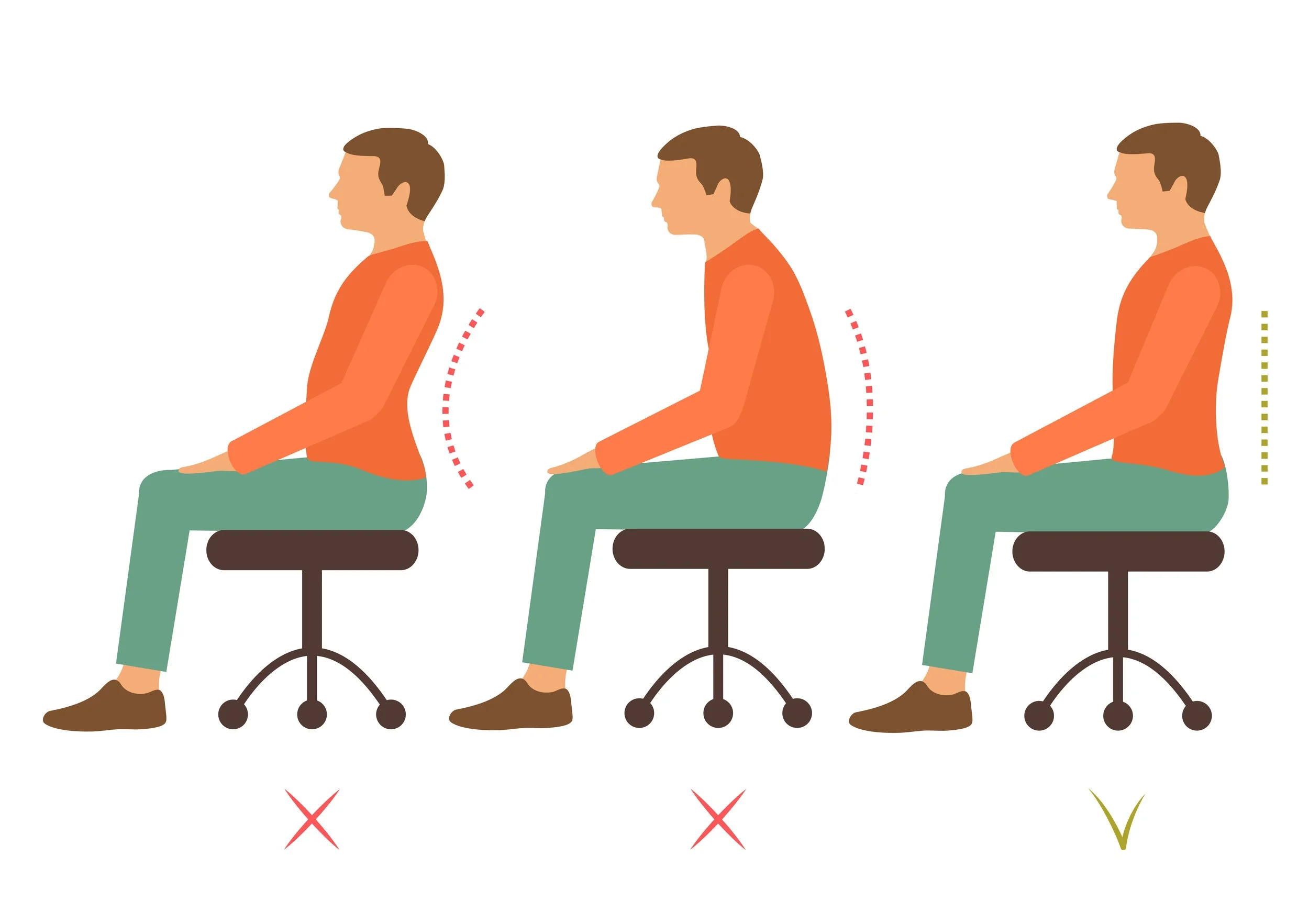
To some, sitting may seem like a crazy thing to make sciatica worse. However, for those who experience this daily, it is a very real thing. To put this simply, sitting compresses the muscles of the posterior hip, possibly putting pressure on the sciatic nerve. Also, the position of sitting puts tension on the entire posterior chain (back, hip, glutes, hamstrings) potentially irritating the sciatic nerve at the spine, hip, or back of the thigh. Many people with sciatica report finding relief by standing and walking around.
TRAVELING:
Traveling is similar to sitting in that you take the nature of sitting and compressing the sciatic nerve, and add in the cramped, tight situation of traveling on a plane or car. In addition to this, a hotel bed, or worse, your second cousins blow up mattress in their spare bedroom is not making the situation any better.
EXERCISE ROUTINE:
Many patients will relate that exercises such as squatting, deadlifting, and rowing can cause their sciatic nerve pain to worsen. The end range of these exercises, tension on the sciatic nerve, and the repetitive nature of exercise all create the perfect storm to irritate a long-standing sciatic nerve issue.
HOME CARE OPTIONS FOR SCIATICA PAIN RELIEF
While many sciatica cases require some formal care, all can benefit from frequent attention through home and office-based stretches and exercises. Below are some of our favorite ‘moves’ to help relieve sciatica pain. The truth here is that sciatica relief and recovery takes time, effort, and focus. Do a stretch one or two times is not enough. You may need to perform one of these every hour. You may have to modify your workspace. Guidance here is one aspect of care in our office but the responsibility to complete these is on the patient. Simply put, the more you focus on care outside of our office, the faster your issue typically resolves.
*NOTE: If any of these stretches increase your symptoms, stop and seek professional care. These exercises are not intended to diagnose any condition. Understanding of these exercises and the prescription of these should be performed by a trained provider.
Seated Sciatica Relief - 2 Best Chair Stretches
Best Sciatica Stretch - Utah Sports Chiropractor
Sciatica Self Release - Foam Roller & LaX Ball
Flexion & Extension For Low Back & Sciatica Relief
RISKS & CONSIDERATION WHEN DEALING WITH SCIATICA
RED FLAGS:
We discussed these in Part 2 of our Sciatica discussion. They are worth reviewing, and if you are experiencing any abnormal or rapid increase in symptoms, professional care and imaging are most likely needed.
STRETCHING:
Something as simple as a hamstring stretch can light up your sciatica like Christmas. As we work through rehabilitative exercises and stretches, gradual progression is a must. Just like any other injury that involves peripheral nerves, more stretching is not always better. Stretching into the pain, or the discomfort zone, when dealing with a nerve issue will likely exacerbate the condition. Start with the above demonstrated exercises, and take it easy!
OCCUPATIONAL & LIFESTYLE MODIFICATION:
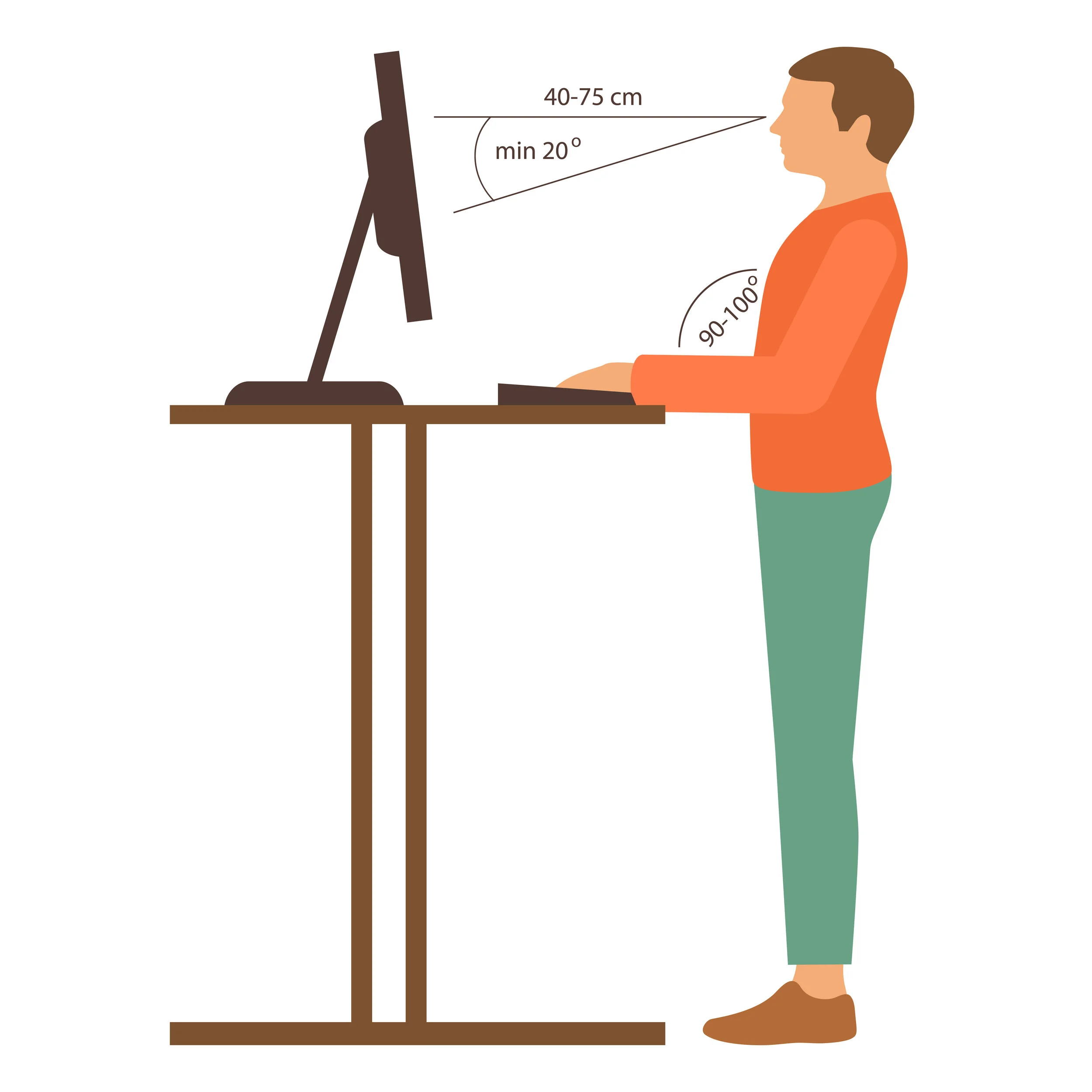
Imagine your workspace. Without going through an extensive ergonomics evaluation, what can you change to help your sciatica? Are you able to stand up and work? Do you have a water cooler to frequent? Can you set an alarm on your phone to remind you to stand up and stretch every hour? It is this type of lifestyle modification that is the long game portion of real sciatica relief.
Dr. Reheisse is a Board Certified Chiropractic Sports Physician practicing in Cottonwood Heights Utah. Revive Sport & Spine provides evidence-supported chiropractic care and conservative sports injury management.

Sciatica Pain Relief Part 2: Common Causes of Sciatica
In part 1 of our Sciatica Pain Relief series, we covered the basics of sciatica, sciatic nerve pain, and the general anatomy involved. While this may not interest everyone, it is useful in understanding the sharp, burning, and often debilitating pain that radiates down the leg that some people experience with low back pain. Our goal in this series is to inform, empower action, and give our fellow Salt Lake City, Utah friends the information and tools to help yourself through this condition as well as the understanding of when to seek care and a trusted source to do so if needed. In part 2, we are going to briefly discuss some of the most common causes of sciatica but before going forward, check out part 1 by clicking the button below.
In part 1 of our Sciatica Pain Relief series, we covered the basics of sciatica, sciatic nerve pain, and the general anatomy involved. While this may not interest everyone, it is useful in understanding the sharp, burning, and often debilitating pain that radiates down the leg that some people experience with low back pain. Our goal in this series is to inform, empower action, and give our fellow Salt Lake City, Utah friends the information and tools to help yourself through this condition as well as the understanding of when to seek care and a trusted source to do so if needed. In part 2, we are going to briefly discuss some of the most common causes of sciatica but before going forward, check out part 1 by clicking the button below.
TOP 5 COMMON CAUSES OF SCIATICA
1) Disc Buldge - Intervertebral Disc Compression
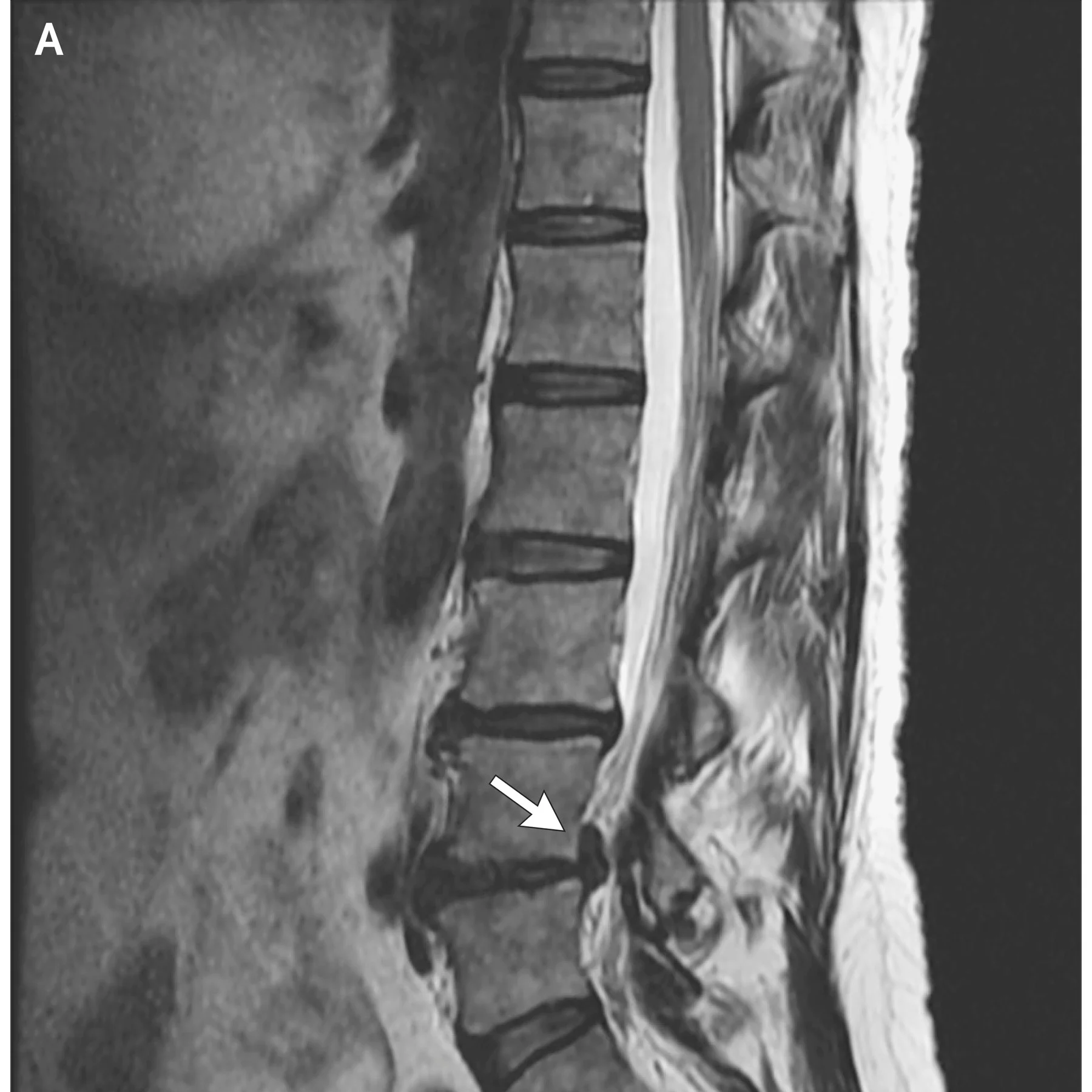
Credit: Allan Ropper, M.D., Ross Zafonte, D.O. Sciatica Review Article. New England Journal of Medicine
Starting with the most common cause makes sense as this is what most literature supports and what most people fear when they have some incident or trauma that leaves them with sciatic nerve pain shooting down their leg. A disc bulge is just that, an outpouching, or bulge, of the disc (compressive and supportive tissue between each vertebrae that acts as a shock absorber and allows for movement of the spine) which then presses up against the spinal cord or a nerve as it exits the spinal column. Compression here can be mild to severe, bringing with it anything from pain, numbness, and tingling, to complete weakness of the muscles and limb supplied by the nerve being compressed.
Note: If you are experiencing the latter of those, please seek help immediately as progressive weakness is a red flag and often requires immediate imaging and intervention.
Now, the debate is out on this as disc, and other lumbar spine pathologies are considered somewhat normal. Chances are, before the injury or event that left you feeling this way, the disc bulge was ALREADY PRESENT! This event just aggravated it enough to cause pain.
For Review: Check out the chart in this article we did on spinal imagining and what the best, most current research supports. You will find that most people are walking around with ‘back issues’ with absolutely no pain or quality of life disruption.
THREE THINGS TO KNOW ABOUT SCIATICA & DISC ISSUES
You are not your image. Chances are, your MRI will show things that were already present and may not be the primary source of your sciatic nerve pain.
A true disc injury and resulting sciatica take time to heal. The body will do most of the work. Chiropractors and therapists are here to help with symptoms, function, and assuring you are in the best position to heal. There is NO magic pill for this, TIME heals.
If you are experiencing sudden weakness or progressive numbness that does not let up, seek care immediately as intervention is most likely needed to assure permanent damage is not experienced.
2) Lumbar Spine Stenosis - Canal & IVF Narrowing

Similar to a disc bulge, Sciatica related to Spinal Stenosis is a physical compression of the nerve roots that make up the sciatic nerve. However, this is more of a slow growing, progressive problem. In most cases, these do not wake up in severe pain overnight, these patients report constant discomfort, on-again-off-again radiation of pain, slow loss of range of motion, and typically do not have a time or event to relate a start of the pain.
As we age, the spine and discs degenerate. In the disc, this happens by a loss of height, dehydration, and loss of flexibility of the tissue. In the spine, and other high-stress bone and joint areas, degeneration happens by bone growth, bone spurs, and rigidity of the joints. This degeneration can cause enough of a response that bone will grow around areas where nerves pass from the spinal cord to the rest of the body (Intervertebral foramen or IFV) taking an already small space and slowly closing it down.
3) Piriformis Syndrome - Posterior Hip Tightness
We hit on this at length in the first part of our sciatica series. The relationship between the sciatic nerve and the piriformis muscle is well established. Most people have a sciatic nerve the tracks superficially (toward the surface) over the top of the piriformis muscle or just inferior to it. However, there is an appreciable percentage of the population where the sciatic nerve or a branch from it, pierces the middle of the piriformis muscle. It is believed to be the main culprit of 2-12% of sciatica pain with research on both sides stating over and under-diagnosis. Either way, anatomical and occupational variants are common causes of sciatic nerve pain as well as low back pain.

Credit: Allan Ropper, M.D., Ross Zafonte, D.O. Sciatica Review Article. New England Journal of Medicine
4) Double Crush Syndrome
Double Crush Syndrome, many of the cases we see fall into this category. Let me explain.
A patient presents after a fall, accident, or just a bad nights sleep with a chief complaint of sciatica with low back pain. An exam reveals a limited range of motion in the lumbar spine, tightness of the muscle in the posterior hip, namely the piriformis muscle, and numbness and tingling down the leg. Let's say that an MRI was ordered and it revealed a mild to moderate disc bulge.
Crush One - The disc bulge, assumed to be caused or irritated by the incident, it mildly compressing the nerve. Crust Two - In response to this injury, the body goes into defense mode and muscles begin to tighten, namely those of the posterior hip.
The initial compression at the spinal level causes a 3/10 pain, when you add in the tightness and compression at the hip, the patient is now up to a 7/10 pain with shocks of pain during specific movements. This is a Double Crush.
As with most, the disc issue is hard to affect with treatment directly, but focus can be directed toward the hip muscles, proper movement of the area and exercises to help with mobility and pain are prescribed, bringing the person back down to a 4/10 pain and allowing them to maintain most daily activities while the disc heals…remember, TIME heals discs.
5) Pregnancy
While this is not a diagnosable cause of Sciatica, sciatica is a very common complaint from expecting mothers. The cause here can be as elusive as any other, but pregnancy, the position of the baby, and the mothers specific size, anatomy, and lifestyle habits and experience with sciatica pain before the pregnancy. While there are many unknowns here, sciatica pain typically affects mothers-to-be in the latter half of the pregnancy, and most will respond to conservative care.
RED FLAGS

Sciatica is a very well described condition. The direct cause can be challenging to uncover, but there are a few things to be aware of if you are suffering from sciatic nerve pain. If you are experiencing any of the below items, we suggest you seek care immediately to assure the condition does not cause long term issues and to direct you to the right healthcare provider. Most cases can be managed conservatively (Chiropractic, Physical Therapy, or At Home) while others require medical intervention (injections, imaging, or surgery).
Progressive neurological symptoms. If you are experiencing numbness, tingling, or weakness that is worsening, please seek help from a trained provider.
If your injury is the result of a fall, auto accident, or home/work accident, consulting with a healthcare provider will help rule out any significant issues and speed our recovery.
As with other serious low back injuries, if you experience any loss of bowel or bladder control, this is an immediate ER referral.
If you have have been dealing with sciatica for more than 1 week without any relief, it is time to get help. Most self-resolving injuries and pain will let up after a couple days.
Dr. Reheisse is a Board Certified Chiropractic Sports Physician practicing in Cottonwood Heights Utah. Revive Sport & Spine provides evidence-supported chiropractic care and conservative sports injury management.

New Year - New Goals: Running To Better Health
Improved health tops nearly every new year's resolution list ever made, 2019 will be no different. From this, running comes to the forefront of our ‘get in shape’ plan because of its ease (almost everyone can shuffle one foot in front of the other, not saying it is easy) and relatively low cost (a decent pair of shoes and some running gear is all you need). While this plan seems fool-proof, there is a reason 60%+ of the people we see in our clinic are runners, new and old.
Improved health tops nearly every new year's resolution list ever made, 2019 will be no different. From this, running comes to the forefront of our ‘get in shape’ plan because of its ease (almost everyone can shuffle one foot in front of the other, not saying it is easy) and relatively low cost (a decent pair of shoes and some running gear is all you need). While this plan seems fool-proof, there is a reason 60%+ of the people we see in our clinic are runners, new and old.

While running seems easy to do, there are many things to consider. Are you a runner? Have you ran since high school, or ever? Did you know your body type matters? Can you cover 1-2 miles and not be in misery the next day? Do you have good shoes? Do you have a partner to run with, accountability is essential for follow-through? You didn’t think about any of that, did you? While we will have more running and running-related injury articles to share with you in 2019, let’s start with some current research (Nerd-Alert).
Who:
In this study, the authors gave 914 novice runners a GPS watch and tracked them over a year to study their habits and direction of their running habits. The group was divided into 3 groups based on their BMI (Normal, Overweight, & Obese) to help determine if there were any differences and similarities in their training selection.
What They Found:
The first interesting finding was that in this self-guided exercise program, all categories selected similar training doses. The authors suggest that this may explain the higher injury risk among overweight and obese runners compared with normal-weight runners.
Normal weight runners ran faster and farther than their overweight and obese counterparts. This is anticipated as these are all novice runners, but the perceived effort was not established and could be an interesting metric to develop.
Suggestions:
Starting a new exercise program is exciting, but one must also be willing to understand and see that they are at a starting point. Novice runners are at high risk of injury if they start too fast, or do too much too soon. An initial dose of high volume can lead to an injury that causes you to become inactive, losing any benefits you sought to gain in the first place.
BMI is important to consider. Have a higher BMI does not mean you can or should not run, it means that the programming must be different. Training has to do with ‘load,’ and by that, we mean that if you are 200 lbs, it is a bit more challenging and harder on your body to run 3 miles than for someone who is 150 lbs. This changes as we continue training and adapt, but at first, we must take things slow.
Any activity is better than a sedentary lifestyle! Remember to take things slowly. Your body will be sore, but that is to be expected. If you have pain, or your soreness lasts longer than a few days after exercise, seek professional guidance on preparing your body and running programming.
Who:
The authors of this study followed 447 runners over a 24-week running program. Their goal was to determine the risk associated with high-intensity running plans and high-volume running plans.
Before the study began, they hypothesized that runners on the high-intensity program would have higher rates of Achilles tendinopathy, calf injuries, and plantar fasciitis while runners on the high-volume program would experience more runners knee, iliotibial band syndrome, and patellar tendinopathy.
What they found:
Over the 24-week training program, 80 runners sustained an injury. However, the authors found no difference in the risk of injuries related to training volume or intensity.
Suggestions:
The others suggest this discrepancy between these results and other related studies and running-related injury beliefs are related to the periodization of the running schedules, the scheduled running intensities, and the categorizations of injuries.
Runners or all shape, sizes, and abilities will eventually run into injury. Prevention by adhering to a solid warm-up routine, frequent attention to weaknesses and immobilities, while also modifying a training plan to one's abilities can help prevent injury.
When beginning a new running plan, or increasing your volume or intensity, it is suggested to do one at a time. Listen to your body and take time off as needed.
If you are taking up running again, or for the first time, and you have questions, we are here to help. Running injuries are common. You often do not have to stop running, just a rework and refocus of your training plan. Train Hard & Train Smart.
Happy & Healthy 2019!
Dr. Reheisse is a Board Certified Chiropractic Sports Physician practicing in Cottonwood Heights Utah. Revive Sport & Spine provides evidence-supported chiropractic care and conservative sports injury management.