THOUGHTS ON:
Training, Rehabilitation,
&
Best Care Practices

Tendinopathy Injuries - 7 Things You Need To Know About Tendinitis and Tendinosis
Tendinopathies are a pain. If you have ever experienced this type of injury, you know this! While we treat these conditions often, these patients often become great friends of ours. Not only because we get them back to running, but because these injuries take time and constant attention.
Tendinopathies are a pain. If you have ever experienced this type of injury, you know this! While we treat these conditions often, these patients often become great friends of ours. Not only because we get them back to running, but because these injuries take time and constant attention.

We see an abundance of ‘failed’ tendinopathy cases, either from conservative care or those who have received injections and other interventions. A big misunderstanding we see it this...a patient comes in, states they have had it scrapped, injected, and have rested...and IT DIDN’T WORK! While frustrating, I have to explain to this person how they were misinformed. An injection will only help with pain, resting will only help with pain...but those two ‘treatment’ options didn’t do anything to fix the problem. Confused yet?
To help with understanding, below are 7 things you need to understand about tendon injuries to help you recover correctly and return to sport better than before.
I will start with the statement that I'm no magician, I don’t have a magic wand to fix these injuries. The one thing these cases need, that no one wants to give, is TIME and PATIENCE. Chronic tendinopathies require progressive loading and TIME. Progressive loading takes TIME. Most good protocols for chronic tendinopathies are 4-12 MONTHS long.
1. Treat This Injury Like Good Barbecue, Cook It SLOW.
Consistent daily loading of 10-15 reps over weeks to months is encouraged. We typically recommend 1 set of 10-15 reps done slowly 4-6x daily.
2. ‘No More Than’ 1,2,3,4, ‘I Hate When We Get To 6,7,8!
Pain during loading should be tolerable; a 1-4 out of 10 pain is just fine! When you push into the 6-8 out of 10 pain, you have done too much. Pay close attention to the 5/10 pain. If it is trending up from 5/10, then stop and modify. If the pain is trending down from 5/10, continue. Pain is an excellent indicator of progress and failure. Listen to your body!
3. Produce & No Worse.
Loading tendinopathies can produce pain, but later (minutes to hours later), the pain should return to baseline, where it was before the exercise. This is important because many patients and most exercise prescription should not produce pain, but tendinopathies are DIFFERENT! Pain (tolerable pain) is very likely with loading, and loading is REQUIRED for management and a successful outcome in many cases.
4. Watching Paint Dry.
The paint will dry. It will just take TIME. The rehab isn't sexy. It's 1-2 exercises several times daily for months. Your tendinopathy, if we assessed correctly, will get better, it just will take TIME. Most protocols are 4-12 months long. I typically will say initial results can begin at 2-3 months, but we won’t abandon the protocol until at least a 4-month trial has been completed. Think about that for a moment! If you have an actual tendinopathy issue, anyone who tells you they can fix it in a few weeks either doesn’t understand anatomy and physiology, or they are unfit to manage your case.
5. Progressive Overload Is Required To Make The Tendon "Bigger, Faster, Stronger And Harder To Put Down."
We start simple and progress as allowed. Isometrics -> Concentrics -> Eccentrics -> Functional Tasks, it’s the process, and most of the time, you can not skip a step. Throughout this process, we may need to back up periodically or adjust and step on the gas depending on how your body responds.
6. Tendon Injury Management.
We typically start by addressing the soft tissue and joint mobility involved to help treat pain and get you on the right track; this usually takes 2-4 weeks. We will then take the in-office exercises and emphasize progressive home loading and exercise progression. Once we start moving the needle, we move to ‘check-ins every 3-4 weeks in the office to evaluate progress, address sticking points, and progress exercises.
7. Slow Healing Tendinopathies.
It is often more than just the tissue and load, what other factors are going on in your life?
Metabolic Concerns -> Function Medicine Workup
Psychological Concerns -> Believe it or not; some people become very attached to their pain. Working through this and realizing that you WILL GET BETTER, it a huge part of the battle with chronic pain. It’s no longer taboo to talk with someone about this!
Long-Standing Tendinopathies that have improved but plateaued must consider additional loading or regenerative medicine referral.
Knowledge is power; what you do with it is your choice. I will end with the most significant issue we see when dealing with these cases, REST. Many believe that rest will heal a tendon injury. We know so much more about Achilles injuries, plantar fasciitis, high hamstring tendinopathy, and other tendinopathies, we KNOW that rest does not help. It will help with pain, but it does not address the problem. Once you return to the activity that causes the problem, it will come right back.
Are you unable to run, hike, ski, or exercise because of a nagging tendon issue that shuts you down in the first few steps? Have you been resting, icing, are have even had an injection or two with little results? It’s time to step-it up...it’s time to load it...it’s time to push it. Schedule an appointment today, and let’s get started getting you back to the things you enjoy.
- - -
Dr. Reheisse is a Board Certified Chiropractic Sports Physician practicing in Cottonwood Heights, Utah. Revive Sport & Spine provides evidence-supported chiropractic care and conservative sports injury management. Special mention and credit to Dr. Dino Pappas for the article outline.

Hamstring Injury - Part 1: Anatomy & Runner's Risk
It’s the start of a beautiful day. You were able to get to the track around 6:00 am for a solid speed workout, your favorite. You warm-up, go through your stretching and dynamic movement routine, and besides a little early morning stiffness, you feel great. Then it happens, you are on number 5 or 12 200 meter repeats, and the back of your leg cramps up something fierce! You stop, stretch, massage, but nothing helps…now you can’t run - workout over.
It’s the start of a beautiful day. You were able to get to the track around 6:00 am for a solid speed workout, your favorite. You warm-up, go through your stretching and dynamic movement routine, and besides a little early morning stiffness, you feel great. Then it happens, you are on number 5 or 12 200 meter repeats, and the back of your leg cramps up something fierce! You stop, stretch, massage, but nothing helps…now you can’t run - workout over.
If this sounds familiar, you know that hamstring injuries are terrible. They are hard to predict, difficult to treat, and can sideline a running longer than a stress fracture. As distance runners, this is a less common injury when compared to Runner’s Knee, Shin Splints, and IT Band Syndrome…but they can be much more complicated and stubborn to bounce back from.
As a Salt Lake City-based runner myself, I have had a few minor (luckily) hamstring injuries back in my hurdling days. Now, as a primarily distance runner, spending more time on the trails of the Wasatch Mountains, my hamstrings have felt strong and resistant to stress. But as we will discuss in this series, that doesn’t mean it can’t all go south tomorrow.
If you have ever watched a runner IMMEDIATELY pull-up in a race and can see the grimace on their face; you can almost feel their pain. If you have been unfortunate enough to experience this yourself, you don’t want to ever think about that moment again…so let’s move on!
We are here to take a deep look at and discuss hamstring injuries. What they are, how they happen, the different types of hamstring injuries we experience as runners, what you can do about them, how to rehab a hamstring injury, what the return to running process looks like, and eventually how we can prevent a dreaded hamstring injury.
Hamstring Anatomy & Function
Hamstring Anatomy Review
Before we dive in to the function of the hamstring, how it responds during the running gait, and the injuries common among the running group, lets have an anatomy review, shall we?
The hamstring group is made up of 3 muscles, one of which has two heads, meaning we have 4 areas to concern ourselves with. The muscles and their actions are as follow:
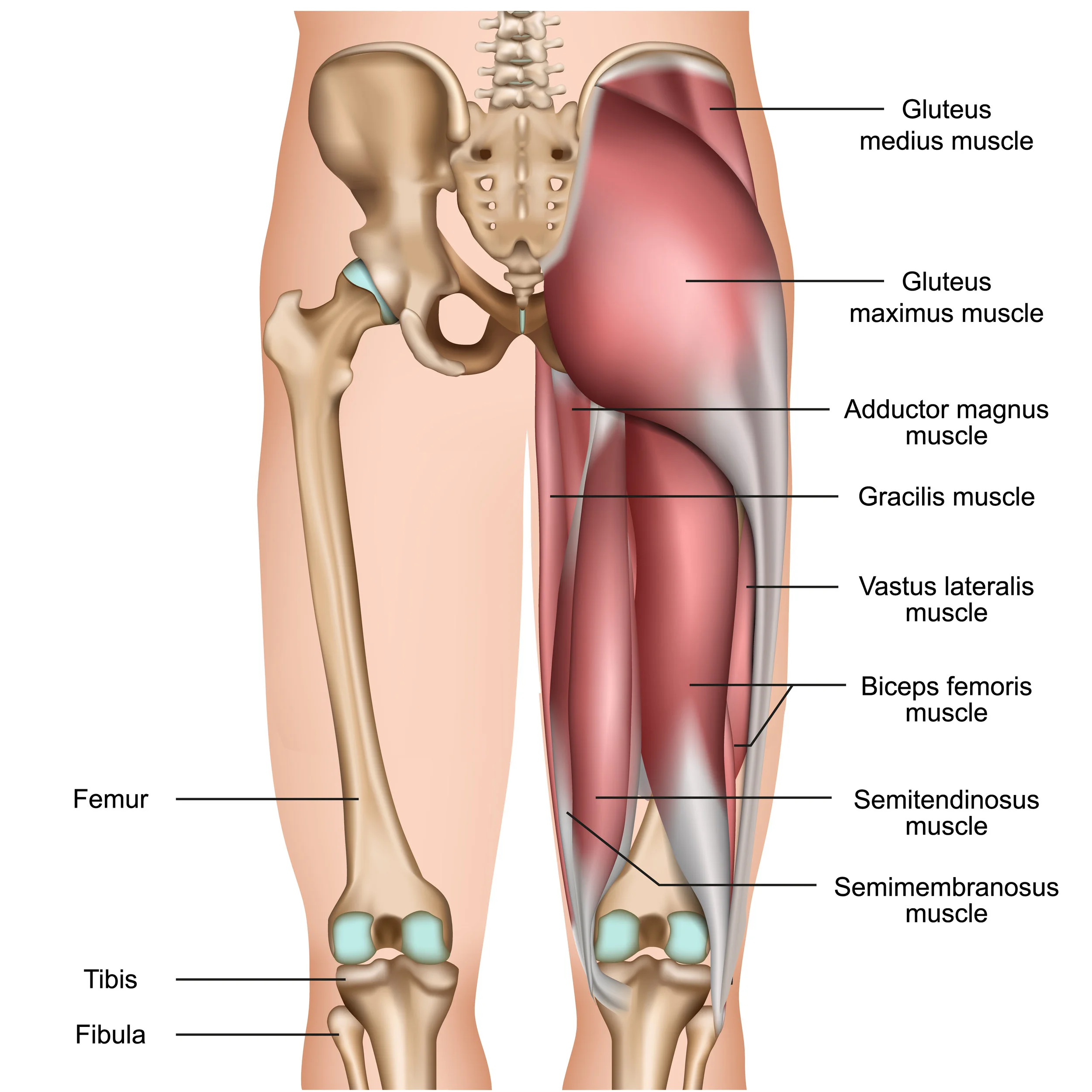
Semitendinosis: The semitendinosis mucles originates from the ischial tuberosity (sit bone) and inserts below the knee on the medial side of the tibia. This orientation causes it to act on two joints meaning it is both a Knee Flexor and Hip Extender. Due to its insertion on the inside of the tibia bone, it can internally/medially rotate the tibia when the knee is bent and also internally rotate the femur when the knee is extended.
Semimembranosis: The semimenbranosis muscle originates and inserts very closely to the semitendinosis and acts similarly as a knee flexor and (poor) hip extender. There are subtle differences in the two ‘semi muscles’ but it’s claim to fame is more along the lines that is may play a role in knee stability given it is suspected to have a functional relationship with the popliteus muscle on the back of the knee and a few fibers supporting the MCL. We learn more about the body everyday, so this may change.
Biceps Femoris: The Biceps Femoris has a similar function as the ‘Semi muscles’ in that it assists in knee flexion, and lower leg deceleration during the runners gain cycle, but it is somewhat special. The biceps femoris muscle has two heads that attach to two different places. The long head comes all the way from ischial tuberosity like the ‘semi brothers’, crossing the hip joint, making it a hip extender. But the short head, it comes off the back of the femur at a spot called the linea aspera. The short head does not cross the hip joint so it does not extend the hip, but it does have a special power. If you are unfortunate enough to experience an avulsion of the hamstring origin off the ischial tuberosity, the short head is still attached and allows you to, albeit weakly, flex the knee. This allows you to maintain some ability of ambulation. Our bodies are smart!
Basic Function Of The Hamstrings In Running
The hamstrings have a very important role in the running gait cycle, but it may not be what you think. As distance runners, our hamstrings are not as strongly used as in our sprinting counterparts, but as we all know after a good speed work session, they are back there serving ther purpose.

To keep this simple. The hamstrings job is to ‘slow’ down the leg as it swings forward. WHAT? SLOW DOWN? Yes! And the faster you run, the harder it works to slow down the leg.
It does this in what is called an eccentric contraction. Simply put, the hamstring fires as the leg swings forward so that your foot and lower leg do not go flying out, causing the knee to fully extend, and then you land on a locked knee. This would cause many injuries, and runners with a lack of control here often have knee and hamstring injuries.
Okay, so lets go a little deeper…nerd-out if you will.

For a great review of the gait cycle, check out the Biomechanic.
When the leg is planted in the stance phase, the hamstring contracts with the quads and adductors to create a stable platform inwhich we can use our momentum to continue to propel forward.
As the leg moves into the toe off phase, the hamstring supports by contracting more concentrically aiding in the push-off that propels us forward..but here is where it gets fun.
During the mid part of the swing phase, the hamstring is passive as the quads and adductors do most of the work bringing the leg foward. The hamstring does work to pull the heel toward the butt in good form, but they do more stretch than anything as studies suggest the hamstring stretches from 50% length to 90% length during this time.
Once we start moving from mid swing to heel contact, the hamstring kicks in eccentrically, and puts the brakes on the lower leg, allowing for a stable platform to land and maintain during the new stance phase.
What Do The Hamstring Do For Distance Runners?
As distance runners, we work through all of theses running phases, just less draumatically than our explosvie sprinter friends. The hamstrings act more in the stability and concentric role during our long outings, which leads way to one theory as to why distance runners deal with more tendinopathy injuries (generally overuse) than strains and avulsion injuries (dynamic and powerful contractions).
What Types Of Hamstring Injuries Do Runners Experience?
Acute Hamstring Strains In Runners:
This is one of the most common overall injuries to plague athletes, for running, it is usually a problem for the sprinter of the group. A muscle strain, or pulled muscle, occurs when a muscle is suddenly overstretched, resulting in the tearing of some of the fibers within the fascicles that make up the larger muscle as a whole. This can be a very small percentage which only causes mild tightness, to a more prominent injury that can range from mild swelling, to complete immobility with bruising and severe swelling.
As a runner, if you are to experience a hamstring injury, a mild strain is preferable. Typically, we can get back out and perform modified running in 2-4 weeks with full healing and return to play in 4-8 weeks.
Hamstring Tendinopathy In Runners:
This is what we see most. As distance runners, we typically run far, make us prone to overuse injuries. Those injuries typically start with a little tightness that goes unaddressed because we are able to continue running. Over time, that muscle tightness begins to place an overload on the tendon, and that tendon begins to get irritated. In can inflame, dehydrate, become sensitive, and eventually make it difficult to run, walk, or sit for long periods.
There are two places this can occur, the lower tendon insertion, which we typically see acutely after a race, fall, or a big downhill effort. This area is often where we see a rupture in sprinters. If you have ever watched a 100m or 200m race and seen a running pull up very quickly and then fall or start hopping, this is what they experienced, and it can be career-ending at the highest level of the sport.
Now, for the upper tendon origin. High hamstring tendinopathy is so common and so frustrating, it has been listed in the runner’s guide of forbidden phrases. High hamstring injuries suck…there is no way around it. These injuries take TIME and often require some time off from running. I told you it was a forbidden term.
High hamstring tendinopathy typically takes 3-6 months for a full recovery and complete release to high volume and high intensity running. Care involves a strict plan for in-office and home care…and even with that, we still send out a good percentage for co-management with an orthopedist.
To summarize this injury. Don’t ignore your hamstring tightness or an injury you believe to be a mild strain. Give it attention, seek help, and rest if necessary. Unfortunately, some runners will press on, and the outcome is very unfortunate.
Hamstring Avulsion Injuries In Runners.
This is a tough one that typically requires surgical intervention. An avulsion injury is when the hamstring tendon pulls away from its attachment on the bone and takes part of the bone with it. These are uncommon without a significant mechanism of injury, we don’t typically see this from just running, but it has happened. This injury will cause severe pain, swelling, and bruising and should be examined by an orthopedist as soon as possible as the muscle can begin to ‘roll-up’ and atrophy shortly after the injury.
Dr. Reheisse is a Board Certified Chiropractic Sports Physician practicing in Cottonwood Heights Utah. Revive Sport & Spine provides evidence-supported chiropractic care and conservative sports injury management.
If you are in the greater Salt Lake City, Utah area and are a runner dealing with a nagging hamstring injury, we are here to help. Click the link below to schedule a consultation appointment and lets get you back out and running.