THOUGHTS ON:
Training, Rehabilitation,
&
Best Care Practices

Youth Running: Benefits, Risks, & Considerations
Running is one of the best (coming from a runner) and easiest sports to take up in the world. Running is a major part of nearly every sport on the planet, making it an excellent option for our school-aged athletes. In 2017, almost 500,000 runners ran XC, and over 1 million athletes ran track. With the ease of access and a million different training techniques and training theories comes the risk of adverse effects. Over the last 10 years, we have seen a 34% increase in injuries incidence among runners.
Running is one of the best (coming from a runner) and easiest sports to take up in the world. Running is a major part of nearly every sport on the planet, making it an excellent option for our school-aged athletes. In 2017, almost 500,000 runners ran XC, and over 1 million athletes ran track. With the ease of access and a million different training techniques and training theories comes the risk of adverse effects. Over the last 10 years, we have seen a 34% increase in injuries incidence among runners.

Shin splints can be an precursor to stress fractures in young runners. Check out our MTSS Blog Series to prevent and rehab this common injury.
It is estimated that 20-80% of runners will experience an injury in a given year. Random range, right? You try to find two studies that can agree on this! However, we do know that more than 50% of all pediatric sports injuries are due to overuse. We also know that overuse has is signs and symptoms and can be prevented.
What do we know about youth running? A lot actually. Let’s look at the facts and discuss how we can prevent future injuries so our young runners can enjoy a life-long relationship with this wonderful sport.
BENEFITS OF RUNNING FOR YOUTH ATHLETES
Great Cardiovascular Health.
Improved Cognitive Development.
Exercise increases metacognition, behavior regulation, and accelerates behavioral and emotional engagement.
Bone Health - Increased Bone Density
Positive Self Image & Emotional Wellbeing
Aids in Development of Total Athleticism.

Running injuries are common in youth-aged runners, but the benefits from frequent exercise, competition, and camaraderie far outweigh the risks. Learn more about beginning running for health and fitness here.
CURRENT TRENDS IN YOUTH RUNNING: INJURY RISKS
Accelerated Growth.
Peak height velocity (when children grow fastest, resulting in bones lengthen faster than muscles and tendons can keep up with) occurs around 12 for females and 14 for males.
Just before this rapid growth, bone mineral content is at its lowest, making bones and growth plates vulnerable to the load and stress of running.
Low Bone Mass For Age.
Affects 39% of female youth runners.
Might be the more likely cause of stress fractures than training load.
Low Energy Availability, Relative Energy Deficiency in Sports
Adolescence is a time of rapid growth with unmet energy demands…inadequate calorie intake with increased running demand can lead to abnormal menstrual function in females, bone mass depletion, and high risk of musculoskeletal injuries and stress fractures.
Males Commonly Suffer From Low Bone Mineral Density As Well.
Risk factors include being less than 85% weight for height, running over 30 miles per week, a history of stress fractures, and having a diet lacking in calcium-rich foods.
Answering ‘YES’ To The Following:
‘do you believe that being thinner leads to faster running performances?’
BIG RED FLAG
Increased Anxiety or Avoidant Coping Strategies Such As Denial.
Perfectionism-related thoughts are associated with higher rates of depression, anxiety disorders, obsessive-compulsive disorders, and eating disorders.
History Of Previous Running Injuries.
Strong indicators for in-season injuries are injuries during summer training (female) and history of previous running injury (males).

HOW CAN WE PREVENT INJURY IN YOUTH RUNNERS:
To prevent injury, cross training is necessary. Recent data suggest that shorter intense bouts of activity like sprinting, other sports, and neuromuscular training are better for developing motor skills compared with endurance running. Remember, though they grow, they are still kids and need time to play. Play outside, play other sports, rest from play. Don’t forget that.
Strength Training #1 - Improved Core And Pelvic Strength Led To Faster Race Times.
A 6 week strength program aimed at pelvic and core strength led to improved race times. Strength training also leads to better weight control, improved motor performance skills, improved cardiovascular health, and enhanced psychosocial well-being…oh, and less sports-related injuries.
Strength Training #2 - Spine & Hip Strengthening.
Exercises aimed at the spine and hip muscles helped injured youth runners rehab from injury faster and prevented future occurrences of common running injuries such as Achilles tendinosis, iliotibial band syndrome, runner’s knee, plantar fasciitis, and shin splints.
Strength Training #3 - Strength Training For Runners Program.
We have developed an instructional series around some of the best strength exercises for runners. You can check those out here.
Set Realistic Expectations - Know Age & Developmental Stage Capabilities.
Unrealistic expectations lead to athlete frustration, low self-esteem, burnout, and injury! This can lead to reclusiveness, depression, and loss of enjoyment.
Monitor Youth Runners For Signs Of Burnout.
Students athletes who withdraw from activities they previously enjoyed may be experiencing chronic stress and burnout from their sport. This leads to more complicated issues if unaddressed, like depression, obsessive-compulsiveness, and eating disorders.
If an athlete becomes more irritable, anxious, or struggles with perfectionism, they are demonstrating signs of burnout. They need time off or decreased self, coach, and or parental pressures related to their sports.
Coordination Of Care For An Athlete.
Extrinsic risk factors for injury include improper training volume, intensity, or progression, early sports specialization, poor footwear, and inefficient running form. These factors are better addressed when the athlete, parent, coach, and healthcare provider have open communication with the athletes BEST INTEREST at the forefront.
Modify Training Program To Allow Rest Periods
Injury can be reduced by developing a training plan that limits weekly and yearly participation time to reduce repetitive movements and increase scheduled rest periods within each week, season, and annual training cycle.
Suggested rest is at least 1 day per week, 1-2 weeks every 3 months, and participation limited to 9-10 months per year.
Avoid Early Sports Specialization (Bolded Based on IMPORTANCE)
Highly specialized youth athletes (those participating in one sport more than 8 months of the year) report more injuries than their peers, independent of age, sex, or training volume.
Early Sport Specialization is associated with unidimensional identity with the sport leading to the athlete feeling as like they lack control with their participation in that sport. This leads to burnout.

All Credit To The Authors & AJSM. No Copyright Violation Intended. Click Here To Access Full Article.
When To Seek Treatment
Now that we are aware of injury risks, YOU have to take preventive measures. For some, this means a little time off before training ramps up again. For others, it’s time to hit the gym, toss a ball around, shoot some hoops, and spend some time at the pool.

Early Care Is Crucial To Retruning To Running In a Resonable Time-Frame. Schedule Today.
Shin Splint Pain Relief -> CLICK HERE
IT Band Pain Relief -> CLICK HERE
Runner’s Knee Pain Relief -> CLICK HERE
When it comes to injuries, we know two things.
(1) Rest is rarely beneficial for sports injury recovery. Rehab needs to be active!
(2) The sooner you seek care with an injury, the sooner you will be back out and running.
If you or your child has been training for the upcoming cross country season but are continually being sidelined by injury and illness, it’s time to find help and get back on track. If you are a runner in the Salt Lake City area, Revive Sport & Spine is your go-to clinic to get you back up and running quickly, giving you the tools to help you run faster, farther, and more efficient than before.
Krabak et al. Youth Distance Running: Strategies for Training and Injury Reduction. American College of Sports Medicine. 2019. Current Sports Medicine Reports. www.acsm-csmr.org.
Dr. Reheisse is a Board Certified Chiropractic Sports Physician practicing in Cottonwood Heights Utah. Revive Sport & Spine provides evidence-supported chiropractic care and conservative sports injury management for the great people and adventurers of the Salt Lake City Valley.

Medial Tibial Stress Syndrome Part 2 - Self-Care For Shin Splints
In PART 1 of our Shin Splints series, we took a look at the anatomy associated with medial tibial stress syndrome as well as the factors that make runners especially susceptible to them, namely the repetitive nature of running compounded by most cases typically doing too much too soon. Here in PART 2, we are going to look at self-care options as well as some considerations for preventing repeate episodes of shin splints so that you can keep running and training for your goal races.
In PART 1 of our Shin Splints series, we took a look at the anatomy associated with medial tibial stress syndrome as well as the factors that make runners especially susceptible to them, namely the repetitive nature of running compounded by most cases typically doing too much too soon.
Here in PART 2, we are going to look at self-care options as well as some considerations for preventing repeate episodes of shin splints so that you can keep running and training for your goal races.
SELF CARE OPTIONS FOR MTSS-SHIN SPLINTS
Self Myofacial Release - 4 Ways To Care For Your Shin Splint Pain
Pre-Running Warm-Up For Shin Splints
Training Modifications, Gear Suggestions, & Other Prevention Considerations
Form, Cadence, & Ground Contact Time:
This is a tricky subject, honestly I’m not sure why I even mentioned it. One can go miles down the form training rabbit hole and come out the other side worse they they were before. However, I do want to mention three things that must be considered and worked into your training plan to help prevent shin splints and make you a more efficient and faster runner.
The ground fights back! The more time we spend in contact with the ground, the harder this battle will be. I’m not here to talk about heel-striking, forefoot running, etc., but I will mention cadence. The higher your cadence, the less time your foot spends on the ground. Meaning, the less ground reactive forces you absorb and the less stress on your body.
Again, I’m not here to correct form. But I do believe we can all be more efficient. Strength training helps us become more efficient for those later stages of the race. Please add strength training to your program, it is extremely useful.
Alter your surfaces. Don’t always pound the pavement. The track and trails are your friend…and your feet will thank you for it.
Shoes:
Shoes are something I get asked about frequently. My honest answer is this, ‘We have more shoe technology and selection than ever…we also have more injuries than ever.’ Take that for what it is worth but I do believe shoes should be rotated and changed frequently. I suggest a 2-3 pair rotation, avoid running in the same pair two days in a row, and switching out for a new pair every 200-300 miles depending on the shoe.
Warm-Up & Cool-Down:
This is SO BIG. In every injury we encounter and talk about, how you warm-up (if at all) and cool-down has a direct impact on your injury risk, and recovery speed from injury. Warming up prepares your body for the task ahead, giving it the best chance to avoid injury. Colling down helps work out those tight spots after training while encouraging faster recovery.
Dr. Reheisse is a Board Certified Chiropractic Sports Physician practicing in Cottonwood Heights Utah. Revive Sport & Spine provides evidence-supported chiropractic care and conservative sports injury management.

Resolve Low Back Issues Part 4: Most Common Myths Of Low Back Pain
Few musculoskeletal conditions have a cult-like following of myths as Low Back Pain, many of which have been said by various healthcare providers across all specialties. To help clear the air, let's take a look at the 5 most common misunderstandings and myths that we encounter in our chiropractic clinic that could actually make your low back pain worse.
Low Back Pain Myths
Few musculoskeletal conditions have a cult-like following of myths as Low Back Pain, many of which have been said by various healthcare providers across all specialties. To help clear the air, let's take a look at the 5 most common misunderstandings and myths that we encounter in our chiropractic clinic that could actually make your low back pain worse.
Before we get started…
These myths and misunderstandings are not aimed at making low back pain seem 'made-up,’ it is a very real and challenging condition. These myths are just folklore passed down from old, unsubstantiated in the research, ways of thinking. Our truth is that, if you believe one thing and that makes you feel that your low back is wrecked for life, a long road of pain is what you are in store for. We call this fear-avoidance and catastrophizing, the medicalization of a condition. We will touch more on this when we cover imaging next week. But a big part of recovering from low back pain is believing that you can get better. It may sound silly, but no more ridiculous than believing these myths below!
NUMBER 1: Your back pain is from a misalignment, bone out of place, or a ‘subluxation.’

We don’t practice this way any longer, stop using explanations from this era.
These are common descriptions patients and doctors alike will give when describing their back pain. The most common being...you threw your back out, and it is now misaligned...commonly spoken by chiropractors of a generation ago or current doctors, chiropractors, and physical therapists that have not caught up with current research. The truth to this is that your spine is a dynamic structure designed to move, what we ACTUALLY find is that the pain you are feeling is often associated with immobility, or areas of the spine that should be moving, but due to tight muscles and previous injury, may not be moving well or correctly anymore. Spinal manipulation or an ‘adjustment’ is designed to restore normal motion to these restricted areas.
A bone did not shift out of place and therefore needs to be put back in! That’s not how it works.
NUMBER 2: Arthritis is the root of all evil!

Arthritis is like wrinkles on your face…lets just keep it nice and say they are signs of wisdom. Truthfully, if you live and play hard and long enough, we will all experience some degree of degeneration. However, and please understand this, it is a natural process and does not necessarily equate to pain! When conditions present that are more challenging, using arthritis as the ‘fall guy’ is the easy way out for a provider and an often acceptable answer for the patient.
NUMBER 3: “But…I have scoliosis and a short leg” that is the cause of my back pain.

Just like arthritis, scoliosis and an actual short leg (1cm or shorter than the other) are comfortable areas to place blame when someone presents with back pain. Both can absolutely lead to dysfunction, and if unaddressed, pain and discomfort. To a certain degree, uneven leg lengths and spinal rotation/curvature are normal variants, meaning most people have these at a mild level and are unlikely to be a pain generator. For most (not all) look to place the blame elsewhere.
NUMBER 4: Rest is what I need to recover, right?

The days of ‘take 2 of these, rest, and call me in the morning’ are long gone. You likely have a relative who spent a good amount of their life with back pain that limited some or all of their activity. When you see a case like this or someone who is much too young to be experiencing recurrent back pain, it may seem like the right thing to do is rest up for a while. Fortunately, we now have stacks of research that supports the fact that bed rest is the worst (top 3 at least) idea when it comes to low back pain. The new adage is ‘Movement is Medicine.’ When someone presents to our office, we are not only just trying to relieve pain, but to relieve pain SO THEY CAN GET OUT AND MOVE. Even walking, WALKING, has been shown to reduce low back discomfort and be a great tool to prevent future occurrences.
NUMBER 5: Slap a brace on it & it will be fine.

Brace low back pain long term & you should join the circus with that thinking.
This is excellent advice if you are looking to weaken your core muscles completely. Did you know that powerlifters use the belt to their advantage to complete amazing feats of strength not to brace their low back, but to give their stomach something to press in to, creating intraabdominal pressure (think bracing your stomach if someone was to punch you) that stabilizes the spine from the inside? Our bodies are amazing, it has its own ‘weight belt’ built-in. Using straps, belts, or any other contraption like this for extended periods of time tells your body that you do not need it to do its job anymore. This core weakness and inability to naturally brace yourself through muscle control —> LEADS TO CHRONIC LOW BACK PAIN.
In summary, things change. Our treatment methods and your outlook on your condition must change. Every single one of these five myths is still spouted today in an office somewhere near you. Knowing the validity of that is often more important than the care you receive. While in certain circumstances, these can be valid reasons for low back pain. For most, especially those who come through our Cottonwood Heights, Utah Chiropractic and Rehabilitation clinic, we want a better answer. One that helps address and correct the dysfunction. One that promotes confidence and encourages the patient to try harder, that they can feel better and live a life they enjoy.
Next week, in part 5 of our Fix Your Low Back Series, we are going to discuss red flags, when you need imagining, and why you shouldn’t always rest your diagnosis and pain on those images.
Dr. Reheisse is a Board Certified Chiropractic Sports Physician practicing in Cottonwood Heights Utah. Revive Sport & Spine provides evidence-supported chiropractic care and conservative sports injury management.

Runner's Knee Bonus: Patellofemoral Pain Syndrome - Not Just For Runners
For several weeks we have been covering patellar femoral pain syndrome (PFPS), or runner’s knee as many like to call it. However, as with many of the conditions we see, it can be found in more than just one population of people. PFPS can also be caused by other physical activities that put repeated stress on the knee. This can include squatting, jumping, climbing stairs, etc. Along with that, PFPS can occur when you have patellar malalignment, which was touched on in Part 1 of our Runner’s Knee series.
With most PFPS we see, it comes from a sudden increase of load placed on the knee. So if you have recently increased your weight at the gym, time on the Stairmaster, or taken on a new activity, if the stress level on your knees has increased you could experience “runner’s knee” even if you do not consider yourself a runner. With that said, here are a few preventative measures we can implement that could help.
For several weeks, we have been covering patellofemoral pain syndrome (PFPS), or runner’s knee, as many like to call it. However, as with many of the conditions we see, it can be found in more than one population. PFPS can also be caused by other physical activities that put repeated stress on the knee. This can include squatting, jumping, climbing stairs, etc. Additionally, PFPS can occur with patellar malalignment, as touched on in Part 1 of our Runner’s Knee series.
Most PFPS we see come from a sudden increase in load on the knee. So if you have recently increased your weight at the gym, time on the StairMaster, or taken up a new activity, and the stress on your knees has increased, you could experience “runner’s knee” even if you do not consider yourself a runner. With that said, here are a few preventive measures we can implement to help.
PREVENTIVE TECHNIQUE #1:
If you are squatting, jumping, or having difficulty hiking or climbing stairs, ensure you get a proper warm-up. In addition to the treatment options listed in Part 3 of our Runner’s Knee series, you can perform band exercises before your activity. Each of these exercises is
beneficial in increasing our mobility and strength, as well as providing our bodies with proper preparation for the activities we engage in.
PREVENTIVE TECHNIQUE #2:
An additional preventive measure is to always use proper form. In all things we do, improper form can cause extra strain on our bodies. In all activities, especially lifting and squatting it is important that before we increase weight we ensure that our form is correct. Squatting with our knees in line with our toes, and our back naturally arched allows the weight to be properly distributed throughout, rather than having all the pressure on our knees.
PREVENTIVE TECHNIQUE #3:
The last preventive measure is simple but effective. It is important that we increase our training gradually and not all at once. If you are a lifter, gradually increase weight. If you are a hiker or climb stairs, increase your distance and pace gradually. Our bodies are adaptable, and with steady increase, it can adjust accordingly.
FINDING ANSWERS
So for those of us who are experiencing knee pain in the front of our knees and are not runners, there are answers here for us as well. It just so happens that those answers are very similar to those who run many miles a day. So don’t be afraid to dive into our multi-part series about runner’s knee. I think you will be able to find answers to your knee pain as well.
Check out the Part 1, Part 2, Part 3, and Part 4 of our Patellofemoral pain syndrome series here.
Janaye Freeman is a Certified Athletic Trainer & Lead Therapy Technician at Revive Sport & Spine in Murray, Utah. Revive Sport & Spine provides evidence-supported chiropractic care and conservative sports injury management for Murray, Holladay, Cottonwood Heights, Millcreek, Midvale, and Sandy.
Injury Prevention For Runners: Tips To Support Your Training
As runners, we really only have 2 goals...
Run faster/farther than we ever have before.
Remain injury free.
For the last 4 years, it has been our goal at Revive Sport & Spine to be the leading sports chiropractic clinic serving the greater Salt Lake City area when it comes to running-related injuries and prevention. Having aimed for the same goals mentioned above through my own running the last 20+ years, there are few endurance sport related injuries that I have not encountered either personally or clinically.
While we field questions about running form, injury prevention, running shoes, pre-race meals, training plans, strength training, etc., some questions are better answered by those who work in that arena day in and day out.
Over that last few months, we were able to sit down with a few local specialists in sports nutrition, mental skills training, strength training, and running shoes. Our goal was to find out how each component can aid runners with injury prevention.
As runners, we really only have 2 goals...
Run faster/farther than we ever have before.
Remain injury-free.
For the last 4 years, our goal at Revive Sport & Spine has been to be the leading sports chiropractic clinic serving the greater Salt Lake City area for running-related injuries and prevention. Having pursued the same goals mentioned above through my own running for the last 20+ years, I have not encountered many endurance-sport-related injuries, either personally or clinically.
While we field questions about running form, injury prevention, running shoes, pre-race meals, training plans, strength training, etc., some questions are better answered by those who work in that arena day in and day out.
Over the last few months, we were able to sit down with a few local specialists in sports nutrition, mental skills training, strength training, and running shoes. Our goal was to find out how each component can aid runners with injury prevention.
INTERVIEW 1: Nutrition Tips For Runners with Dietitian Tayla Russell.
INTERVIEW HIGHLIGHTS:
Runners and other endurance athletes are different from athletes who play soccer, football, baseball, etc., and therefore have higher specific nutritional needs that fluctuate depending on the distance and type of race. One must is that we need more carbs during our training cycles. Choose good carbs like grains, fresh fruit, and fresh vegetables.
As runners, injuries are inevitable. Know what foods can help during the healing cycles can speed up your recovery and get you back out on the road or trails quickly. Great Anti-Inflammatory foods include healthy fats like avocados, nuts, and seeds, high anti-inflammatory fruits like pineapple, and spices such as ginger and turmeric.
Myth: All runners must carb load before a race? False, while long-distance runners do need some extra for energy stores later in the race, most people just over-eat the night before a race. So if you are waking early the next morning for a 5k or 10k race, you are better served to have a light dinner of fresh veggies, lean protein, and a small amount of carbohydrates.
Contact: Tayla Russell - dietitiantayla@gmail.com - 435.553.5698 - Max Muscle Cottonwood
INTERVIEW 2: Mental Skills Training with Nate Last, M.S. from Mental Grit Consulting
INTERVIEW HIGHLIGHTS:
Negative Self Talk: Negative talk puts us in our own way on our path to our goals. Everyone does it and it is a major contributor to not performing at our best.
Ideal Mindset: We have an ideal mindset, we have to practice it just like everything else we are working on. Understand you can accomplish your goals, we can and will fail at things in the process, but use it as a building tool to strengthen your mindset.
Process Before Outcome: When training and racing, focus on the basics, focus on doing everything you can do RIGHT NOW, in the moment that will help you perform better in the future. It is okay to think ahead and dream about the future, but don't stay there! Bring yourself back to the process.
When Injured: Stay on track through an injury. Believe your body is capable of healing and training again. When you believe this, it will happen, and it will likely happen faster.
Contact: Nate Last - Mental Grit Consulting - 801.368.7564
INTERVIEW 3: Strength Training For Runners with Ryan Carver, CSCS from Leverage Fitness Solutions.
INTERVIEW HIGHLIGHTS:
Should Runners Weight Train: YES! Weight training can help prevent injury by building the strength of not just your muscle, but ligaments, tendons, and joints. Weight training can also make you faster by improving your overall economy and efficiency.
Increase The Weight Or Volume: As runners, we spend most of our time doing high volume training. So when it comes to weightlifting, increasing the weight and shift toward lower reps is ideal to obtain the most benefit. Also, just because we run or cycle, we still need to lift with our legs, don't shy away from the squats, lunges, and deadlifts.
Top Exercises For Runners: (1) Weighted Step-Ups (2) Nordic Curls - Hamstring (3) Hip-Hike (4) Shin Strength - Toes To Shin w/ Resistance (5) Stir-The-Pot Core Exercise.
Contact: Ryan Carver - Leverage Fitness Solutions - 385.985.3603
INTERVIEW 4: Running Shoes & Injury Prevention with Darrell Phippen from Wasatch Running Center.
INTERVIEW HIGHLIGHTS
New Technology: All name brands have great technology, but which one is best for you and your running style and goals? Shoes are lighter, have better and more comfortable uppers, and have more fits than ever before. Getting a correct fit, and finding the best shoe for YOU, is almost as important as your training plan.
Shoe Fitting: Trying a shoe on is not enough to make a decision. How does it feel with movement, walking and running? Working with the professionals who have been trained in shoe fitting can make all the difference in finding the right shoe to help you remain injury free.
How Many Shoes Do You Need: As runners, more shoes is always better. But when you look at the average mileage of shoes, 250-350, and how often you run, having multiple shoes has its advantages. Our suggestion is to have a minimum of 2 shoes if you are primarily a one surface runner, 3 if you mix trails with road running. This allows them to last longer, continually challenge your feet and allow them to adapt to a variety of surfaces, and help prevent injury.
Contact: Darrell Phippen - Wasatch Running Center - 801.566.8786
Dr. Reheisse is a Board Certified Chiropractic Sports Physician practicing in Murray, Utah. Revive Sport & Spine provides evidence-supported chiropractic care and conservative sports injury management.

Iliotibial Band Syndrome Pain - What You Need To Know & What You Can Do About It.
Runners in Utah and all over the country have expereinced that stabbing knee pain, during and after a run, that seems to come out of no where, leaving you sidelined and unsure what caused it or how to deal with it. Iliotibial Band Syndrome, or ITBS, is one of the most common injuries experienced by new and veteran runners alike. We discuss some of the basics and a few simple tools to help deal with it.
I can remember like it was yesterday. I was nearly halfway through Chiropractic school and roughly 1.5 years returned to frequent running. It was a cold morning race, cold enough to earn its race title of ‘Frostbite’ series. As I ran down a slight decline, 3 miles into a 10k jaunt, I felt this sudden STABBING on the side of my right knee. Unsure of what was happening, I was able to run another 400 meters before having to stop and walk...I had never done that before, stopping in a road race was absurd...but to my surprise, outside of a little tightness, the knee pain subsided, that is until I started running again. Within 100 meters, the stabbing pain was back. From there, I journeyed on my longest 10k race to date!
Of all the running injuries that come through the clinic, Iliotibial (IT) Band complaints take the cake. While few runners escape the stabbing grip that is an IT Band Syndrome injury, there is much confusion as to what is actually causing the pain, and even more about how to treat it. Nowadays, I encounter a handful of people every week who complain of this exact same thing, so let's take a simple look at what is going on as well as a few proven ways to take care of it.
5 THINGS YOU NEED TO KNOW ABOUT IT BAND SYNDROME
1. It is one of the most frustrating running injuries known to wo/man!
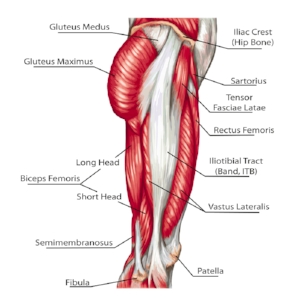
ITBS is a common overuse running injury. The IT band (who wrongly gets most of the attention) is a dense band, made of fibrous connective tissue, that connects the hip to the lower leg, while also crossing the lateral (outside) of the knee, providing stability in the process. The band is a continuation of the Tensor Fasciae Latae (TFL) muscle, acted on by the glute max, and assists in hip extension, abduction, and external rotation.
2. If you succeed in 'stretching' the band...it's called tearing! You Can't Stretch It!
Yes, you read that right, you can’t actually stretch the IT Band. Why? It’s a tendon! It’s Thick! Connective tissue is very strong….the band is like a truck tire! A few studies have attempted to measure some sort of stretch of the band itself, one going as far to harvest the band from cadavers, try to break it down by freezing and thawing the tendon and then put it under mechanical stretch to find that...NOPE, didn’t gain much more than a millimeter. If this is the case, how can you expect it to stretch by rolling the outside of your leg with a piece of foam, or by crossing one leg over the other and leaning into a wall?
3. Running causes this pain, how? Good question...It Depends!
The IT Band is tightest at 30-40 degrees of knee flexion, an angle many runners pass through multiple times in the gait cycle. In addition to this, it can help absorb ground reactive forces from each foot strike while also being required to provide more and more support of the lateral knee as the hip fatigues in the later stages of a run. This allows the hip to drop during the stance phase, causing a valgus knee, excessive foot pronation, pronation speed control, and rotation and friction at the lateral knee. Now, this is all just mechanical mumbo-jumbo. Running irritates it because it is a high-compression (no longer believed to be a friction issue), high-load spot of the lower extremity, and with movement and need for stability and function comes the opportunity for dysfunction. If you combine this with the capacity every runner has to overtrain, or that most new runners take up the sport with no coaching, we have created the perfect storm!
4. But it hurts RIGHT HERE! You mean that is NOT the cause?

We now know that the IT band courses from the outside of the hip/thigh region to the outside of the leg just below the knee, therefore the pain in on the outside of the knee. We bring this up as it is often confused with Runner’s Knee. While both interrupt our ability to enjoy running and racing, they have very different causes and presentations.
5. Treatment is relatively simple, sometimes aggressive, but simple. The commitment, on the other hand... runners don't do well with commitment.
So where do we focus our attention as we work to decrease the pain and get back to running? THE HIPS! Have you been listening? With runners, there is always a hip component of the problem; in the instance of IT Band complaints, it is a 95% hip problem. As we address how you can begin tackling this irritation on your own, remember that the sight of pain is not always...more like ‘rarely’....the site of the problem.
3 THINGS YOU CAN DO TO TREAT IT BAND SYNDROME A STARTING POINT
Self Treatment Phase 1: Foam Roll and Stretch The Cause
This should be expected, I love the foam roller. Mostly because it is simple to use and travels well, but when used correctly, it is honestly the best $20 you can spend. You are more than welcome to roll over the IT band itself, under 3 circumstances - 1. Know that it will hurt! 2. You admit you are not lengthening the IT band itself and are more addressing trigger points and just smashing the lateral quad into the femur. 3. As with any area, you do not to do it excessively.
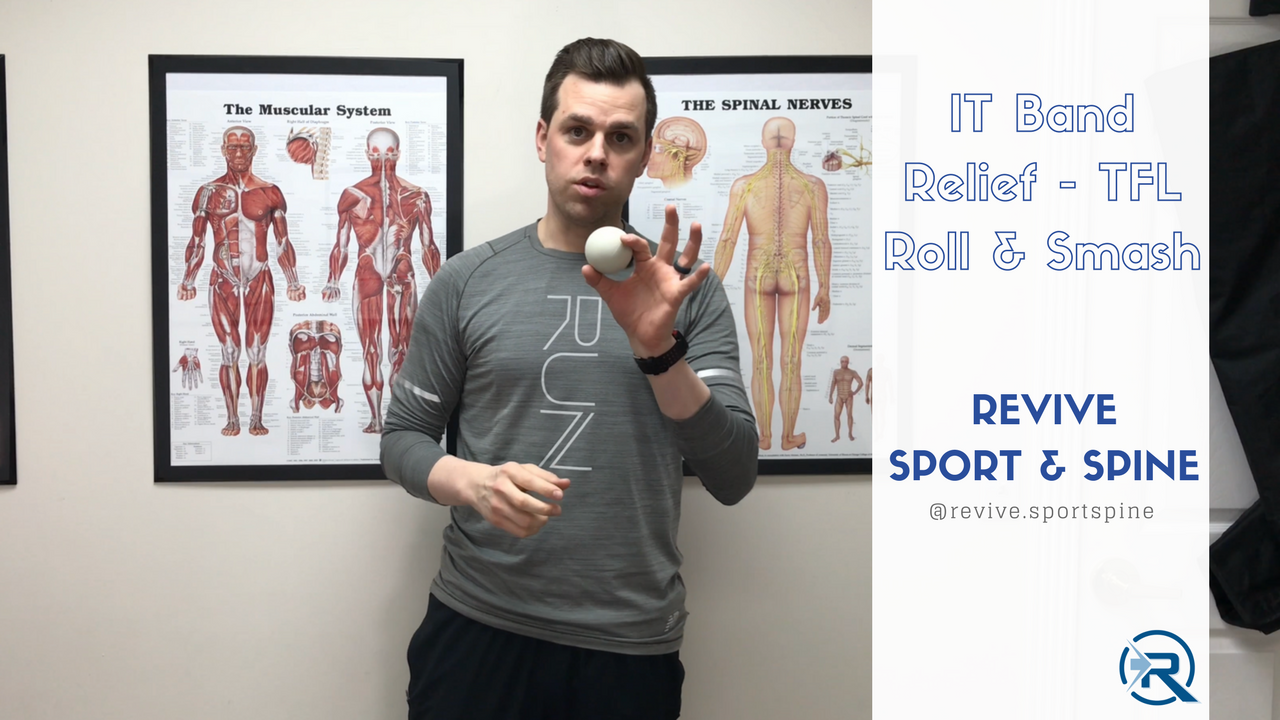
With that being said, we DO want to use the foam roller on the posterior hip to address the glutes and external rotators of the hip as well as the TFL muscle itself. Work through these videos, they are no more difficult than sitting on the roller and moving back and forth but I do suggest 3-5 sessions per day, no more than 10-25 rolls up and down on each area of the hip and leg
Self Treatment Phase 2: Strengthen The Hips
Once you have addressed the mobility of the hips and the flexibility of the associated muscles, it’s time to build strength. As we fatigue during running, our hips begin to dip and get sloppy. This not only causes us to be extremely inefficient, but it leads to mechanical breakdown and resulting IT band syndrome related lateral knee pain.
We have worked hard over the last few years to develop a warm-up routine that addresses many of the most common running injuries, and this particular injury is the one that started it all. Our suggestions here is to utilize strength bands in your warm up to ignite the posterior hip, as seen in our BANDS warm-up video. Start with 1 set of 10 for each exercise, PRIOR to running! Exercises: Clams, Bridges, Band Walks.
Self Treatment Phase 3: Increase Cadence/Change the Terrain/Work The Hills
Lastly, while we have little data on how ground reactive forces contribute to IT band complaints, clinically, it is a big enough factor for us to consider a few modifications while you run back to health. From personal experience and talking with 1000s of runners who have worked through their IT band problems in our office, the two things your IT band does not like are hard pavement and downhill running. If you are a runner in Utah, this just set off a huge signal in your brain, recalling every race you have run in the last 2 years and realizing they were ALL downhill road races!
Rarely do we shut runners down while we are working through an IT band issue, but I will suggest 3 ways to change up your running.
Increase your cadence by 10-20 steps per minute. While difficult at first, it helps relieve many common running complaints.
Check out some alternate terrain. In my book, it goes trails first, track is a close second, and lastly, the road. I get that it is easiest to run out the door and do a road run, but the track (rubber) and especially the trails are much more forgiving to your legs.
Work the hills - YES, UP! Not only is there less pounding going up a hill, but it also builds some great strength in the legs and hips!
Work on adding these simple steps to your running warm-up and cool-down. One thing I can attest to as a past ITBS sufferer, if you think that once the pain is gone, you can slack on your flexibility, your warm-up, strength training, post-run rolling session...you will be sorely mistaken
Dr. Reheisse is a Board Certified Chiropractic Sports Physician practicing in Murray, Utah. Revive Sport & Spine provides evidence-supported chiropractic care and conservative sports injury management.

How 'The Big 3' Can Decrease Low Back Pain and Make You Stronger & Faster
If you are among the estimated 50% of all athletes who experience recurrent low back pain, don’t stress, there are exercises that can help…and a couple you should probably avoid.
Our ‘core’ is the link between our upper and lower bodies, and mastery of control here is the secret to improved strength, running efficiency, faster speed, and overall health and athleticism. In regards to back pain, our core needs to be solid to not only support a stable spine but provide for proper biomechanics when running, throwing, squatting, swimming, and even just walking.
From an anatomical perspective, our core is made up of the rectus abdominis, transversus abdominis, internal and external obliques, quadratus lumborum, glutes, and internally, the diaphragm and pelvic floor muscle. The goal of these muscles is not only to be strong but to provide a stable platform for our spine through any and all movements. Stability here has a dramatic impact on injury risk and should be a focal point in any sport and health training plan.

Lets use the example of a runner as the majority of our patient population are runners and almost every sport requires it. A strong core, one with ample endurance, allows for proper movement through our hips, legs, and upper body without excess expenditure of energy. If we are weak here, the late stages of a long run or race become challenging injury risk increase. As the core fatigues, the hips begin to dip, causing extension through the low back, excessive strain on the hamstrings, inward rotation of the femur causing excessive rotation of the tibia that can lead to excessive strain of the ligaments of the knee. This can travel down the chain and lead to poor pronation control causing shin splints, Achilles strains and plantar foot pain…you see where we are going here. Simply put, the core needs to function properly, or the whole system fails.
Most people understand parts of this and that core strength is important, but we still find people who lie on the floor, knock out 100 crunches, call it a day and then wonder why their low back hurts the next day. For this reason, I do not recommend sit-ups or crunches. These two exercises cause undue strain on the low back through repetitive flexion that stresses the discs, joints, and muscles of the lumbar spine.
While many finds these exercises easy to perform, and a staple in their routine, I want to introduce you to a more effective core routine. One that focuses on proper back support and overall functionality as an athlete, regardless of sport. These 3 exercises, termed ‘The Big 3’ were developed by Prof. Stuart McGill, rigorously studied, and proven to protect your back and improve core endurance.
The big 3 are made up of the Modified Curl-Up, Bird Dog, and Side Bridge.
1. Modified Curl-Up
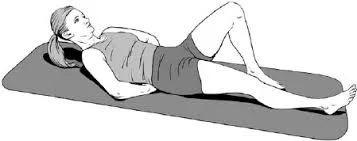
McGill Curl - Up. Low Back Pain Relief Utah.
Lying on your back, place one leg flat on the floor with the other bent. This position allows for a neutral pelvis during the movement and puts your core muscles in control of the movement without undue strain on the low back. Place your hands under the small of your low back to ensure a normal arch is maintained during the movement. Begin by bearing down to brace your abdomen, continue a normal breathing pattern throughout. If you have difficulty maintaining the brace while breathing, this is where you start. Now, pretend your neck, upper back, and low back are locked together and cannot move independent of one another (straight line from head to pelvis), slowly, lift your shoulders blades off the floor and return to the floor in a smooth pattern, only coming off the ground a couple inches. Take note of your posture, did your chin stick out, did your shoulders round forward from memories of doing endless crunches? Work through 2–3 sets of 10–15, slow and controlled.
2. Bird Dog

Bird Dog Ex. for Low Back Pain
Begin in a quadruped position with hands under shoulders and knees under hips, both about shoulder-width apart. Brace your abdominals while maintaining a neutral (straight) spine. While maintaining this posture, breath in and out, squeeze your glutes and begin moving your right arm up to a point position while also bringing your left leg to a straight position. Our goal here is to avoid rotation through the spine, maintain our posture and keeping the hips in line. Slowly return to the starting position and then perform with the opposite arm and leg. That is one repetition, perform 3 sets 10–15.
3. Side Bridge

Side Bridge - Core Stability
Lying on your side, prop yourself up on your elbow, hinge at the hips, and stack your knees on top of each other with a 90 degree bend. Maintaining a solid shoulder directly over the elbow on the ground, lift your hips up and push them forward, bringing your spine to a neutral position. Hold for a 5 count and then slowly return to the starting position. Be aware of head posture and hip extension, maintain a straight line from the head to the pelvis. Perform 3 sets of 10–15 on each side, holding each for a 5 count at the top.
Obviously, there are numerous other exercises that provide stability for the spine while strengthening the core, this is just a starting point. Focus and repetition will bring proficiency, and proficiency will bring improved performance! If you have any questions, please ask, I’m happy to answer what I can.
Until next time, train hard, train smart, and recover well.
Source: McGill, S. (2002). Low Back Disorders: Evidence Based Prevention and Rehabilitation. (2nd Ed).
Dr. Reheisse is a Board-Certified Chiropractic Sports Physician practicing in Murray, Utah. Revive Sport & Spine provides evidence-supported chiropractic care and conservative sports injury management.

What's The Deal With Hip Internal & External Rotation?
As I near my 2 year mark in clinical practice, you start to realize trends. Sometimes these trends solidify what we already know, align greatly with what we are already practicing, and allow us to continue down the beaten path. However, there are things we begin to see as key indicators on how an injury occurred, things that are so simple, they often get overlooked in a treatment plan. Today I want to briefly discuss an item that falls under both of these categories.
Hip range of motion (ROM) is often taken for granted, until that time comes where one side is severely restricted and we are unable get up off the floor without the use of our hand, or the assistance from another. As I have progressed clinically, hip ROM started as just something to jot down in a patients notes, but has quickly become one of the first areas I look to and address for nearly all of the low back pain** and lower extremity complaint (acute and overuse) patients that come into our clinic.
The problem we see is that the restriction is never symmetrical, causing compensatory patterns that quickly lead to injuries and confused patients. While getting you out of pain is our job, our goal is education and prevention. Below are some great stretches and mobility movements that are not only easy to perform, but effective is restoring symmetrical movement. Enjoy.
Learn, Practice, Perform!
Level 1 Hip Internal & External Rotation
Internal Rotation Hang
Setup: Lie flat on back with knees bent and feet about 6 inches wider than shoulder/hip width.
Step 1: Allow knees to ‘hang’ inward, letting gravity to do the work. We want to sit here for 1-2 minutes.
Step 2: If you get bored, slowly and gently, swing the legs/pelvis back and forth to induce some extra motion into internal rotation.
External Rotation/Mobilization Stretch
Setup: Lie flat on back with the leg being treated in a flexed hip position and the non-treated leg lying flat on the floor.
Step 1: Pull the foot of the flexed hip leg toward the mid-line and up toward the torso, you should begin to feel this over the posterior hip in the external rotators and glutes.
Step 2: Pull the knee toward the OPPOSITE shoulder and hold for a 3-5 count, release and repeat 10 times on each side.
Level 2 Hip Internal and External Rotation
Internal Rotation with band assistance.
Setup: Our setup is the same as the ER exercise in level one. This time with a band wrapped around the mid-foot and tracing the outside of the leg.
Step 1: The band provides a mechanical advantage and when pulled over the knee and across the body, provides assisted over-pressure into hip internal rotation.
External Rotation: Pigeon Pose
Setup: In a modified lunge position, externally rotate the treated leg and and sit back with the non-treated leg extended behind you.
Step 1: Begin with the foot of the treated leg near mid-line (easier) and begin to bring your torso closer to the ground while maintaining a straight spine.
Step 2: As this movement becomes easier, our goal is to get the treated lower leg perpendicular to your torso and away from the pelvis. Again, push the torso down toward the ground with a straight spine.
Level 3 Internal/External Rotation - 90/90 Get-up to 1/2 kneeling
Setup: Sitting up tall with a straight spine, the forward leg positioned in external hip rotation and the leg 'coming through' in internal hip rotation. The lead leg foot should be close to midline and near the other leg making this a closed position.
Step 1: Push into the ground with the outer knee of the forward leg and bring the rear leg around to the front, landing in a lunge/half kneeling position.
Step 2: In a slow and controlled manner, return to the starting position...enjoying the eccentric phase.
** A 2015 study out of the Shahid Beheshti University of Medical Sciences found that Asymmetrical and limited hip internal rotation ROM were a common finding in patients with LBP. Another study from The Sahmyook University Department of Physical Therapy found that hip mobilization brings positive effects on pain, function and psychological factors for patients with chronic low back pain, causing them to strongly recommend hip mobilization as an effective treatment method in treating chronic low back pain.
Break Up the Endurance Training With Some Strength!
Endurance athletes, especially runners, tend to shy away from strength training due to what I would consider a misunderstanding of what it can provide. After working with hundreds, probably thousands by now, of runners and triathletes over the last few years, I find very few have a regular strength plan. Some are afraid of getting hurt, some do not know how to effectively strength train, and some still have the ridiculous notion that if they lift weights they will get so bulky, the can no longer run!
Endurance athletes, especially runners, tend to shy away from strength training due to what I would consider a misunderstanding of what it can provide. After working with hundreds, probably thousands by now, of runners and triathletes over the last few years, I find very few have a regular strength plan. Some are afraid of getting hurt, some do not know how to effectively strength train, and some still have the ridiculous notion that if they lift weights they will get so bulky, the can no longer run!
Let’s address these, shall we?
STRENGTH TRAINING SAFETY
As with every sport, there is a calculated risk of injury when strength training. What will surprise some is that it is often much lower than the risk associated with training for an endurance sport. This can depend on whether you are single sport athlete (running only!) or have taken to the range that triathlon offers.
More can be read about sports specialization HERE from Dr. Greg Schiable. While this article is focused on sports specialization in children, the same can be shown for adult athletes who only participate, practice, and focus on one sport….an explanation why overuse injury rates are lower in triathletes compared to strict runners.
This morning, I read a great post from Chris Beardsley discussing the relative safety of strength training, especially when compared to endurance sports. This article launched me into, again, thinking about strength training for endurance athletes, and puts another feather in the cap of it being a great cross option to break up the often monotonous droning on that running provides.
We can show that single sport athletes are more prone to overuse injuries and burnout, as well as demonstrate the benefits strength training gives to endurance, injury prevention and movement efficiency.
An interesting point made...Beardsley writes,
“In comparison to the overall rate of injury in strength sports of between 0.24 – 5.5 injuries per 1,000 hours of training, the rate of injury during long-distance running is around 2.5 – 12.1 injuries per 1,000 hours and the rate during triathlon is around 1.4 – 5.4 injuries per 1,000 hours training.”
He goes on to state that many studies put running injuries on the higher side of the stated rate.
GETTING SWOLE
Let’s talk about getting bulky, to the point where you start to lose speed and endurance because you are just too massive to run efficiently. It used to be that this conversation was primarily had with female athletes, but more and more we find male runners of the same belief. In short, this is non-sense! Why is that you ask?
GENETICS:
As a younger male, I spend countless hours, day after day, month after month, for a number of years, trying to pack on muscle and reach the elusive 200 lb mark. It was a stage in my life….enjoyable and very educational… I have since returned to my love of endurance training, but strength training remains a big part of what keeps me fit, injury free, and happy.
ENERGY & FOCUS:
I never made it to that 200 lbs mark. Mainly because I could not eat, sleep, and breath lifting weights and energy intake. To go from a slim and trim 155 to 200 is a feat which requires a lifestyle shift and not much time for anything else. As runners, we simply can not consume enough, or slow down enough to really pack on muscle. To make that shift, one would have to take all the time invested in putting in the miles...almost completely stop...and replace it with lifting weights...Not going to happen! Stop worrying about getting bulky and think of what a 10-20% increase in strength could do for you during those last miles of a long run or how you can conserve energy by moving more efficiently.
BUT GYMS ARE SCARY
Many endurance athletes just don’t know what to do when they end up in a gym. Fortunately, popular running sites and magazines have jumped aboard the strength train (locomotive type), and there are countless exercises and routines available if one simply does a Google search.
My personal advice is to first master your body weight, which allows you to more comfortably perform exercise at home or on a track after a run. Begin with push-ups, pull-ups, squats, lunge variations and jumps. Once you reach a point where sets of 10, 20 or even 50 feel ‘easy’, it may be time to add in some weighted movements like kettlebell swings (my #2), deadlifts (my #1), and overhead press and pull variations.
If you feel like you have been in a rut this summer or have had more than your share of injuries lately, maybe it is time to try something new? Change up the routine a little...it is likely that you will enjoy the change and be surprised by the outcome.

S T R E T C H I N G
Do you stretch? When? How? More importantly WHY? This will be brief, and there are many sides to this table, but where do you sit on this topic? When the discussion about stretching arises, it is sort of like the old saying on religion and politics; no matter what you have to say or how compelling your argument, you will never change the views of the other person and will usually walk away further apart on the subject than when you began.
Do you stretch? When? How? More importantly WHY? This will be brief, and there are many sides to this table, but where do you sit on this topic? When the discussion about stretching arises, it is sort of like the old saying on religion and politics; no matter what you have to say or how compelling your argument, you will never change the views of the other person and will usually walk away further apart on the subject than when you began.
Lets start the conversation…shall we?
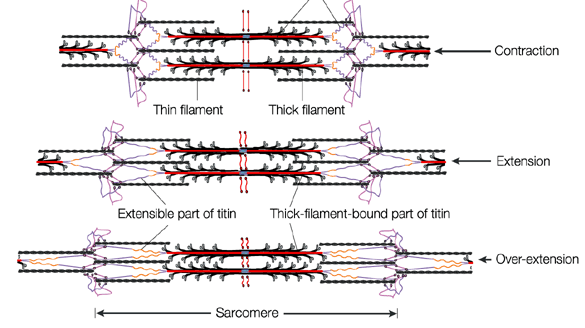
When you stretch, what are you trying to accomplish? Are you trying to lengthen a muscle, increase range of motion or are you just reaching and praying that one day you can wrap your fingers around those toes down there? Truth is, you can elongate a muscle, kind of, and only temporarily. What you are actually stretching is the sarcomere, the contractile unit of the muscle, causing it to elongate but also decreasing its ability to contract. The sarcomere at rest, has quite a bit of overlap between the actin and myosin filaments. As you stretch, it creates less overlap and leaves the muscle with not much to grab on to when it is called on to work, decreasing its power and increasing risk for injury.
When a sarcomere is stretched, there is less myosin and actin overlap causing less power and increasing risk for strain.
In January 2014, The Journal of Strength and Conditioning Research studies the effects of static and dynamic stretching, revealing that static stretching had a negative impact on performance for up to 24 hours while dynamic stretching improved measures in power movements such as jumping. (Haddad et al.)
I do not despise stretching, just stretching of the static type before activity. I cringe when I see someone hop on to the field, or out of their car at a race and reach for their toes, pull their heel to their butt and off they go. I refer to this as the ‘stretching the cold rubber band trick’, it may work once or twice but eventually it is going to pop.
Some Non-Stretching (Static) Ideas
Before exercise: Activate and be Dynamic! Activate the muscles you are going to use, increase blood flow and ease into your exercise. Before running, activate the glutes, hips and core followed by some dynamic movement such as skips, leg swings and sport specific drills.
Foam Rolling provides a much better option to stretching as it allows trigger point work, reduced tension at the myotendinous junction and helps with circulation of fresh, oxygenated blood to flush out H+ buildup from lactate* breakdown, decreasing DOMS.
Mobility: Some may confuse mobility and stretching but the key difference here is that it not only works with muscle flexibility but joint mobility as well. Exercise or not, mobility should be addressed daily with focus on your trouble areas, which, depending on your sport and job, probably includes hips and thoracic spine.
This is the side of the table I sit on when it comes to stretching. This position comes from recent literature but mostly from personal & professional experience. Take it for what it is but if you are suffering from injury and you just can’t get it to loosen up, maybe stretching is the problem, not the answer.
Dr. Reheisse is a Board Certified Chiropractic Sports Physician practicing in Cottonwood Heights Utah. Revive Sport & Spine provides evidence-supported chiropractic care and conservative sports injury management.