THOUGHTS ON:
Training, Rehabilitation,
&
Best Care Practices

Tendinopathy Injuries - 7 Things You Need To Know About Tendinitis and Tendinosis
Tendinopathies are a pain. If you have ever experienced this type of injury, you know this! While we treat these conditions often, these patients often become great friends of ours. Not only because we get them back to running, but because these injuries take time and constant attention.
Tendinopathies are a pain. If you have ever experienced this type of injury, you know this! While we treat these conditions often, these patients often become great friends of ours. Not only because we get them back to running, but because these injuries take time and constant attention.

We see an abundance of ‘failed’ tendinopathy cases, either from conservative care or those who have received injections and other interventions. A big misunderstanding we see it this...a patient comes in, states they have had it scrapped, injected, and have rested...and IT DIDN’T WORK! While frustrating, I have to explain to this person how they were misinformed. An injection will only help with pain, resting will only help with pain...but those two ‘treatment’ options didn’t do anything to fix the problem. Confused yet?
To help with understanding, below are 7 things you need to understand about tendon injuries to help you recover correctly and return to sport better than before.
I will start with the statement that I'm no magician, I don’t have a magic wand to fix these injuries. The one thing these cases need, that no one wants to give, is TIME and PATIENCE. Chronic tendinopathies require progressive loading and TIME. Progressive loading takes TIME. Most good protocols for chronic tendinopathies are 4-12 MONTHS long.
1. Treat This Injury Like Good Barbecue, Cook It SLOW.
Consistent daily loading of 10-15 reps over weeks to months is encouraged. We typically recommend 1 set of 10-15 reps done slowly 4-6x daily.
2. ‘No More Than’ 1,2,3,4, ‘I Hate When We Get To 6,7,8!
Pain during loading should be tolerable; a 1-4 out of 10 pain is just fine! When you push into the 6-8 out of 10 pain, you have done too much. Pay close attention to the 5/10 pain. If it is trending up from 5/10, then stop and modify. If the pain is trending down from 5/10, continue. Pain is an excellent indicator of progress and failure. Listen to your body!
3. Produce & No Worse.
Loading tendinopathies can produce pain, but later (minutes to hours later), the pain should return to baseline, where it was before the exercise. This is important because many patients and most exercise prescription should not produce pain, but tendinopathies are DIFFERENT! Pain (tolerable pain) is very likely with loading, and loading is REQUIRED for management and a successful outcome in many cases.
4. Watching Paint Dry.
The paint will dry. It will just take TIME. The rehab isn't sexy. It's 1-2 exercises several times daily for months. Your tendinopathy, if we assessed correctly, will get better, it just will take TIME. Most protocols are 4-12 months long. I typically will say initial results can begin at 2-3 months, but we won’t abandon the protocol until at least a 4-month trial has been completed. Think about that for a moment! If you have an actual tendinopathy issue, anyone who tells you they can fix it in a few weeks either doesn’t understand anatomy and physiology, or they are unfit to manage your case.
5. Progressive Overload Is Required To Make The Tendon "Bigger, Faster, Stronger And Harder To Put Down."
We start simple and progress as allowed. Isometrics -> Concentrics -> Eccentrics -> Functional Tasks, it’s the process, and most of the time, you can not skip a step. Throughout this process, we may need to back up periodically or adjust and step on the gas depending on how your body responds.
6. Tendon Injury Management.
We typically start by addressing the soft tissue and joint mobility involved to help treat pain and get you on the right track; this usually takes 2-4 weeks. We will then take the in-office exercises and emphasize progressive home loading and exercise progression. Once we start moving the needle, we move to ‘check-ins every 3-4 weeks in the office to evaluate progress, address sticking points, and progress exercises.
7. Slow Healing Tendinopathies.
It is often more than just the tissue and load, what other factors are going on in your life?
Metabolic Concerns -> Function Medicine Workup
Psychological Concerns -> Believe it or not; some people become very attached to their pain. Working through this and realizing that you WILL GET BETTER, it a huge part of the battle with chronic pain. It’s no longer taboo to talk with someone about this!
Long-Standing Tendinopathies that have improved but plateaued must consider additional loading or regenerative medicine referral.
Knowledge is power; what you do with it is your choice. I will end with the most significant issue we see when dealing with these cases, REST. Many believe that rest will heal a tendon injury. We know so much more about Achilles injuries, plantar fasciitis, high hamstring tendinopathy, and other tendinopathies, we KNOW that rest does not help. It will help with pain, but it does not address the problem. Once you return to the activity that causes the problem, it will come right back.
Are you unable to run, hike, ski, or exercise because of a nagging tendon issue that shuts you down in the first few steps? Have you been resting, icing, are have even had an injection or two with little results? It’s time to step-it up...it’s time to load it...it’s time to push it. Schedule an appointment today, and let’s get started getting you back to the things you enjoy.
- - -
Dr. Reheisse is a Board Certified Chiropractic Sports Physician practicing in Cottonwood Heights, Utah. Revive Sport & Spine provides evidence-supported chiropractic care and conservative sports injury management. Special mention and credit to Dr. Dino Pappas for the article outline.

Youth Running: Benefits, Risks, & Considerations
Running is one of the best (coming from a runner) and easiest sports to take up in the world. Running is a major part of nearly every sport on the planet, making it an excellent option for our school-aged athletes. In 2017, almost 500,000 runners ran XC, and over 1 million athletes ran track. With the ease of access and a million different training techniques and training theories comes the risk of adverse effects. Over the last 10 years, we have seen a 34% increase in injuries incidence among runners.
Running is one of the best (coming from a runner) and easiest sports to take up in the world. Running is a major part of nearly every sport on the planet, making it an excellent option for our school-aged athletes. In 2017, almost 500,000 runners ran XC, and over 1 million athletes ran track. With the ease of access and a million different training techniques and training theories comes the risk of adverse effects. Over the last 10 years, we have seen a 34% increase in injuries incidence among runners.

Shin splints can be an precursor to stress fractures in young runners. Check out our MTSS Blog Series to prevent and rehab this common injury.
It is estimated that 20-80% of runners will experience an injury in a given year. Random range, right? You try to find two studies that can agree on this! However, we do know that more than 50% of all pediatric sports injuries are due to overuse. We also know that overuse has is signs and symptoms and can be prevented.
What do we know about youth running? A lot actually. Let’s look at the facts and discuss how we can prevent future injuries so our young runners can enjoy a life-long relationship with this wonderful sport.
BENEFITS OF RUNNING FOR YOUTH ATHLETES
Great Cardiovascular Health.
Improved Cognitive Development.
Exercise increases metacognition, behavior regulation, and accelerates behavioral and emotional engagement.
Bone Health - Increased Bone Density
Positive Self Image & Emotional Wellbeing
Aids in Development of Total Athleticism.

Running injuries are common in youth-aged runners, but the benefits from frequent exercise, competition, and camaraderie far outweigh the risks. Learn more about beginning running for health and fitness here.
CURRENT TRENDS IN YOUTH RUNNING: INJURY RISKS
Accelerated Growth.
Peak height velocity (when children grow fastest, resulting in bones lengthen faster than muscles and tendons can keep up with) occurs around 12 for females and 14 for males.
Just before this rapid growth, bone mineral content is at its lowest, making bones and growth plates vulnerable to the load and stress of running.
Low Bone Mass For Age.
Affects 39% of female youth runners.
Might be the more likely cause of stress fractures than training load.
Low Energy Availability, Relative Energy Deficiency in Sports
Adolescence is a time of rapid growth with unmet energy demands…inadequate calorie intake with increased running demand can lead to abnormal menstrual function in females, bone mass depletion, and high risk of musculoskeletal injuries and stress fractures.
Males Commonly Suffer From Low Bone Mineral Density As Well.
Risk factors include being less than 85% weight for height, running over 30 miles per week, a history of stress fractures, and having a diet lacking in calcium-rich foods.
Answering ‘YES’ To The Following:
‘do you believe that being thinner leads to faster running performances?’
BIG RED FLAG
Increased Anxiety or Avoidant Coping Strategies Such As Denial.
Perfectionism-related thoughts are associated with higher rates of depression, anxiety disorders, obsessive-compulsive disorders, and eating disorders.
History Of Previous Running Injuries.
Strong indicators for in-season injuries are injuries during summer training (female) and history of previous running injury (males).

HOW CAN WE PREVENT INJURY IN YOUTH RUNNERS:
To prevent injury, cross training is necessary. Recent data suggest that shorter intense bouts of activity like sprinting, other sports, and neuromuscular training are better for developing motor skills compared with endurance running. Remember, though they grow, they are still kids and need time to play. Play outside, play other sports, rest from play. Don’t forget that.
Strength Training #1 - Improved Core And Pelvic Strength Led To Faster Race Times.
A 6 week strength program aimed at pelvic and core strength led to improved race times. Strength training also leads to better weight control, improved motor performance skills, improved cardiovascular health, and enhanced psychosocial well-being…oh, and less sports-related injuries.
Strength Training #2 - Spine & Hip Strengthening.
Exercises aimed at the spine and hip muscles helped injured youth runners rehab from injury faster and prevented future occurrences of common running injuries such as Achilles tendinosis, iliotibial band syndrome, runner’s knee, plantar fasciitis, and shin splints.
Strength Training #3 - Strength Training For Runners Program.
We have developed an instructional series around some of the best strength exercises for runners. You can check those out here.
Set Realistic Expectations - Know Age & Developmental Stage Capabilities.
Unrealistic expectations lead to athlete frustration, low self-esteem, burnout, and injury! This can lead to reclusiveness, depression, and loss of enjoyment.
Monitor Youth Runners For Signs Of Burnout.
Students athletes who withdraw from activities they previously enjoyed may be experiencing chronic stress and burnout from their sport. This leads to more complicated issues if unaddressed, like depression, obsessive-compulsiveness, and eating disorders.
If an athlete becomes more irritable, anxious, or struggles with perfectionism, they are demonstrating signs of burnout. They need time off or decreased self, coach, and or parental pressures related to their sports.
Coordination Of Care For An Athlete.
Extrinsic risk factors for injury include improper training volume, intensity, or progression, early sports specialization, poor footwear, and inefficient running form. These factors are better addressed when the athlete, parent, coach, and healthcare provider have open communication with the athletes BEST INTEREST at the forefront.
Modify Training Program To Allow Rest Periods
Injury can be reduced by developing a training plan that limits weekly and yearly participation time to reduce repetitive movements and increase scheduled rest periods within each week, season, and annual training cycle.
Suggested rest is at least 1 day per week, 1-2 weeks every 3 months, and participation limited to 9-10 months per year.
Avoid Early Sports Specialization (Bolded Based on IMPORTANCE)
Highly specialized youth athletes (those participating in one sport more than 8 months of the year) report more injuries than their peers, independent of age, sex, or training volume.
Early Sport Specialization is associated with unidimensional identity with the sport leading to the athlete feeling as like they lack control with their participation in that sport. This leads to burnout.

All Credit To The Authors & AJSM. No Copyright Violation Intended. Click Here To Access Full Article.
When To Seek Treatment
Now that we are aware of injury risks, YOU have to take preventive measures. For some, this means a little time off before training ramps up again. For others, it’s time to hit the gym, toss a ball around, shoot some hoops, and spend some time at the pool.

Early Care Is Crucial To Retruning To Running In a Resonable Time-Frame. Schedule Today.
Shin Splint Pain Relief -> CLICK HERE
IT Band Pain Relief -> CLICK HERE
Runner’s Knee Pain Relief -> CLICK HERE
When it comes to injuries, we know two things.
(1) Rest is rarely beneficial for sports injury recovery. Rehab needs to be active!
(2) The sooner you seek care with an injury, the sooner you will be back out and running.
If you or your child has been training for the upcoming cross country season but are continually being sidelined by injury and illness, it’s time to find help and get back on track. If you are a runner in the Salt Lake City area, Revive Sport & Spine is your go-to clinic to get you back up and running quickly, giving you the tools to help you run faster, farther, and more efficient than before.
Krabak et al. Youth Distance Running: Strategies for Training and Injury Reduction. American College of Sports Medicine. 2019. Current Sports Medicine Reports. www.acsm-csmr.org.
Dr. Reheisse is a Board Certified Chiropractic Sports Physician practicing in Cottonwood Heights Utah. Revive Sport & Spine provides evidence-supported chiropractic care and conservative sports injury management for the great people and adventurers of the Salt Lake City Valley.

Medial Tibial Stress Syndrome Part 2 - Self-Care For Shin Splints
In PART 1 of our Shin Splints series, we took a look at the anatomy associated with medial tibial stress syndrome as well as the factors that make runners especially susceptible to them, namely the repetitive nature of running compounded by most cases typically doing too much too soon. Here in PART 2, we are going to look at self-care options as well as some considerations for preventing repeate episodes of shin splints so that you can keep running and training for your goal races.
In PART 1 of our Shin Splints series, we took a look at the anatomy associated with medial tibial stress syndrome as well as the factors that make runners especially susceptible to them, namely the repetitive nature of running compounded by most cases typically doing too much too soon.
Here in PART 2, we are going to look at self-care options as well as some considerations for preventing repeate episodes of shin splints so that you can keep running and training for your goal races.
SELF CARE OPTIONS FOR MTSS-SHIN SPLINTS
Self Myofacial Release - 4 Ways To Care For Your Shin Splint Pain
Pre-Running Warm-Up For Shin Splints
Training Modifications, Gear Suggestions, & Other Prevention Considerations
Form, Cadence, & Ground Contact Time:
This is a tricky subject, honestly I’m not sure why I even mentioned it. One can go miles down the form training rabbit hole and come out the other side worse they they were before. However, I do want to mention three things that must be considered and worked into your training plan to help prevent shin splints and make you a more efficient and faster runner.
The ground fights back! The more time we spend in contact with the ground, the harder this battle will be. I’m not here to talk about heel-striking, forefoot running, etc., but I will mention cadence. The higher your cadence, the less time your foot spends on the ground. Meaning, the less ground reactive forces you absorb and the less stress on your body.
Again, I’m not here to correct form. But I do believe we can all be more efficient. Strength training helps us become more efficient for those later stages of the race. Please add strength training to your program, it is extremely useful.
Alter your surfaces. Don’t always pound the pavement. The track and trails are your friend…and your feet will thank you for it.
Shoes:
Shoes are something I get asked about frequently. My honest answer is this, ‘We have more shoe technology and selection than ever…we also have more injuries than ever.’ Take that for what it is worth but I do believe shoes should be rotated and changed frequently. I suggest a 2-3 pair rotation, avoid running in the same pair two days in a row, and switching out for a new pair every 200-300 miles depending on the shoe.
Warm-Up & Cool-Down:
This is SO BIG. In every injury we encounter and talk about, how you warm-up (if at all) and cool-down has a direct impact on your injury risk, and recovery speed from injury. Warming up prepares your body for the task ahead, giving it the best chance to avoid injury. Colling down helps work out those tight spots after training while encouraging faster recovery.
Dr. Reheisse is a Board Certified Chiropractic Sports Physician practicing in Cottonwood Heights Utah. Revive Sport & Spine provides evidence-supported chiropractic care and conservative sports injury management.

Medial Tibial Stress Syndrome Part 1 - What Are Shin Splints and Why Runners?
Springtime is here! The weather is warming up, the sun is starting to shine on those early morning runs, and we can finally shed many of those heavy layers of clothes for our preferred running shorts and singlet top!
But…spring time also means something else for runners.
Springtime is here! The weather is warming up, the sun is starting to shine on those early morning runs, and we can finally shed many of those heavy layers of clothes for our preferred running shorts and singlet top!
But…spring time also means something else for runners.
For most runners, it means it is time to come out of the pain cave, get off the globogym cardio theater dreadmill, and start hitting the roads again. For some, it means it is time to come out of hibernation and begin training again. While this all seems well and good, the road can cause some aches and pains that the somewhat forgiving treadmill or cushy couch hid from you all winter long.

You know what I am talking about. That all too familiar pain down the inside of shin bone that can also sometimes radiate into the foot and seems to intensify with every run. Road running in the spring can be wonderful, but it can also be painful. The road is an unforgiving surface (part of the reason our treatment plans include running on a track or trail) that can bring even a veteran runner to their knees in frustrating agony with each run.
Yes, I’m talking about Shin Splints!
Today we are beginning our Shin Splint Relief & Prevention series by discussing what ‘shin splints’ are, how they occur, who is more likely to experience shin splints, as well as a few other complicating factors. We will follow this up with self-care in Part 2, and Treatment & Rehabilitation options in Part 3.
WHAT ARE SHIN SPLINTS: MEDIAL TIBIAL STRESS SYNDROME
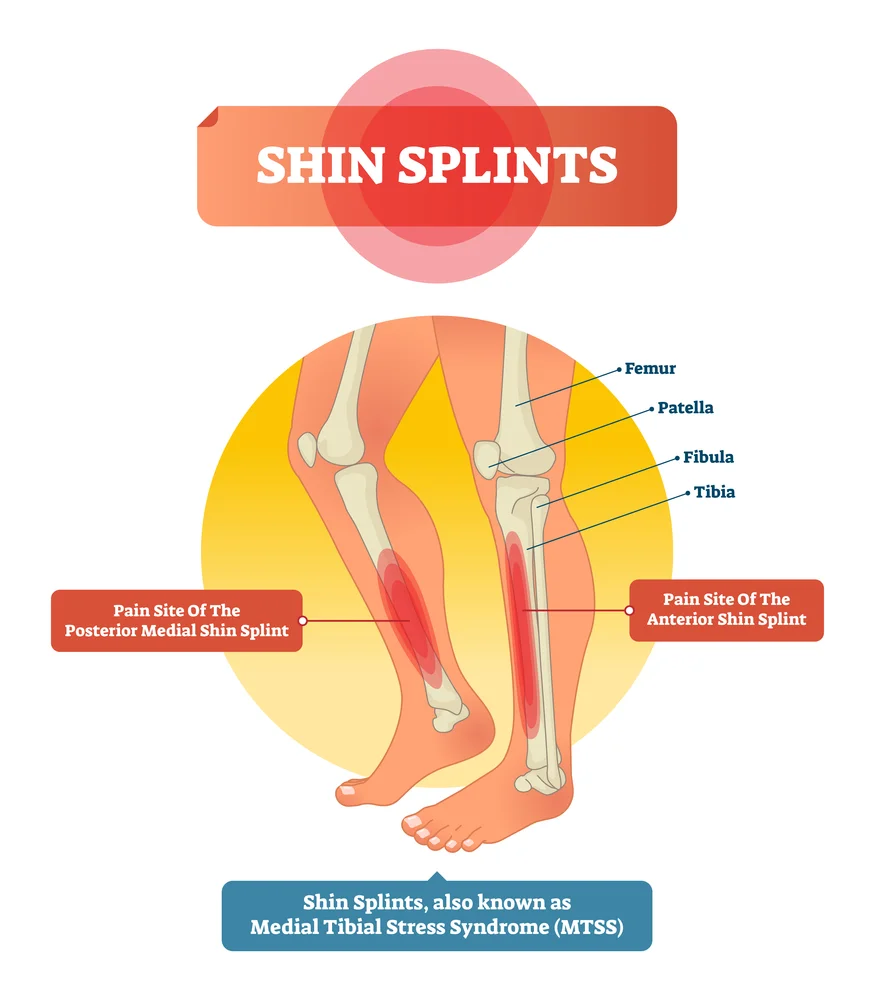
From an anatomical perspective, shin splints are a condition where there is pain, tenderness, and sometimes swelling along the middle, inside of the tibia (shin) bone. While the cause is debated as to whether this pain comes from a muscle and tendon response to doing too much too soon, the tibia bones inability to handle the stress and pounding from running, or damage to the connective tissue that wraps and supports all of these structures in the lower leg and foot.
The hallmark sign of Shin Splints is the extreme tenderness along the inside of the shin that seems to improve as a runner warms up, but begins to worsen, last longer, and eventually prevent running as time passes without care. From this, this condition is more aptly named Medial Tibial Stress Syndrome.
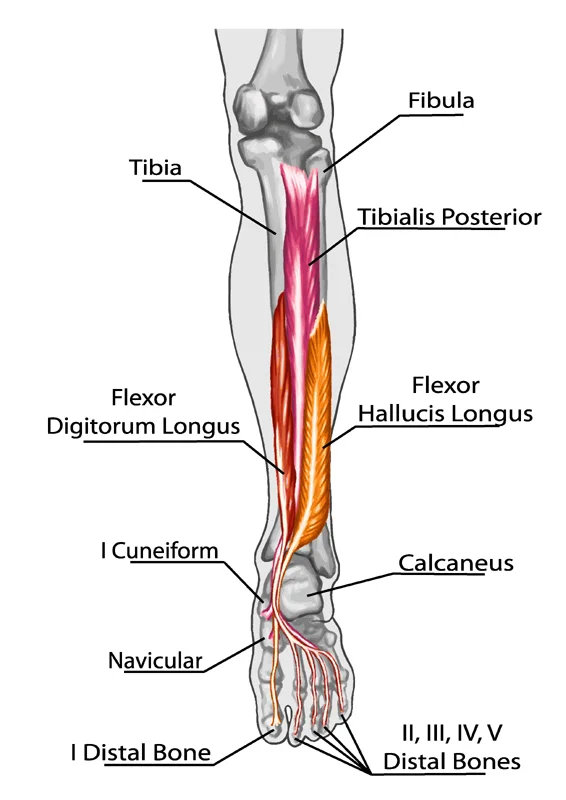
Before we discuss why this condition plagues runners, and what we in the medical community think is actually happening, let’s look at the important anatomy involved.
WHY RUNNERS & WHAT FACTORS LEAD TO SHIN SPLINTS
Running injury statistics are horrifying, with studies estimating that anywhere from 40-80% of runners experience an injury EVERY YEAR. I am not going to bother trying to track down the actual number because it changes montlhy as new research comes out, but the fact is that as runners, we run a high risk of injury. From that, it is estimated that 1 in 5 are dealing with shin splints. Since this is such great news, let’s look at some reasons why this injury is so common and who could be at higher risk.
New Runners - If you are truly new to running, Shin Splints are almost a right of passage. In the process of your body adapting to this new stress, figuring out your form, and slowly increasing your mileage, your body will get to the point where it starts to scream…’why are you doing this to me’. As we progress through this series, you will find ways to build up your body, more specifically your legs, so that it can handle this new stress of running.
Running Biomechanics - The Tibia bone is believed to absorb 2-3x’s your body weight with each step. Take into account that the average runner has a cadence (steps per minute) of 140-180, it is no wonder we begin breaking down at the tibia.
Higher BMI/Body Weight - Looking at the last statement, if you have higher body weight, and you are new to running, forcing your tibia to withstand the pounding from running should be a slow process with ample recovery.
Training Volume - Just like new runners, if you are a veteran with a solid training base of 30-35 miles per week and you sharply bump up to 55-60 miles per week, you are essentially treating your body like a newbie with a very unfamiliar stress.
SIMILAR PROBLEM: Too Much Too Soon & Classic Overtraining
Form - Forefoot, Midfoot, or Heel Striker, you efficiency within that form and allowance for adaptation to stress is what either prevents or causes injury. I have seen all forms present with shin splints, and it is usually a combination of the above causes.
WHAT ACTUALLY CAUSES SHIN SPLINTS
While the cause of Medial Tibial Stress Syndrome is still debated, with research naming a different cause. It is likely a combination of the factors we are going to cover. This is why, if you have been suffering from shin splints for a month or so and are just trying to run through them, it is important to get an evaluation, a structured plan around your goals, and some treatment to get you over the hump.
Weak Ankle Dorsiflexion - Loss of eccentric control.
One issue that many believe to be a cause, or at least a contributor to shin splints is poor control of the anterior leg muscles, or weakness of the Tibialis Anterior muscle. This one stands out in newer runners because it is responsible for the slapping sound one makes when their foot hits the ground. This comes from weak eccentric control of the muscle, or the ability to slowly let it down to the ground. Our bodies are amazing, so when one area fails, another area takes the load…
Poor Pronation Control & Tight Posterior Tibialis Muscle
Lets first start by reminding everyone that pronation is a normal part of the gait cycle, but poor control of the speed of pronation can cause problems. If we have excessive tightness through the posterior tibialis muscles, either due to overuse or poor adaptation to load, it is unable to respond well enough when the foot hits the ground, causing the foot to crash in during pronation. If this is the case, we see each step pulling on this already tightened muscle, as well as the facia that wraps it and attached to the inside of the tibia bone (that spot where you are tender), inflaming the area, damaging the muscle, and leading to poor mechanics while running.
Bowing of the Tibia Bone
To further the case of this mid-shin bone pain where the posterior tibial muscle lies, we have data that shows the Tibia bone actually bowing during running. While our bodies are adaptive and resilient, we believe this bowing to be minimal, undetectable without fancy equipment, but a natural part of our body handling the forces the road gives back with each step. Where this comes in to play is with a young or new-to-running runner who decides to run through their pain. If this goes on long enough, and the runner overtrains, this can lead to a stress fracture injury.
Over Training - Too Much Too Soon
This is probably the most common reason runners experience shin splints, and most other injuries for that matter. Over-training is the common factor of the 3 potential causes we mentioned above. As a new runner or an experienced one looking to increase mileage, a plan that not only includes a structured running plan, but strength training, cross training, and rest must be considered.
SUMMARY
Shins Splints are most known to cause pain along the inner edge of the tibia bone that is tender to the touch. Swelling may or may not be present.
While many causes are debated, one thing holds true. Whether you are a new runner or a veteran. Doing too much too soon will likely lead injury.
Runners are most at risk due to the repetitive nature of running. Add in volume changes, the pounding of the road, lack of self-care and warming up before each run..it all adds up.
Dr. Reheisse is a Board Certified Chiropractic Sports Physician practicing in Cottonwood Heights Utah. Revive Sport & Spine provides evidence-supported chiropractic care and conservative sports injury management.

Sciatica Pain Relief Part 2: Common Causes of Sciatica
In part 1 of our Sciatica Pain Relief series, we covered the basics of sciatica, sciatic nerve pain, and the general anatomy involved. While this may not interest everyone, it is useful in understanding the sharp, burning, and often debilitating pain that radiates down the leg that some people experience with low back pain. Our goal in this series is to inform, empower action, and give our fellow Salt Lake City, Utah friends the information and tools to help yourself through this condition as well as the understanding of when to seek care and a trusted source to do so if needed. In part 2, we are going to briefly discuss some of the most common causes of sciatica but before going forward, check out part 1 by clicking the button below.
In part 1 of our Sciatica Pain Relief series, we covered the basics of sciatica, sciatic nerve pain, and the general anatomy involved. While this may not interest everyone, it is useful in understanding the sharp, burning, and often debilitating pain that radiates down the leg that some people experience with low back pain. Our goal in this series is to inform, empower action, and give our fellow Salt Lake City, Utah friends the information and tools to help yourself through this condition as well as the understanding of when to seek care and a trusted source to do so if needed. In part 2, we are going to briefly discuss some of the most common causes of sciatica but before going forward, check out part 1 by clicking the button below.
TOP 5 COMMON CAUSES OF SCIATICA
1) Disc Buldge - Intervertebral Disc Compression
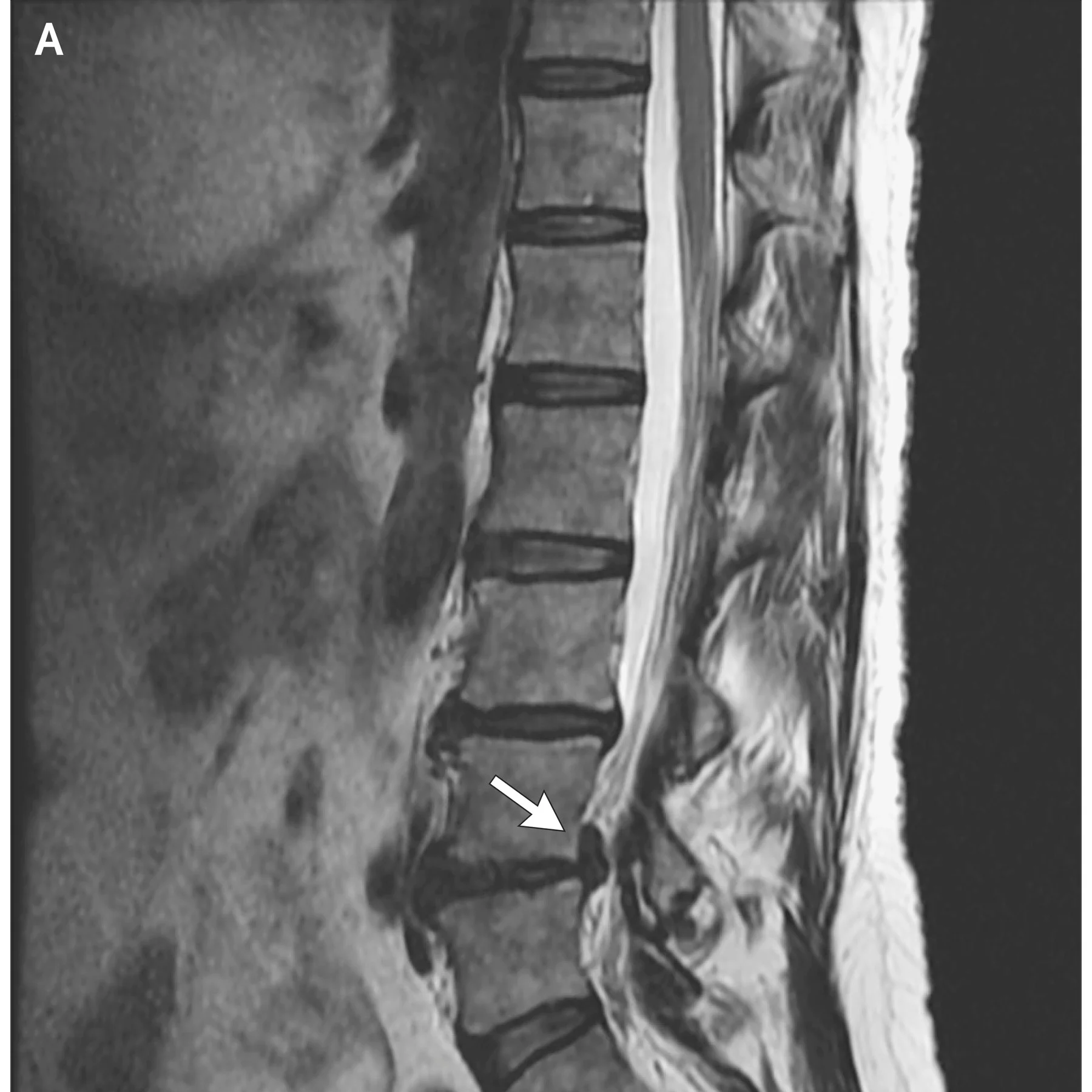
Credit: Allan Ropper, M.D., Ross Zafonte, D.O. Sciatica Review Article. New England Journal of Medicine
Starting with the most common cause makes sense as this is what most literature supports and what most people fear when they have some incident or trauma that leaves them with sciatic nerve pain shooting down their leg. A disc bulge is just that, an outpouching, or bulge, of the disc (compressive and supportive tissue between each vertebrae that acts as a shock absorber and allows for movement of the spine) which then presses up against the spinal cord or a nerve as it exits the spinal column. Compression here can be mild to severe, bringing with it anything from pain, numbness, and tingling, to complete weakness of the muscles and limb supplied by the nerve being compressed.
Note: If you are experiencing the latter of those, please seek help immediately as progressive weakness is a red flag and often requires immediate imaging and intervention.
Now, the debate is out on this as disc, and other lumbar spine pathologies are considered somewhat normal. Chances are, before the injury or event that left you feeling this way, the disc bulge was ALREADY PRESENT! This event just aggravated it enough to cause pain.
For Review: Check out the chart in this article we did on spinal imagining and what the best, most current research supports. You will find that most people are walking around with ‘back issues’ with absolutely no pain or quality of life disruption.
THREE THINGS TO KNOW ABOUT SCIATICA & DISC ISSUES
You are not your image. Chances are, your MRI will show things that were already present and may not be the primary source of your sciatic nerve pain.
A true disc injury and resulting sciatica take time to heal. The body will do most of the work. Chiropractors and therapists are here to help with symptoms, function, and assuring you are in the best position to heal. There is NO magic pill for this, TIME heals.
If you are experiencing sudden weakness or progressive numbness that does not let up, seek care immediately as intervention is most likely needed to assure permanent damage is not experienced.
2) Lumbar Spine Stenosis - Canal & IVF Narrowing

Similar to a disc bulge, Sciatica related to Spinal Stenosis is a physical compression of the nerve roots that make up the sciatic nerve. However, this is more of a slow growing, progressive problem. In most cases, these do not wake up in severe pain overnight, these patients report constant discomfort, on-again-off-again radiation of pain, slow loss of range of motion, and typically do not have a time or event to relate a start of the pain.
As we age, the spine and discs degenerate. In the disc, this happens by a loss of height, dehydration, and loss of flexibility of the tissue. In the spine, and other high-stress bone and joint areas, degeneration happens by bone growth, bone spurs, and rigidity of the joints. This degeneration can cause enough of a response that bone will grow around areas where nerves pass from the spinal cord to the rest of the body (Intervertebral foramen or IFV) taking an already small space and slowly closing it down.
3) Piriformis Syndrome - Posterior Hip Tightness
We hit on this at length in the first part of our sciatica series. The relationship between the sciatic nerve and the piriformis muscle is well established. Most people have a sciatic nerve the tracks superficially (toward the surface) over the top of the piriformis muscle or just inferior to it. However, there is an appreciable percentage of the population where the sciatic nerve or a branch from it, pierces the middle of the piriformis muscle. It is believed to be the main culprit of 2-12% of sciatica pain with research on both sides stating over and under-diagnosis. Either way, anatomical and occupational variants are common causes of sciatic nerve pain as well as low back pain.

Credit: Allan Ropper, M.D., Ross Zafonte, D.O. Sciatica Review Article. New England Journal of Medicine
4) Double Crush Syndrome
Double Crush Syndrome, many of the cases we see fall into this category. Let me explain.
A patient presents after a fall, accident, or just a bad nights sleep with a chief complaint of sciatica with low back pain. An exam reveals a limited range of motion in the lumbar spine, tightness of the muscle in the posterior hip, namely the piriformis muscle, and numbness and tingling down the leg. Let's say that an MRI was ordered and it revealed a mild to moderate disc bulge.
Crush One - The disc bulge, assumed to be caused or irritated by the incident, it mildly compressing the nerve. Crust Two - In response to this injury, the body goes into defense mode and muscles begin to tighten, namely those of the posterior hip.
The initial compression at the spinal level causes a 3/10 pain, when you add in the tightness and compression at the hip, the patient is now up to a 7/10 pain with shocks of pain during specific movements. This is a Double Crush.
As with most, the disc issue is hard to affect with treatment directly, but focus can be directed toward the hip muscles, proper movement of the area and exercises to help with mobility and pain are prescribed, bringing the person back down to a 4/10 pain and allowing them to maintain most daily activities while the disc heals…remember, TIME heals discs.
5) Pregnancy
While this is not a diagnosable cause of Sciatica, sciatica is a very common complaint from expecting mothers. The cause here can be as elusive as any other, but pregnancy, the position of the baby, and the mothers specific size, anatomy, and lifestyle habits and experience with sciatica pain before the pregnancy. While there are many unknowns here, sciatica pain typically affects mothers-to-be in the latter half of the pregnancy, and most will respond to conservative care.
RED FLAGS

Sciatica is a very well described condition. The direct cause can be challenging to uncover, but there are a few things to be aware of if you are suffering from sciatic nerve pain. If you are experiencing any of the below items, we suggest you seek care immediately to assure the condition does not cause long term issues and to direct you to the right healthcare provider. Most cases can be managed conservatively (Chiropractic, Physical Therapy, or At Home) while others require medical intervention (injections, imaging, or surgery).
Progressive neurological symptoms. If you are experiencing numbness, tingling, or weakness that is worsening, please seek help from a trained provider.
If your injury is the result of a fall, auto accident, or home/work accident, consulting with a healthcare provider will help rule out any significant issues and speed our recovery.
As with other serious low back injuries, if you experience any loss of bowel or bladder control, this is an immediate ER referral.
If you have have been dealing with sciatica for more than 1 week without any relief, it is time to get help. Most self-resolving injuries and pain will let up after a couple days.
Dr. Reheisse is a Board Certified Chiropractic Sports Physician practicing in Cottonwood Heights Utah. Revive Sport & Spine provides evidence-supported chiropractic care and conservative sports injury management.

Iliotibial Band Syndrome: Self-Care & Training Modification
As we work our way through this series, let not forget what we have learned so far.
Iliotibial band syndrome is a common overuse injury plaguing runners of all abilities. The most common offense is trying to increase your volume too soon while also increasing the intensity without cross-training or varying surfaces.
The Iliotibial band DOES NOT STRETCH! The tension we feel is caused by the muscles that support the IT band, Tensor Fascia Latae and Gluteus Maximus.
The stabbing pain we experiences as runners suffering from IT band syndrome is thought to be caused by the band itself shifting forward and backward as the knee flexes and extends. The research is out on that one…if we ever reach a consensus, I will let you all know!
Where are we now? Well…if you have made it this far, you are probably dealing with IT band syndrome and wondering if it will ever go away and let you get back to running the way you would like.
For this, we are going to discuss self-care. What you can do about the knee pain and tight hips at home while also mentioning a few stretches you can do at work or out on a run. Our goal is simple - Allow you to continue to train, modified while improving your IT band syndrome pain week-to-week.
What we are talking about today, where the real work takes place, the day in and day out self-care. And the big question….can you continue training?
As we work our way through this series, let not forget what we have learned so far.
Iliotibial band syndrome is a common overuse injury plaguing runners of all abilities. The most common offense is trying to increase your volume too soon while also increasing the intensity without cross-training or varying surfaces.
The Iliotibial band DOES NOT STRETCH! The tension we feel is caused by the muscles that support the IT band, Tensor Fascia Latae and Gluteus Maximus.
The stabbing pain we experiences as runners suffering from IT band syndrome is thought to be caused by the band itself shifting forward and backward as the knee flexes and extends. The research is out on that one…if we ever reach a consensus, I will let you all know!
Where are we now? Well…if you have made it this far, you are probably dealing with IT band syndrome and wondering if it will ever go away and let you get back to running the way you would like.
For this, we are going to discuss self-care. What you can do about the knee pain and tight hips at home while also mentioning a few stretches you can do at work or out on a run. Our goal is simple - Allow you to continue to train, modified while improving your IT band syndrome pain week-to-week.
What we are talking about today, where the real work takes place, the day in and day out self-care. And the big question….can you continue training?
SELF CARE PART 1 - START WITH A BETTER WARM-UP
I can not stress this enough! As you are working through an injury, maintaining some kind of load (training volume) is important, but you are better served spending time on a proper warm up, running just a few miles, then spending a good amount of time on the cool down. With just about every running injury we deal with, runners have a dismal warm-up if one at all. Most are so pressed for time, they lace up the shoes, run out the door, only to return and head straight to work. Most of us are not teenagers anymore, our bodies just can’t do this…not for long periods anyway. Start with a thorough warm-up - we will emphasize this again in our next article where we talk rehab and return to running so prepare yourself!
SELF CARE PART 2 - SELF MYOFASCIAL RELIEF
Understanding that foam rolling and stretching of the IT band itself is ineffective, where do we focus our attention? The hips…it is always the hips! But some attention at the knee can be beneficial while appropriate rest and recovery are always suggested after an acute flair-up or long run.
Rest & Recovery:
Traditional pain relievers for running related pain include ice, heat, topical creams like biofreeze, and some good old-fashioned rest. Today we have an array of tools that can aid in recovery, one we like to use frequently are compression boots from Rapid Reboot. We don’t expect everyone just to have these lying around, but they sure feel great after some dry needling, IASTM, and manipulation in the clinic.
Rolling & Stretching:
Now that we understand what anatomy we need to address, it is time to get your roll on! If we are able to continue to train, we suggest rolling and stretching 4-5 times each day. Before you lose it, these sessions are only 3-4 minutes each. If you are a frequent runner, or just starting out, here are the basics.
Rollers should be in your home, office, and car. You should have at least 3 lacrosse balls around, purse, cup holder in your car, in your desk, and your gym bag.
Roll in the morning, pre and post run, after your lunch break, when you get home, and then a good session before bed.
Cupping & Flossing:
These may not be tools accessible to all, but they help you achieve stretching in ways that are difficult to do on your own. One of my personal approaches to provide relief to the knee pain we experience with IT Band syndrome is to place a few cups (I have a few sets of these) around the lateral knee and lateral quadricep muscle, walk about for a few minutes, perform a few squats, rinse and repeat 2-3 times per week.


SELF CARE PART 3 - TRAINING MODIFICATION
Training modification is the hardest part to address. For most, the ability to continue training toward your race is almost as important as fixing the injury. While maintaining some load is ideal, there are instances where a total shut-down is necessary for a few weeks. If you are a typical runner, meaning that you are going to run through the injury, we must modify. Here are the basics. Remember that Iliotibial band syndrome is the result of too much mileage or intensity, too soon in your training plan. Not having a proper base as you head into a 20-week marathon training plan is a recipe for disaster.
Our first suggestion is to cut your volume by 50% and decrease your intensity for the next 2-4 weeks. Our goal is to maintain some running, but the speed work and downhill bombs need to take a backseat for a while.
Please, cross-train! As runners, we think that running is it, period. When we are injured, and more so when we are not so that we can prevent injury, we must cross train. If you have been battling IT band syndrome for more than a few weeks, it is time to work in some biking, swimming and weightlifting. This allows you to maintain most of your cardiovascular capacity while taking out the pounding associated with running.
Lastly, look at your running form. Can it be cleaned up a bit? For most of us, that is a very strong, Yes! I’m not saying to go out and get an extensive running evaluation to change the subtle nuances of your stride, most of us just are not at that level, but shortening your stride, increasing your cadence, and working on your running drills can provide a needed boost in your running efficiency.
Cadence should be upwards of 170-180 steps per minute.
Perform drills on a soft surface (track or field) 2-3 times per week.
More on this in the rehab portion next week.
Dr. Reheisse is a Board Certified Chiropractic Sports Physician practicing in the Greater Salt Lake City Area of Utah. Revive Sport & Spine provides evidence-supported chiropractic care and conservative sports injury management.

Iliotibial Band Syndrome: Anatomy & Symptoms Of The Most Common Running Injury
You are out on another long run. It is a mid-Saturday morning, the weather is a cool 50 degrees, clear skies, and your focus is on the audiobook or podcast playing through your headphones. All of a sudden, out of nowhere, you get this sharp, STABBING, pain on the outside of your knee. Where did this come from? Did you do something wrong? What the heck is happening?
If this is your first time dealing with Iliotibial band syndrome, or you are remembering your first experience with it right now, the feeling is all too real. IT Band issues are a frequent occurrence for runners of all abilities, one of the most common conditions we relieve in our office and feel so prevalent that it is almost a ‘right of passage’ of sorts for new runners.
You are out on another long run. It is a mid-Saturday morning, the weather is a cool 50 degrees, clear skies, and your focus is on the audiobook or podcast playing through your headphones. All of a sudden, out of nowhere, you get this sharp, STABBING, pain on the outside of your knee. Where did this come from? Did you do something wrong? What the heck is happening?

If this is your first time dealing with Iliotibial band syndrome, or you are remembering your first experience with it right now, the feeling is all too real. IT Band issues are a frequent occurrence for runners of all abilities, one of the most common conditions we relieve in our office and feel so prevalent that it is almost a ‘right of passage’ of sorts for new runners.
In this series, we are going to dive into the details of IT band issues, what causes this dreaded running injury, what you can do about it when it happens to you (It Will!), and when you need to seek care to help get your training back on track. I can tell you from experience, as a past sufferer of IT band issues myself, it can be stubborn, frustrating, and damaging to your confidence as a runner…but it does not have to be.
I tell patients daily that IT Band syndrome is a relatively easy condition to treat…but it requires time, effort, and a change of routine. We start here today by understanding what it is and move through this series to self-treatment and prevention.
WHAT MAKES UP THE IT BAND…
… and why you can’t just stretch the Iliotibial band and make it better.
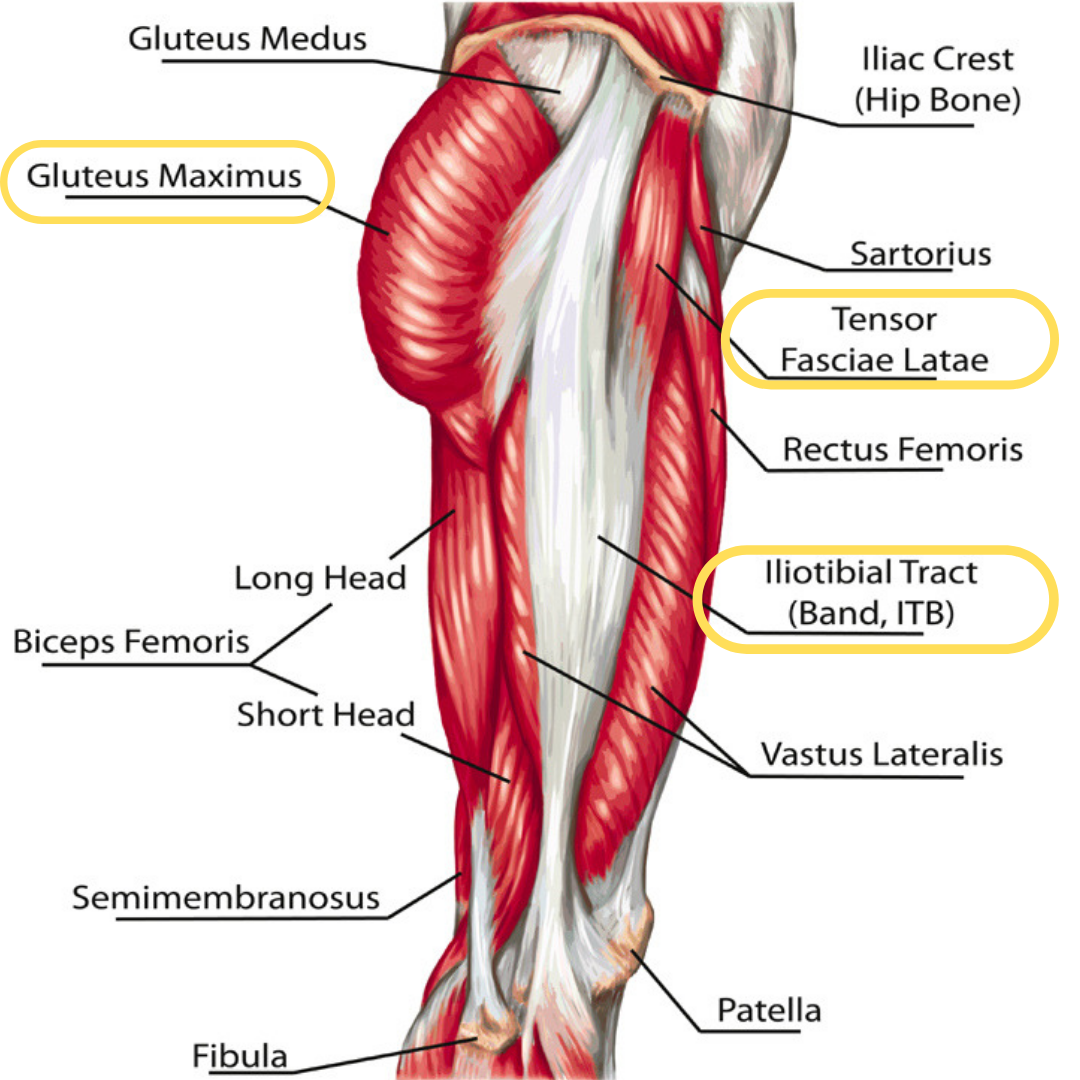
IMPORTANT ANATOMY:
Insertion Points: Iliac Crest, Knee
Muscles Involved & To Know:
Tensor Fascia Latae
Gluteus Maximus
Gluteus Medius
The Iliotibial tract runs from the hip (iliac crest) to the knee with insertion on the tibia at Gerdy’s Tubercle (trivia!) and is believed to also span some fibers to the outside of the kneecap and head of the fibula. The IT band itself acts as a stabilizer of the lateral knee while also extending, abduct, and laterally rotate the hip when the associated muscles are functioning properly.
If you notice, the band itself is fibrous, meaning…
it is not designed to stretch.
Attention must be given to the muscles that make up and act on the IT band. Those would be the Tensor Fascia Latae (TFL) and the Gluteus Maximus (G. Max). If attention is not given to these essential muscles for running that are involved in stability, pelvic balance, and propulsion, they will slowly tighten up, eventually leading to a - multiple month long - process to rid yourself of the stabbing knee pain it can cause. We will discuss the biomechanics and how to address these muscles later in this series, but this is the basics that you must know to help relieve Iliotibial band pain while running. Focus on the muscles…not the band and the site of pain.
SIGNS, SYMPTOMS, & PREVALENCE
As described at the beginning of this article, Iliotibial Band Syndrome has a very distinct presentation of pain and discomfort. While the hip tightness is often not recognized, appreciated, or correlated until after we exam someone and describe the nature of their injury, the pain at the side of the knee is unmistakable. So that we have a more tangible understanding of this pain, here is a more succinct description.
sharp or burning pain at the lateral joint line of the knee.
How common is Iliotibial Band Syndrome? With injury prevalence in runners nearly 50% (Studies suggest 25-65%), IT Band Syndrome is the most common lateral knee injury.
IT Band Syndrome makes up nearly 15% off all running injuries.
Studies suggest it is slightly more common in male runners, new runners, and higher volume runners.
Clinical experience suggests it is one of the most common injuries runners present to a sports chiropractic office with.
Now that we have some understanding of the anatomy and prevalence of Iliotibial Band Syndrome in runners, we will progress our conversation to risks, common causes, and the biomechanics associated with ITBS.
Dr. Reheisse is a Board Certified Chiropractic Sports Physician practicing in Cottonwood Heights Utah. Revive Sport & Spine provides evidence-supported chiropractic care and conservative sports injury management.

Runner's Knee Bonus: Patellofemoral Pain Syndrome - Not Just For Runners
For several weeks we have been covering patellar femoral pain syndrome (PFPS), or runner’s knee as many like to call it. However, as with many of the conditions we see, it can be found in more than just one population of people. PFPS can also be caused by other physical activities that put repeated stress on the knee. This can include squatting, jumping, climbing stairs, etc. Along with that, PFPS can occur when you have patellar malalignment, which was touched on in Part 1 of our Runner’s Knee series.
With most PFPS we see, it comes from a sudden increase of load placed on the knee. So if you have recently increased your weight at the gym, time on the Stairmaster, or taken on a new activity, if the stress level on your knees has increased you could experience “runner’s knee” even if you do not consider yourself a runner. With that said, here are a few preventative measures we can implement that could help.
For several weeks, we have been covering patellofemoral pain syndrome (PFPS), or runner’s knee, as many like to call it. However, as with many of the conditions we see, it can be found in more than one population. PFPS can also be caused by other physical activities that put repeated stress on the knee. This can include squatting, jumping, climbing stairs, etc. Additionally, PFPS can occur with patellar malalignment, as touched on in Part 1 of our Runner’s Knee series.
Most PFPS we see come from a sudden increase in load on the knee. So if you have recently increased your weight at the gym, time on the StairMaster, or taken up a new activity, and the stress on your knees has increased, you could experience “runner’s knee” even if you do not consider yourself a runner. With that said, here are a few preventive measures we can implement to help.
PREVENTIVE TECHNIQUE #1:
If you are squatting, jumping, or having difficulty hiking or climbing stairs, ensure you get a proper warm-up. In addition to the treatment options listed in Part 3 of our Runner’s Knee series, you can perform band exercises before your activity. Each of these exercises is
beneficial in increasing our mobility and strength, as well as providing our bodies with proper preparation for the activities we engage in.
PREVENTIVE TECHNIQUE #2:
An additional preventive measure is to always use proper form. In all things we do, improper form can cause extra strain on our bodies. In all activities, especially lifting and squatting it is important that before we increase weight we ensure that our form is correct. Squatting with our knees in line with our toes, and our back naturally arched allows the weight to be properly distributed throughout, rather than having all the pressure on our knees.
PREVENTIVE TECHNIQUE #3:
The last preventive measure is simple but effective. It is important that we increase our training gradually and not all at once. If you are a lifter, gradually increase weight. If you are a hiker or climb stairs, increase your distance and pace gradually. Our bodies are adaptable, and with steady increase, it can adjust accordingly.
FINDING ANSWERS
So for those of us who are experiencing knee pain in the front of our knees and are not runners, there are answers here for us as well. It just so happens that those answers are very similar to those who run many miles a day. So don’t be afraid to dive into our multi-part series about runner’s knee. I think you will be able to find answers to your knee pain as well.
Check out the Part 1, Part 2, Part 3, and Part 4 of our Patellofemoral pain syndrome series here.
Janaye Freeman is a Certified Athletic Trainer & Lead Therapy Technician at Revive Sport & Spine in Murray, Utah. Revive Sport & Spine provides evidence-supported chiropractic care and conservative sports injury management for Murray, Holladay, Cottonwood Heights, Millcreek, Midvale, and Sandy.

Runner's Knee Part 3: Training Modification & Self-Care
Over the last two weeks, we have discussed the ins and outs of what Patellofemoral Pain Syndrome is, the anatomy involved, how adjacent joints (hip and ankle) can lead to maltracking issues, and why runner’s are specifically susceptible to this common overuse injury. You can read Part 1 & Part 2 here.
Now it’s time to talk self-treatment and training modification. Our goal is to maintain training (load) if possible when you find Runner’s Knee settling in, but more times than not, rest and self-care is needed while also modifying our training volume and intensity until symptoms recede.
Over the last two weeks, we have discussed the ins and outs of Runner’s Knee - Patellofemoral Pain Syndrome, the anatomy involved, how adjacent joints (hip and ankle) can contribute to maltracking, and why runners are particularly susceptible to this common overuse injury. You can read Part 1 & Part 2 here.
Now it’s time to talk about self-treatment and training modification. Our goal is to maintain training (load) if possible when you find Runner’s Knee settling in, but more often than not, rest and self-care are needed while also modifying our training volume and intensity until symptoms recede.
TRAINING MODIFICATION FOR RUNNER'S KNEE
Let's get the big one out of the way first! One of the reasons many runners try to avoid visits to a doctor’s office about one pain or another is the fear that the physician will tell them to stop running. Depending on the injury, how long it has been ongoing, current severity, and other factors, some runners are able to continue training during treatment and rehab, albeit in modified form.
Without getting too technical, we first need to understand the concept of 'load' and how it changes when we are injured. As runners, we have a specific language, so I am going to explain it in those terms. When our training is on and we are injury-free and fit, long runs, speed work, tempo runs, and intervals go well and help us improve. The load on the knee (and other joints) is well managed, and there is ample time to recover. Now, let's say you decide to sign up for a race that is in 6 weeks, and your training base is less than optimal. In hopes of having a good race, you ramp up quickly, doing hard days back-to-back, pushing it to your goal race pace for a good portion of your long run, etc., and now...BOOM, knee pain! What has happened here is that you exceeded the load threshold your body can handle and recover from.
For an interesting read, look into Scott Dyes work. This is what is commonly referred to the ‘envelope of function’ in the coaching and physician world.
Jumping back in...now that we are injured, our load threshold is lower. This is why a 5-mile run is painful halfway through when just 2 weeks ago, you were cruising through 10 miles with a few pickups. If you continue down this path, patellofemoral pain can become so severe that just getting out of bed and navigating stairs is difficult. When we encounter a runner in this position, we need to sit down and talk about a training plan, race expectations, and our long-term goals.
While it is never our goal to shut a runner down in the middle of a training cycle, the athlete's long-term health and ability are top of mind. Because of this, when discussing training, we tend to cover three things.
Can we gradually ramp up training while continuing to respond to treatment?
When we begin treatment, we have to start with a baseline. That may be 2 miles, 5 miles, or No miles before the pain sets in. That is our starting spot. As we follow-through with the suggested treatment plan, this load threshold must also go up. Rarely does pain go from 100 to 0, meaning, the pain goes from beginning at mile 2, then mile 4, then we find ourselves back up to 8-10 miles with no pain. This is the progress we look for.
Initial volume should decrease by 50% for the first 2 weeks.
If you are coming to us for knee pain, make a conscious effort to dial it back for a few weeks. This allows you to keep training, but also a little more rest than normal while we get through the first few treatment session.
Intensity, or pain-provoking runs, need to take a full break until volume can increase without pain.
With runner’s knee, we find that the harder, hillier efforts cause the most problems. While we want to maintain load on the knee while we treat, easy runs are the plan for the first few weeks. Looking at what we just talked about with gradually ramping up, we need to make sure you can handle a good distance without pain before we start pounding out the speed-work and hill repeats. And this goes for downhill too!
SELF TREATMENT OPTIONS FOR RUNNER'S KNEE
Now that we have discussed training modification, what can you start doing at home to help with Runner’s Knee? Honestly, you should be doing all of this already, but pain is a much better reminder to break out the foam roller than a good run. Your relationship with your foam roller needs to be strong. Your diet needs to be on point. Your bedtime needs to be early. Lastly, you need to realize that weight training is your friend.
Let's discuss a few of the easiest and most common self-treatment options.
Foam Rolling:
I don’t need to further detail my love for foam rolling over stretch or the benefits that regular foam rolling can provide for a runner. As we address runner’s knee, rolling needs to be frequent, short bursts throughout the day. Meaning, roll the quadriceps, hamstrings, and posterior hip muscles 3-5 times per day. Again, these are short 2-3 minute sessions. 10-15 rolls up and down over each area. Check the video!
Hip Mobility Drills:
As runner’s, our knee functions is highly influenced and controlled by what is happening at the hip. If your hip range of motion is limited, this will eventually show up at the knee. Check the video!
Ankle Mobility Exercises:
As a practitioner, I’m typically a ‘ground-up’ person when it comes to runners. While the hip controls the show, if the ankle does not move properly, it can not react properly or efficiently when the foot hits the ground causing problems up the chain. Studies show that just a few degrees difference between ankles is a good indicator of future injury. Work on your ankle mobility - Check the video!
This is a bit controversial. As you will hear me say in the demonstration below, the effect of taping is hard to prove. Don’t get me wrong, I love taping, in the short-term. It is by no means a long term fix for any injury! With that, you can also find 500 runners at the upcoming Big Cottonwood Marathon or the St. George Marathon that have their knees, shins, hips, and ankles taped that will absolutely swear by it. With all of that, I just don’t have solid evidence that proves any of that...but placebo is a powerful tool and I do appreciate taping as a means to help someone recovery and cue good movement patterns. If anything, the tape is a visible reminder to roll, stretch, and rest more. Check the video!
Body-Mass Index:
BMI has to be briefly discussed her because whatever weight we are carrying around affects our knees! Remember from the part of this series we mentioned that during running, the knee takes on 5-6 x’s your body weight during each step. While many people us running for weight loss, and other avoid it due to weight, the fact is, those with knee pain will benefit from weight loss if they are in the higher BMI category. I am not a dietician, we do not push weight-loss in our office, and I can’t tell you how many ‘Clydesdales’ category runners that can kick my tail in a race. Health is more than just pounds, but Runner’s Knee can be helped by a better BMI.
Psychosocial Influences:
Lastly, psychosocial factors. Runner’s are among the worst when it comes to injuries and the doom and gloom that comes with it. Some are severe enough that I have referred out to a professional for guidance. This is not something to be ashamed of and can actually help your recovery and performance. We now understand pain a bit better than we did 20 years ago, we still have a long way to go, but we know one thing to be true, if you do not think you will get better, you won’t. You have to buy into the plan, think positive, take the little wins, and know that this will not last forever. Any injury will last longer than we want it to, but you have to realize that by pure running statistics, you will get hurt at some time if you are training consistently, but it will also pass.
Hopefully, this article cleared up a few things regarding your training and the ability to continue through treatment, as well as a few ways to care for Runner’s Knee yourself. Ideally, you can manage this yourself, learn from it, and prevent it from recurring. As runners, we are prone to injury; that is just the way it is. But, we want to make sure you have the necessary knowledge and tools to help yourself before you give up, stop running, and then drag yourself into a sports physician's office.
LET'S REVIEW TODAY’S INFORMATION
When faced with Runner's Knee, training modifications are a must. We typically cut the training volume by 50% and avoid intense workouts (intervals, hills, tempo) for the first 2 weeks.
Self-care is a must. It not only helps speed your recovery over your treatment plan, but it can also help prevent future injury.
Self-care can be as simple as foam rolling a few times per day or running specific mobility, stability, and strength exercises.
Stay tuned for part 4 of our runner’s knee series, where we will discuss when to seek treatment and how we treat Runner’s Knee in our office, as well as a few examples of our suggested rehabilitation exercises.
Train smart, recover well, race great!
Dr. Reheisse is a Board Certified Chiropractic Sports Physician practicing in Murray, Utah. Revive Sport & Spine provides evidence-supported chiropractic care and conservative sports injury management.

Runner's Knee Part 2: Hip & Ankle Mobility - How It Relates To Patellofemoral Pain Syndrome
In part 1 of our runner’s knee series, we discussed the specific anatomy involved, how and why we experience pain over/in the front of the knee, and most importantly, how running, and specifically downhill running, can hasten your onset of patellofemoral pain syndrome. ->Read Part 1 Here <-
Today, in part 2, we are going to move away from the knee and look at the friendly joints above and below. As we know, and you will soon find out, the hip and the ankle are in control of the knee and more times than not, pain at the knee is caused by faulty mechanics, immobility, or strength and stability deficiencies at either or both of these joints. Read on!
In part 1 of our runner’s knee series, we discussed the specific anatomy involved, how and why we experience pain over/in the front of the knee, and most importantly, how running, and specifically downhill running, can hasten the onset of patellofemoral pain syndrome. ->Read Part 1 Here <-
Today, in part 2, we are going to move away from the knee and look at the friendly joints above and below. As we know, and you will soon find out, the hip and the ankle are in control of the knee, and more often than not, pain at the knee is caused by faulty mechanics, immobility, or strength and stability deficiencies at either or both of these joints. Read on!
HIP FUNCTION IN RUNNING AND ITS RELATION TO KNEE PAIN
So that we have a starting point, we are going to travel from the hip down. Mainly because it is more commonly the culprit of running-associated knee pain (my own clinical experience), but also because it is the bigger joint with more opportunity for complications.
To help explain how the hip acts on the knee, I commonly tell patients in the clinic that we have no ‘knee muscle’, but that everything controlling the knee comes from the hip. While this is not exactly true, we have some very important muscles, like the VMO and popliteus, that act strongly on the knee without originating from the hip. Hopefully, you can read through that and see my point here. Control at the knee is primarily governed by the hip.
When we encounter a runner with patellofemoral pain, we will ‘treat’ the knee… but the majority of our work is spent on improving hip mobility, strength, and stability. We find that issues here can lead to compensations, deficiencies, and imbalances that contribute to Runner’s Knee.
IT band tightness pulls on the patella causing it to track laterally, or to the outside.
Hip tightness can cause an anterior pelvic stance. This can inhibit and tighten the hamstrings causing an altered gait that is ‘quad heavy’. This tilt and tightening can lead to altered mechanics at the knee and also lead to patellofemoral pain.
Hip drop due to a weakness of the glute muscles can lead to what we are now calling the Miserable Malalignment Syndrome.
Let's talk about that last one for a minute as this is becoming more and more common in running associated knee pain. Miserable Malalignment Syndrome is the name now given to the cascading breakdown when the hip and ankle fail. Essentially, when our foot is planted, the glute medius muscle of the foot planted holds our pelvis level. When this weakens, the hip drops, causing the other side to respond. This response causes an inward rotation of the femur bone, an outward rotation of the tibia (shin bone) in an attempt to compensate, and lastly, a turning out of the foot resulting in a crashing in of the inside of the foot.
Guess which joint is in the middle taking all of that rotation torque?
I explain this in the video and picture below. Now, this condition got its name, not necessarily for runners, but for those who sit too much and exhibit the same pattern, but it fits here. If anything, this helps explain how important our hip mobility and strength is to the health of our knees. If you remember, as runners, we load the knee with 5-6 times our body weight with each and every step. Rotation in a joint NOT designed for rotation is destined to cause problems.
ANKLE FUNCTION IN RUNNING AND ITS RELATION TO KNEE PAIN

Now that we better understand the hip and its relation to knee pain, let's travel down the road a little to the ankle joint. Without getting into the kinematics of the ankle and the joints that make up this complex area of the body, let's just try to understand one thing...DORSIFLEXION.
Dorsiflexion is your ability to bring the top of your foot toward your shin. When we run, dorsiflexion allows us to strike the ground, react, and toe-off properly, pushing from our big and second toes. To help understand this, lets picture what poor dorsiflexion looks like. The next time you are walking around, look for someone who walks with their feet turned outward. What is usually happening here is that their hip tightness causes their posterior hip muscles (glutes, piriformis, etc.) to pull on the femur, resulting in an outward turned leg and foot. And...Unless they rode in on a horse, they are not walking with their kneecaps over their feet in this position which leads us to what we just discussed, the foot crashes inward, the kneecap points a different direction of the foot, and we now have pain. You can now imagine that there is no way this person is walking properly, meaning they are not actually toeing off correctly, but the inside of their foot, now...IMAGINE THIS PERSON RUNNING.
You may have realized that poor ankle dorsiflexion and the lack of hip mobility and stability can cause the same problem. The truth is, they tend to run together. While we will always treat any and all problems presented to us, it is my job to find the key that unlocks the whole system and more times than not, it is the hips!

TIME TO REVIEW WHAT WE LEARNED TODAY
Most of the muscular control of the knee comes from the hip. Lack of mobility and strength here can contribute to patellofemoral pain syndrome.
Lack of ankle dorsiflexion (the ability to bring the foot toward the shin) can cause outward rotation of the foot and undue rotational strain on the knee.
Issues at the hip and knee can lead to what we are now calling the Miserable Malalignment Syndrome. Essentially, when we run, our hips drop, causing an inward rotation of the femur, a counter-outward rotation of the shin bone, turning out of the foot, and caving in of the inner foot, leaving the stress on the knee.
To properly address runner’s knee, we must address these deficiencies at the hip and ankle.
Once you have digested the information we discussed in these last two articles, keep your eyes peeled for part 3 next week, as we will begin discussing what to do if you already have patellofemoral pain and when you should seek care so you can continue, or return to, training.
Dr. Reheisse is a Board-Certified Chiropractic Sports Physician practicing in Murray, Utah. Revive Sport & Spine provides evidence-supported chiropractic care and conservative sports injury management.