THOUGHTS ON:
Training, Rehabilitation,
&
Best Care Practices

5 Areas To Develop Great Habits That Will Improve Your Health
With the continuation and exacerbated condition of the COVID-19 pandemic, this might be a challenging question to answer. You may feel physically well. Heck, you may even be one of the strong ones, unphased by the "stay home" orders and are socially and mentally doing well also.
Regardless of how you respond to the initial question, I have one response for you.
It is April 5th, 2020, and I have one question for you.
How are you?
With the continuation and exacerbated condition of the COVID-19 pandemic, this might be a challenging question to answer. You may feel physically well. Heck, you may even be one of the strong ones, unphased by the "stay home" orders and are socially and mentally doing well also.
Regardless of how you respond to the initial question, I have one response for you.
Developing healthy habits I hope!
Like every other email, letter, and news article I have read lately, let me start by saying that I genuinely hope that you are safe, well, and maintaining some sort of routine that allows some hint of normalcy.
Now that we have handled the essential "well-being" statement, I hope that you are using this time wisely.
If you think as I do, this will relate… I've always wondered how much I could get done if I were granted an unlimited amount of time. Could I get all of those projects done? Spend more time with my family? Learn a new skill? Improve my health and fitness? Grow stronger in the ways I see myself when not restricted by the finite resource of time?
That request has been granted, and I'm going to test the limits of my productivity. I urge you to do the same.
Below are the most important five areas in my life right now. I want to discuss ways we can improve in these areas, and I will share what I am individually working on during our 'down-time.' Until next time, stay safe, protect your family, and let's all come out of this with improved habits and as a better version of ourselves.
PHYSICAL HEALTH

The number one hurdle to improving your physical health is TIME. Since you have it, start a routine. Walk once per day. Make it fun and have challenges within your home or online. Commit to doing one thing each day that is positive for your physical health.
Our family's goal is to do something active after each meal. It may be a walk, basketball game, playing catch, or having a wall-sit/push-up/plank challenge.
I'm working up to running 5-6 days per week, typically in the morning, and strength training 3-4 times per week, usually at night. With the extra time, having 90-120 minutes each day to exercise is doable. Remember, once fitness is obtained, it is easier to maintain. Meaning, when we have to go back to the usual grind of work and life, exercising a few times each week will keep what you earn during this downtime.
FAMILY HEALTH
What has your kid's been begging you to do? Unless it is going to Disneyland, you have the time to do it. Take time each day to do what one of your kids wants to do, minimal restrictions. Their imagination might prove to be a refreshing break from our turbulent times.
We have committed to playing a family game every day. Right now, we are really into Ticket To Ride and Cover Your Assets.
PROFESSIONAL HEALTH

What work project, or side hustle, have you been dreaming about getting started, or finished, but just haven't had the time. Commit to it, and DO IT!
My big three to accomplish during this downtime are 1. Catch up on all of our blog posts and exercise videos. 2. Automate many of the technical processes in our office. 3. Update our website. Bonus: LEARN - Currently, I'm working through a strength and conditioning certification and a golf-specific stretch program.
MENTAL HEALTH
Improvements in mental health are hard and take chunks of time. Which is why many people don't work in this area of their well-being. We can meditate, read, journal, pray, explore nature, etc. What helps you be at ease? Do that!
I have committed to journaling 15-minutes each morning and ending my day with 30-minutes of reading something inspirational. Right now, I'm reading 'The Courage To Be Disliked.'
As a bonus, I'm learning the piano, but that may hinder my mental health progress. Ha!
SOCIAL HEALTH

Since we are supposed to be social distancing, though I will argue it is physical distancing, this area needs attention. We are human, and the only way we have survived this long and will continue to do so is by social interaction. We have unlimited technology, so find one person each day and call them, write to them, spend all day texting with them, just be sociable.
Outside of spending time with my family, I have committed to calling one friend each day. Using my journal as inspiration, which starts with gratitude, I'm writing one or two people each day. Maybe you will get a letter from me?
In times of challenge, the robust and adaptable will prosper. Inside our clinic, we deal with the physically afflicted, but there is so much more to your overall health. Physical limitations can have an impact on each of these areas, but when the physical restriction is remedied, you still have to work on these other areas.
Wishing you all the very best in health and safety! We look forward to seeing you, talking with you, and helping you in the future.
-Dr. Reheisse
Dr. Reheisse is a Board Certified Chiropractic Sports Physician practicing in Cottonwood Heights Utah. Revive Sport & Spine provides evidence-supported chiropractic care and conservative sports injury management.

Hamstring Injury - Part 1: Anatomy & Runner's Risk
It’s the start of a beautiful day. You were able to get to the track around 6:00 am for a solid speed workout, your favorite. You warm-up, go through your stretching and dynamic movement routine, and besides a little early morning stiffness, you feel great. Then it happens, you are on number 5 or 12 200 meter repeats, and the back of your leg cramps up something fierce! You stop, stretch, massage, but nothing helps…now you can’t run - workout over.
It’s the start of a beautiful day. You were able to get to the track around 6:00 am for a solid speed workout, your favorite. You warm-up, go through your stretching and dynamic movement routine, and besides a little early morning stiffness, you feel great. Then it happens, you are on number 5 or 12 200 meter repeats, and the back of your leg cramps up something fierce! You stop, stretch, massage, but nothing helps…now you can’t run - workout over.
If this sounds familiar, you know that hamstring injuries are terrible. They are hard to predict, difficult to treat, and can sideline a running longer than a stress fracture. As distance runners, this is a less common injury when compared to Runner’s Knee, Shin Splints, and IT Band Syndrome…but they can be much more complicated and stubborn to bounce back from.
As a Salt Lake City-based runner myself, I have had a few minor (luckily) hamstring injuries back in my hurdling days. Now, as a primarily distance runner, spending more time on the trails of the Wasatch Mountains, my hamstrings have felt strong and resistant to stress. But as we will discuss in this series, that doesn’t mean it can’t all go south tomorrow.
If you have ever watched a runner IMMEDIATELY pull-up in a race and can see the grimace on their face; you can almost feel their pain. If you have been unfortunate enough to experience this yourself, you don’t want to ever think about that moment again…so let’s move on!
We are here to take a deep look at and discuss hamstring injuries. What they are, how they happen, the different types of hamstring injuries we experience as runners, what you can do about them, how to rehab a hamstring injury, what the return to running process looks like, and eventually how we can prevent a dreaded hamstring injury.
Hamstring Anatomy & Function
Hamstring Anatomy Review
Before we dive in to the function of the hamstring, how it responds during the running gait, and the injuries common among the running group, lets have an anatomy review, shall we?
The hamstring group is made up of 3 muscles, one of which has two heads, meaning we have 4 areas to concern ourselves with. The muscles and their actions are as follow:
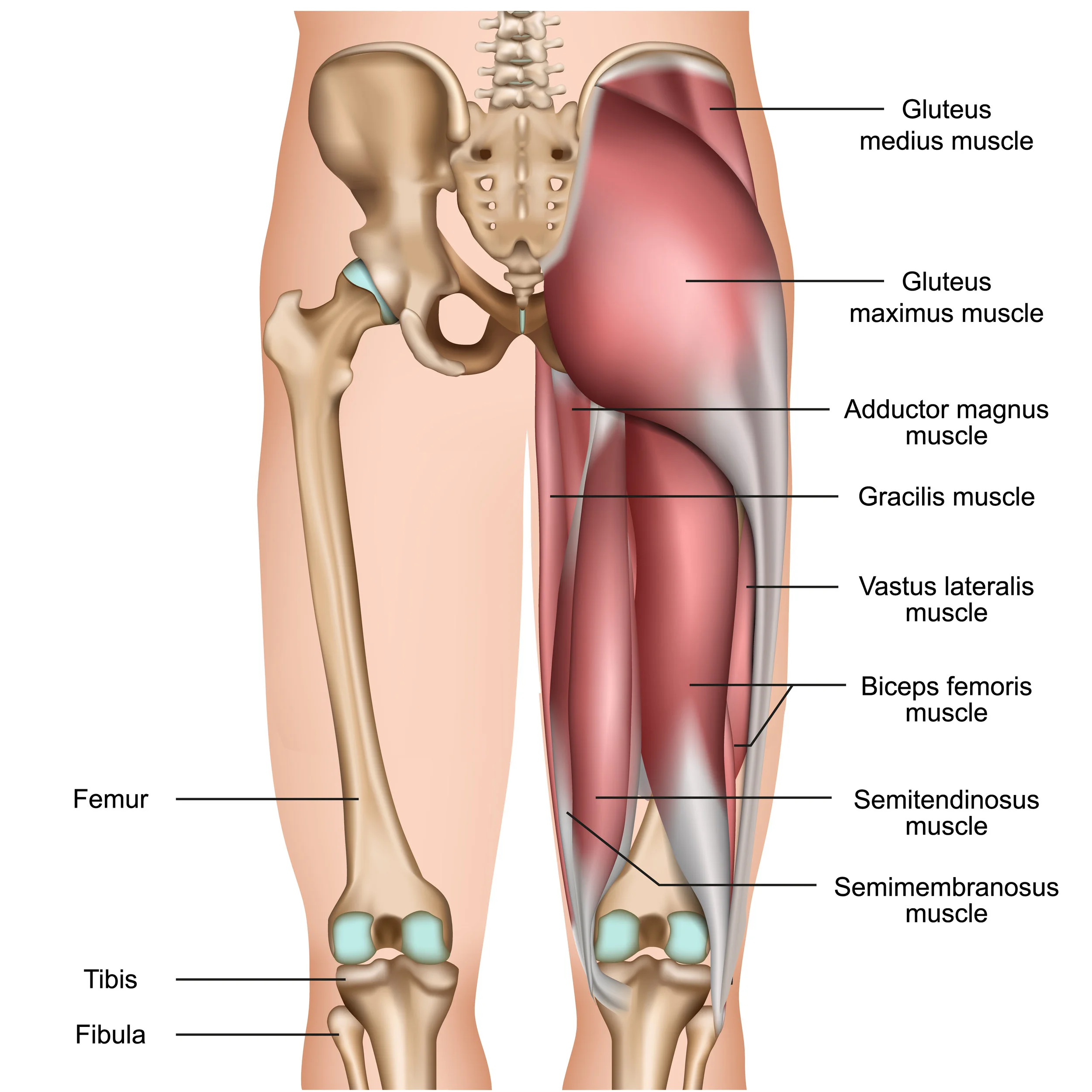
Semitendinosis: The semitendinosis mucles originates from the ischial tuberosity (sit bone) and inserts below the knee on the medial side of the tibia. This orientation causes it to act on two joints meaning it is both a Knee Flexor and Hip Extender. Due to its insertion on the inside of the tibia bone, it can internally/medially rotate the tibia when the knee is bent and also internally rotate the femur when the knee is extended.
Semimembranosis: The semimenbranosis muscle originates and inserts very closely to the semitendinosis and acts similarly as a knee flexor and (poor) hip extender. There are subtle differences in the two ‘semi muscles’ but it’s claim to fame is more along the lines that is may play a role in knee stability given it is suspected to have a functional relationship with the popliteus muscle on the back of the knee and a few fibers supporting the MCL. We learn more about the body everyday, so this may change.
Biceps Femoris: The Biceps Femoris has a similar function as the ‘Semi muscles’ in that it assists in knee flexion, and lower leg deceleration during the runners gain cycle, but it is somewhat special. The biceps femoris muscle has two heads that attach to two different places. The long head comes all the way from ischial tuberosity like the ‘semi brothers’, crossing the hip joint, making it a hip extender. But the short head, it comes off the back of the femur at a spot called the linea aspera. The short head does not cross the hip joint so it does not extend the hip, but it does have a special power. If you are unfortunate enough to experience an avulsion of the hamstring origin off the ischial tuberosity, the short head is still attached and allows you to, albeit weakly, flex the knee. This allows you to maintain some ability of ambulation. Our bodies are smart!
Basic Function Of The Hamstrings In Running
The hamstrings have a very important role in the running gait cycle, but it may not be what you think. As distance runners, our hamstrings are not as strongly used as in our sprinting counterparts, but as we all know after a good speed work session, they are back there serving ther purpose.

To keep this simple. The hamstrings job is to ‘slow’ down the leg as it swings forward. WHAT? SLOW DOWN? Yes! And the faster you run, the harder it works to slow down the leg.
It does this in what is called an eccentric contraction. Simply put, the hamstring fires as the leg swings forward so that your foot and lower leg do not go flying out, causing the knee to fully extend, and then you land on a locked knee. This would cause many injuries, and runners with a lack of control here often have knee and hamstring injuries.
Okay, so lets go a little deeper…nerd-out if you will.

For a great review of the gait cycle, check out the Biomechanic.
When the leg is planted in the stance phase, the hamstring contracts with the quads and adductors to create a stable platform inwhich we can use our momentum to continue to propel forward.
As the leg moves into the toe off phase, the hamstring supports by contracting more concentrically aiding in the push-off that propels us forward..but here is where it gets fun.
During the mid part of the swing phase, the hamstring is passive as the quads and adductors do most of the work bringing the leg foward. The hamstring does work to pull the heel toward the butt in good form, but they do more stretch than anything as studies suggest the hamstring stretches from 50% length to 90% length during this time.
Once we start moving from mid swing to heel contact, the hamstring kicks in eccentrically, and puts the brakes on the lower leg, allowing for a stable platform to land and maintain during the new stance phase.
What Do The Hamstring Do For Distance Runners?
As distance runners, we work through all of theses running phases, just less draumatically than our explosvie sprinter friends. The hamstrings act more in the stability and concentric role during our long outings, which leads way to one theory as to why distance runners deal with more tendinopathy injuries (generally overuse) than strains and avulsion injuries (dynamic and powerful contractions).
What Types Of Hamstring Injuries Do Runners Experience?
Acute Hamstring Strains In Runners:
This is one of the most common overall injuries to plague athletes, for running, it is usually a problem for the sprinter of the group. A muscle strain, or pulled muscle, occurs when a muscle is suddenly overstretched, resulting in the tearing of some of the fibers within the fascicles that make up the larger muscle as a whole. This can be a very small percentage which only causes mild tightness, to a more prominent injury that can range from mild swelling, to complete immobility with bruising and severe swelling.
As a runner, if you are to experience a hamstring injury, a mild strain is preferable. Typically, we can get back out and perform modified running in 2-4 weeks with full healing and return to play in 4-8 weeks.
Hamstring Tendinopathy In Runners:
This is what we see most. As distance runners, we typically run far, make us prone to overuse injuries. Those injuries typically start with a little tightness that goes unaddressed because we are able to continue running. Over time, that muscle tightness begins to place an overload on the tendon, and that tendon begins to get irritated. In can inflame, dehydrate, become sensitive, and eventually make it difficult to run, walk, or sit for long periods.
There are two places this can occur, the lower tendon insertion, which we typically see acutely after a race, fall, or a big downhill effort. This area is often where we see a rupture in sprinters. If you have ever watched a 100m or 200m race and seen a running pull up very quickly and then fall or start hopping, this is what they experienced, and it can be career-ending at the highest level of the sport.
Now, for the upper tendon origin. High hamstring tendinopathy is so common and so frustrating, it has been listed in the runner’s guide of forbidden phrases. High hamstring injuries suck…there is no way around it. These injuries take TIME and often require some time off from running. I told you it was a forbidden term.
High hamstring tendinopathy typically takes 3-6 months for a full recovery and complete release to high volume and high intensity running. Care involves a strict plan for in-office and home care…and even with that, we still send out a good percentage for co-management with an orthopedist.
To summarize this injury. Don’t ignore your hamstring tightness or an injury you believe to be a mild strain. Give it attention, seek help, and rest if necessary. Unfortunately, some runners will press on, and the outcome is very unfortunate.
Hamstring Avulsion Injuries In Runners.
This is a tough one that typically requires surgical intervention. An avulsion injury is when the hamstring tendon pulls away from its attachment on the bone and takes part of the bone with it. These are uncommon without a significant mechanism of injury, we don’t typically see this from just running, but it has happened. This injury will cause severe pain, swelling, and bruising and should be examined by an orthopedist as soon as possible as the muscle can begin to ‘roll-up’ and atrophy shortly after the injury.
Dr. Reheisse is a Board Certified Chiropractic Sports Physician practicing in Cottonwood Heights Utah. Revive Sport & Spine provides evidence-supported chiropractic care and conservative sports injury management.
If you are in the greater Salt Lake City, Utah area and are a runner dealing with a nagging hamstring injury, we are here to help. Click the link below to schedule a consultation appointment and lets get you back out and running.

The Best Running Warm-Up To Help Prevent Injury
If you are like SOME runners, you prepare for your run by completing two quick stretches. First, you bend over and touch your toes. Next, you stand up, grab your foot from behind, and pull it toward your butt.
If you are like MOST runners, you don't even do that! In place of a long-winded stance on why you should be doing this and how research shows that warming-up before exercise not only prevents injury but improves performance. We are going to cover the bases of a great running warm-up through our Bands, Balance, & Bounce Running Warm-Up Routine.
SHOULD YOU WARM-UP BEFORE RUNNING?
If you are like SOME runners, you prepare for your run by completing two quick stretches. First, you bend over and touch your toes. Next, you stand up, grab your foot from behind, and pull it toward your butt.
If you are like MOST runners, you don't even do that! In place of a long-winded stance on why you should be doing this and how research shows that warming-up before exercise not only prevents injury but improves performance. We are going to cover the bases of a great running warm-up through our Bands, Balance, & Bounce Running Warm-Up Routine.
Running Warm-Up Part 1: BANDS

Clamshell
Glute Bridge
Band Walks
Low Row
Running Warm-Up Part 2: BALANCE

Plank
Dead Bug
Bird Dog
Single-Leg Stance
Leg Swing
Running Warm-Up Part 3: BOUNCE

Iron Cross
Scorpion
Mountain Climbers
Plank Twists
Butt Kickers
High Knees
A-Skips
Side Shuffle
Carioca
Reverse Shuffle Butt Kicker
Dr. Reheisse is a Board-Certified Chiropractic Sports Physician practicing in Murray, Utah. Revive Sport & Spine provides evidence-supported chiropractic care and conservative sports injury management.
(1) Fradkin, Zazryn, Smoliga. Effects of Warming-Up on Physical Performance: A Systematic Review With Meta-analysis. The Journal of Strength & Conditioning Research. January 2010.